
montessorikiwi
Phonetic Sentence Reading Cards | Montessori Science of Reading Shelf Work
Phonetic Sentence Reading Cards | Montessori Science of Reading Shelf Work
Couldn't load pickup availability
Can your child read individual phonetic words—but still become slow, hesitant or overwhelmed when those words appear together in a complete sentence?
Moving from single-word decoding into connected reading is an important step.
A child may confidently read words one at a time and still need much more practice to:
- move smoothly from one word to the next
- hold the beginning of the sentence in mind
- maintain accurate decoding across several words
- understand what the complete sentence means
- build enough stamina to keep reading
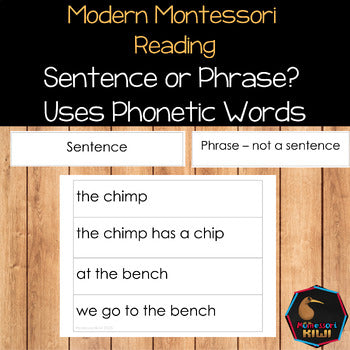
This hands-on Phonetic Sentence Reading Shelf Work gives children purposeful practice reading simple phonetic sentences and decodable phrases in an independent Montessori-inspired format.
Rather than staying at isolated word level, children apply their phonics knowledge in connected text while building fluency, comprehension, reading confidence and independence.
Designed for Montessori classrooms, Science of Reading-aligned instruction, structured literacy, intervention, literacy centres and homeschool learning, this resource provides a practical bridge between decoding individual words and reading complete sentences with increasing confidence.
🌿 At a Glance
✔ Hands-on phonetic sentence reading shelf work
✔ Includes phonetic sentence reading cards
✔ Includes simple decodable phrases
✔ Helps children move beyond isolated word decoding
✔ Supports reading fluency and sentence comprehension
✔ Montessori-inspired independent-work format
✔ Includes self-correcting reading activities
✔ Print-and-go literacy materials
✔ Suitable for structured literacy and reading intervention
✔ Ideal for Montessori shelves, literacy centres, small groups and homeschool learning
📚 What's Included?
This printable early reading resource includes:
- Phonetic sentence reading cards
- Simple decodable phrases
- Montessori-inspired shelf work
- Self-correcting reading activities
- Print-and-go literacy materials
- Structured literacy practice
- Independent reading activities
The resource is designed to give children repeated opportunities to apply phonics knowledge in meaningful connected text.
Why Can Sentence Reading Be So Much Harder Than Word Reading?
A child may be able to decode:
- cat
- sat
- mat
and still struggle when those words appear together inside a sentence.
Sentence reading requires the child to do much more.
They need to:
- decode each word accurately
- move from one word to the next
- remember what they have already read
- maintain the meaning of the sentence
- notice when something does not make sense
This is why children need a deliberate bridge between isolated word cards and longer passages.
From Single Words to Connected Text
This resource supports the progression:
decode individual words → read short phrases → read complete phonetic sentences → hold meaning across the sentence → build greater fluency and confidence.
This helps children apply what they already know in a more demanding but still manageable format.
Why Connected Text Matters
Children need opportunities to use phonics knowledge while reading real connected language.
Reading a sentence requires them to coordinate:
- phonics
- decoding
- word recognition
- syntax
- fluency
- comprehension
This resource gives children a structured way to practise those skills together.
Why Use Phonetic Sentences?
Early readers benefit when the text they are asked to read is closely matched to the phonics knowledge they have already been taught.
This allows the child to rely on decoding rather than guessing from pictures or context alone.
The child can focus on:
- looking carefully at the print
- applying known sound-spelling correspondences
- blending words accurately
- holding the sentence meaning in mind
This helps strengthen the connection between explicit phonics learning and real reading.
From Accurate Decoding to Fluency
Fluency does not mean rushing.
It develops as children become more accurate and efficient at recognising words and moving through connected text.
The learning progression is:
decode accurately → reread when needed → recognise familiar patterns more quickly → read the sentence more smoothly → focus more attention on meaning.
Repeated sentence reading can help children build greater confidence and stamina.
Why Comprehension Still Matters
Reading a sentence correctly is not enough if the child does not understand it.
After reading, children can be encouraged to ask:
- What happened?
- Who is the sentence about?
- What did the person or animal do?
- Does the sentence make sense?
- Can I say it in my own words?
This keeps meaning at the centre of early reading.
Why Use Montessori Shelf Work?
A prepared shelf activity gives children an opportunity to revisit reading independently after an initial presentation.
This can support:
- choice
- repetition
- independence
- self-pacing
- confidence
- reading stamina
Children can return to the activity as often as needed without every practice session needing to be adult-directed.
Why Self-Correction Matters
The self-correcting format supports children in checking their own work rather than depending on immediate adult feedback.
This can help develop:
- independence
- self-monitoring
- persistence
- confidence
- awareness of whether the reading makes sense
This fits naturally with Montessori practice, where carefully designed materials encourage children to notice and correct errors themselves.
Build Reading Stamina Gradually
For some emerging readers, even one sentence can feel like a lot.
This resource provides a manageable way to build stamina gradually.
Children can begin with:
- one short phrase
- one sentence
- a small number of cards
- supported reading with an adult
As confidence grows, they can work more independently and read for longer.
Why This Can Be Helpful for Reluctant or Struggling Readers
Some children become discouraged when they are moved too quickly from individual words into books or long passages.
Sentence cards offer an intermediate step.
The task is:
- short
- clear
- focused
- repeatable
- less visually overwhelming than a full page of text
This can be especially useful for children who benefit from smaller chunks of learning and a clear sense of completion.
From Decoding to Independence
The deeper learning progression is:
look carefully at the print → decode each word → read the complete sentence → understand the meaning → reread for greater fluency → work increasingly independently.
This helps children move from teacher-supported phonics work towards genuine independent reading.
What Skills Does This Resource Support?
Children will practise:
- Phonetic sentence reading
- Decoding
- Reading fluency
- Sentence comprehension
- Connected-text reading
- Word recognition
- Reading stamina
- Self-monitoring
- Independent reading
- Reading confidence
A Useful Step in the Reading Progression
This resource works particularly well after children are already able to decode simple phonetic words.
A useful progression might be:
individual sounds → CVC words → CCVC and digraph words → short phrases → phonetic sentences → increasingly complex connected text.
This shelf work provides that important bridge into sentence reading.
Easy to Differentiate
You can adapt the activity by:
- offering only a few cards at one time
- pre-reading difficult words together
- inviting children to reread one sentence for fluency
- asking the child to explain the sentence meaning
- using the cards independently or in small groups
This makes the resource useful for mixed-ability classrooms and intervention settings.
More Than a Set of Sentence Cards
The goal is not simply to get to the end of the sentence.
The deeper learning progression is:
apply phonics knowledge → decode the words → connect them into a sentence → hold the meaning in mind → reread more smoothly → become increasingly independent.
That makes this a purposeful bridge between word-level decoding and genuine connected reading.
🌿 Perfect For
- Montessori language shelves
- Science of Reading-aligned instruction
- Structured literacy
- Decodable sentence practice
- Early elementary reading
- Literacy centres
- Small-group instruction
- Reading intervention
- Independent shelf work
- Homeschool reading
- Emerging readers
- Reluctant readers
- Neurodivergent learners who benefit from smaller, manageable chunks of text
Help Children Move From Reading Words to Reading Sentences
Reading individual words is an important beginning—but children also need to connect those words into meaningful text.
This shelf work supports the progression:
decode the word → read the phrase → read the sentence → understand the meaning → reread more fluently → build independence.
That makes it a practical next step for children who are ready to move beyond isolated word cards but are not yet confident with longer passages.
🔗 Related Resources
Continue building children's confidence as they move from word-level decoding into connected sentence reading and comprehension:
🌿 CVC Sentence Frames
Support children as they move from individual CVC words into simple supported sentence reading and early writing.
Explore the CVC Sentence Frames →
🌿 CCVC Picture to Sentence Matching Cards
Help children decode complete sentences and connect written language with meaning.
Explore the CCVC Sentence Matching Cards →
🌿 Digraph Sentence Matching Cards
Take children from isolated digraph words into complete sentences containing sh, th, ch and ng.
Explore the Digraph Sentence Matching Cards →
🌿 Simple Reading Comprehension Task Cards
Help children decode sentences, use meaning and select the word that completes each sentence.
Explore the Reading Comprehension Task Cards →
🌿 Story Sequencing Sentence Cards
Extend sentence-level comprehension by asking children to read and arrange sentences into a logical story order.
Explore the Story Sequencing Sentence Cards →
🌿 Modern Montessori Reading Collection
Explore hands-on resources for phonemic awareness, phonics, decoding, sentence reading, fluency and comprehension.
Explore the Modern Montessori Reading Collection →
🌿 Modern Montessori Science of Reading Bundle
Explore a broader Montessori-aligned literacy sequence covering phonological awareness, decoding, spelling patterns, syllables, morphology, fluency, sentence reading and comprehension.
Created by Lisa, a Montessori-trained teacher, NZ registered teacher, school principal and former homeschooler. My resources are designed with real learners in mind—including neurodivergent children—and focus on practical, affordable, low-prep materials that support independence.
Share
-
Items are secured / Terms of Use
Our items are secured. They are not able to be altered. We secure our items because they are our intellectual property and because we use art from artists who require that we secure our files.
You may not:
-resell our items or use them for commercial gain
-claim these items as your own
-modify this resource
-share them with others by any means e.g. electronic or hard copy
-
All Items are instant downloads
You will not get a printed product in the mail.
-
All prices are in USD
Due to the international nature of our customers our prices are all in USD. If you wish to work out the conversion before you buy we recommend www.xe.com