


montessorikiwi
Sequence Sentences into a Story | Montessori Reading Comprehension Task Cards | Montessori Science of Reading
Sequence Sentences into a Story | Montessori Reading Comprehension Task Cards | Montessori Science of Reading
Couldn't load pickup availability
Can your child read each sentence—but still struggle to work out how the sentences fit together?
Reading comprehension requires more than decoding one sentence at a time. Children also need to recognise which sentence introduces the topic, what logically follows, and how ideas connect to form a complete text.
These self-correcting sentence sequencing cards give children hands-on practice with that important step.
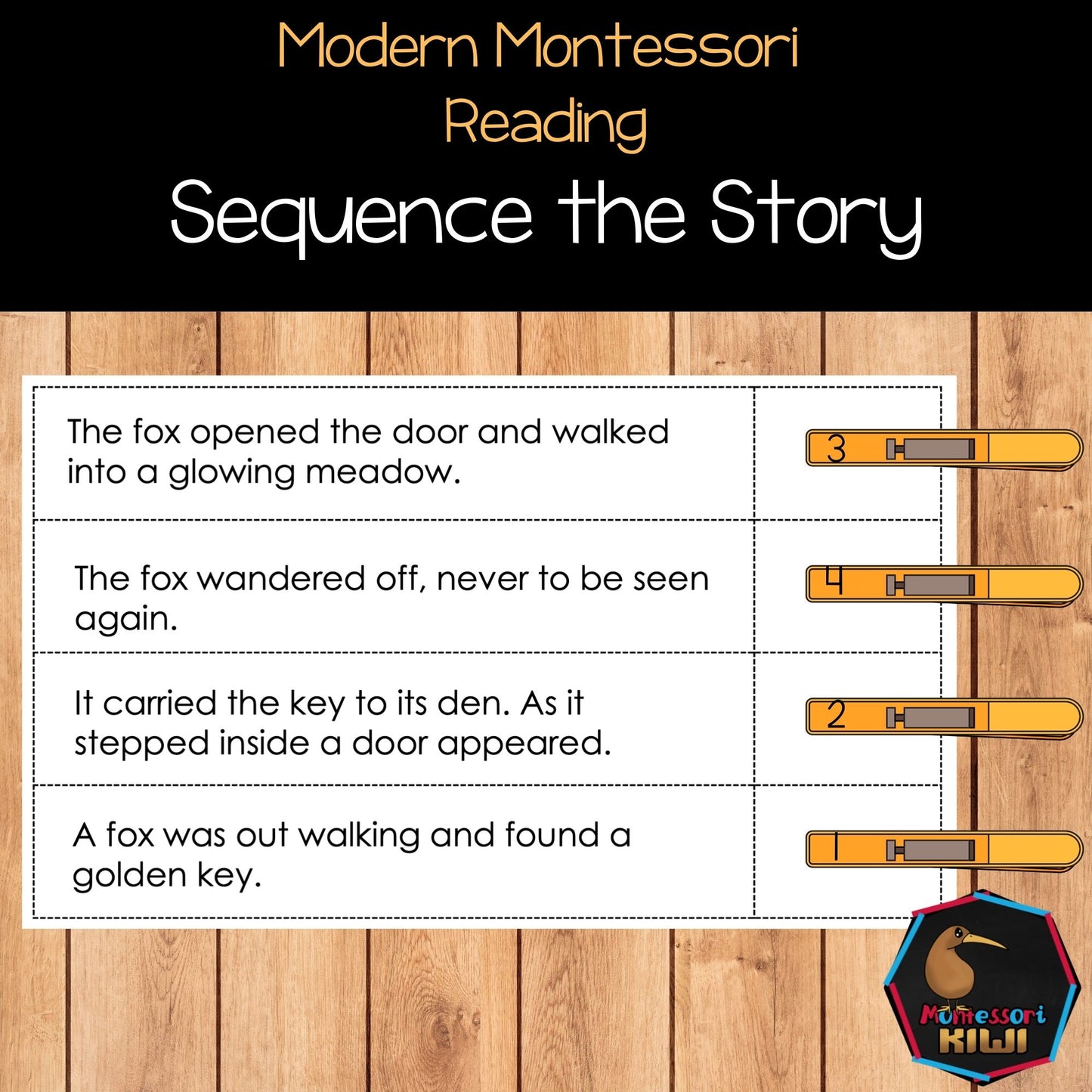
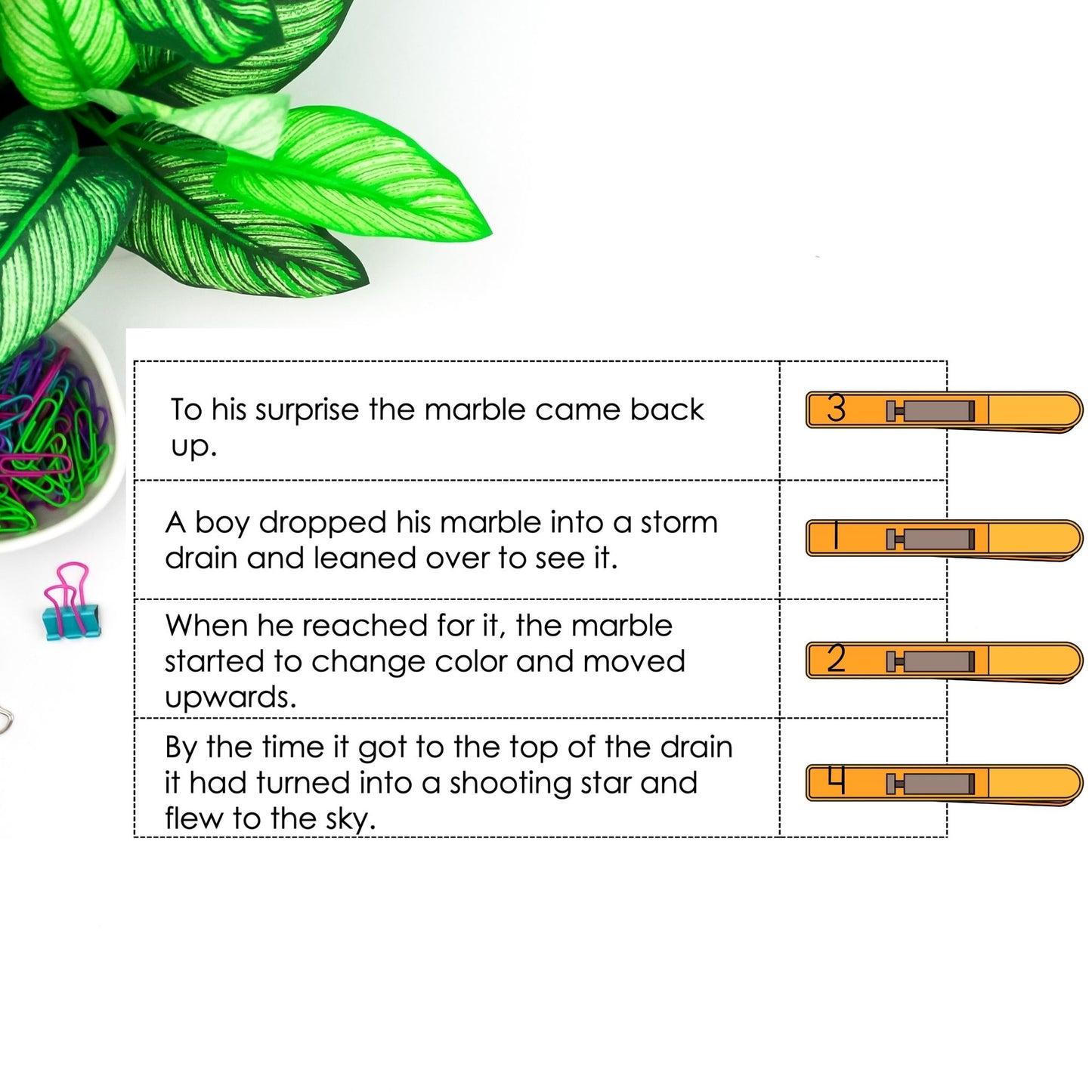
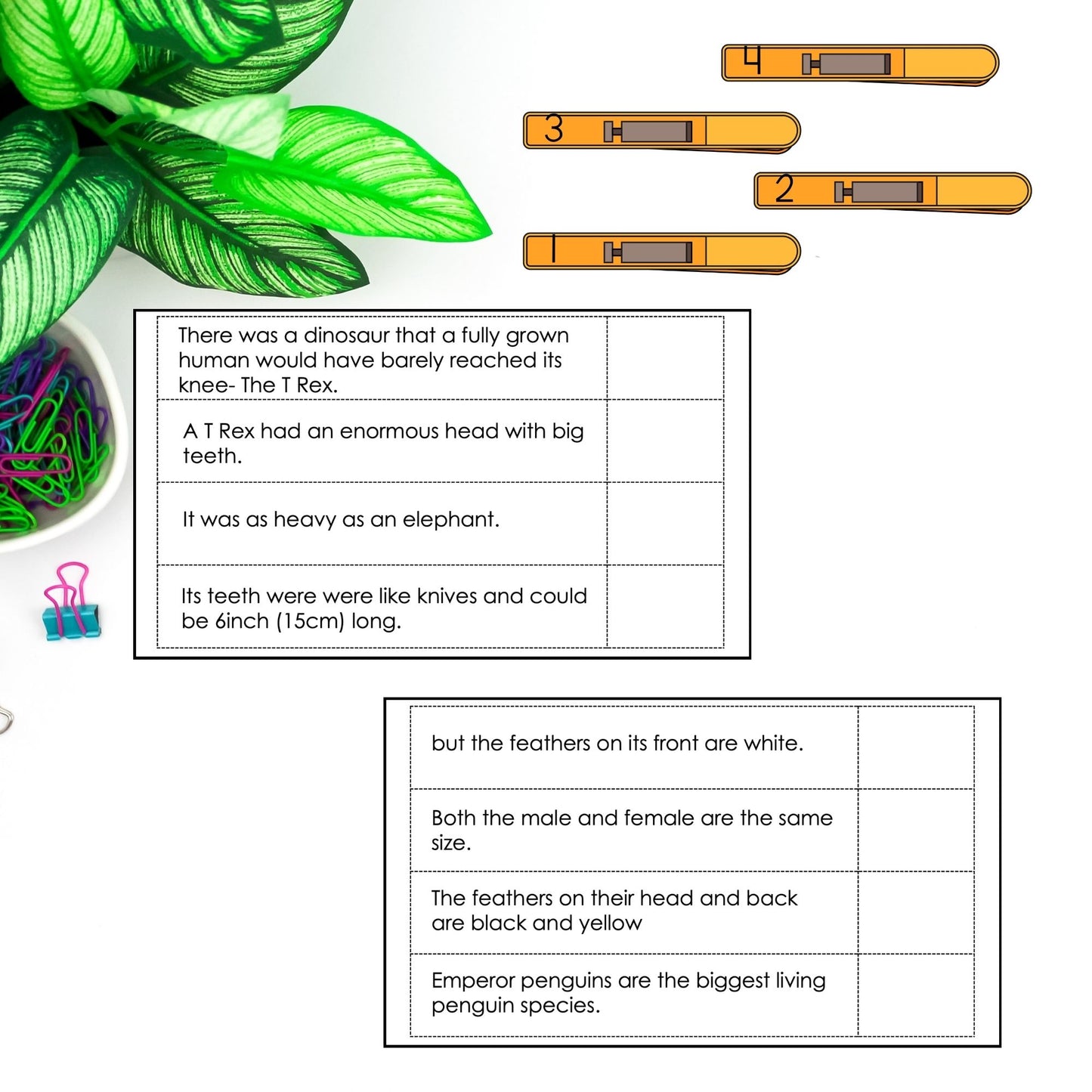
Each card contains a short three- or four-sentence text presented in the wrong order. Children read each sentence, use numbered pegs to mark the correct sequence, and then turn the card over to check their answer independently.
The set includes narrative, imaginative, procedural and informational texts, helping children understand that logical order matters across more than one type of reading.
At a glance
Focus: Sentence sequencing and reading comprehension
Includes: 13 self-correcting sequencing cards
Text length: Three or four sentences per card
Text types: Narrative, imaginative, procedural and informational
Response format: Numbered pegs
Control of error: Answers printed on the reverse
Best for: Montessori shelves, homeschool literacy, reading centres, small groups and intervention
The problem this resource solves
A child may decode every sentence correctly yet still read each one as an isolated piece of information.
They may:
- miss which sentence properly introduces the people or topic
- choose a detail rather than the real beginning
- struggle to follow cause and effect
- place an outcome before the action that caused it
- overlook clues such as pronouns, time words and linking phrases
- find procedural steps difficult to organise
- need an adult to confirm every answer
These cards make the relationships between sentences more concrete.
Children can reread the text, compare possible sequences, move the pegs and revise their thinking before checking the answer for themselves.
What is included?
- 13 printable sentence-sequencing cards
- a mixture of three- and four-sentence texts
- narrative stories based on familiar experiences
- imaginative stories involving unusual and magical events
- simple procedural sequences
- short informational passages
- numbered answers designed to be printed on the reverse
- teacher instructions for presentation, modelling and independent use
The topics include games, ice cream, wearing a hat, taking a photograph, space travel, a mysterious key, a magical marble, dinosaurs, emperor penguins, washing clothes, riding a bike and helping at home.
How the activity works
- Print the pages back-to-back. This places the numbered answer on the reverse of each sequencing card.
- Prepare pegs numbered 1–4. Some cards use only numbers 1–3.
- Choose one card. Explain that the sentences belong together but have been placed in the wrong order.
- Read every sentence. Encourage the child not to decide after reading only the first line.
- Find the opening sentence. The child looks for the sentence that introduces the person, topic, setting or situation.
- Sequence the remaining sentences. Numbered pegs are clipped beside the sentences to show the correct order.
- Reread the completed text. The child checks whether the sequence sounds logical and complete.
- Turn the card over. The child compares the pegs with the control of error and makes any needed changes.
What children learn to notice
To sequence the texts successfully, children must attend to clues such as:
- names being introduced before pronouns such as he, she or they
- a setting or subject being introduced before further details are added
- time words such as one day, then, after and when
- cause-and-effect relationships
- problems followed by actions or outcomes
- steps that must occur in a practical order
- sentences that only make sense after earlier information has been supplied
- concluding sentences that complete the event or idea
For example, a sentence beginning with “When they got there” cannot logically come before the sentence that explains where the people were going.
Skills developed
- reading comprehension
- sentence reading and rereading
- text cohesion
- logical sequencing
- narrative structure
- procedural order
- cause and effect
- pronoun-reference understanding
- attention to linking words
- reasoning and verbal explanation
- independent self-correction
More than story sequencing
Although several cards contain short stories, this resource also includes procedural and informational passages.
This helps children learn that different types of texts are organised in different ways. They may need to identify:
- the chronological order of events
- the steps needed to complete a process
- a general statement followed by supporting details
- a person or topic introduced before pronouns are used
- a problem followed by a response or outcome
This makes the activity useful for broader reading-comprehension work rather than only practising the beginning, middle and end of a story.
Self-correcting Montessori shelf work
Many comprehension activities require an adult to mark the child’s work or involve a significant amount of handwriting.
This activity reduces both barriers.
Children demonstrate their understanding using numbered pegs, then turn the card over to check the answer. This supports:
- independence
- repetition
- careful observation
- persistence
- willingness to revise
- confidence without constant adult approval
Once presented, the cards can be placed on the language shelf for children to revisit independently.
Differentiation ideas
For children needing more support
- begin with a three-sentence card
- read the sentences aloud together
- identify the opening sentence jointly
- draw attention to names, pronouns and time words
- offer a choice between two possible next sentences
- model your reasoning aloud
- let the child arrange copied sentence strips before using the peg card
For children ready for extension
- explain the clue that establishes each sentence’s position
- identify whether the text is narrative, procedural or informational
- copy the passage in the correct order
- underline linking words and pronouns
- add a suitable title
- write an additional sentence
- change the ending
- create a scrambled passage for another child to solve
Use this resource for
- Montessori language shelves
- reading-comprehension centres
- homeschool literacy lessons
- small-group teaching
- reading intervention
- independent follow-up work
- text-structure lessons
- literacy rotations
- early-finisher work
- children who can decode but need help connecting ideas across sentences
Montessori-aligned and evidence-informed
Some children need more explicit help to understand how sentences connect across a text.
These cards provide a structured way to teach that skill while preserving Montessori qualities such as hands-on activity, independent repetition, an orderly presentation and a built-in control of error.
The child is not simply matching a picture or answering an isolated recall question. They must read, reason, test an idea, reread for meaning and revise when necessary.
Continue the learning
Building comprehension before independent sentence reading?
Try the
Picturing Stories Listening Comprehension Activity
, which helps children listen to a short story, form a mental image and choose the picture that best represents its main idea.
Looking for more Montessori-aligned literacy activities?
Browse the
Modern Montessori Reading Collection
for hands-on resources covering phonological awareness, phonics, sentence reading, vocabulary, fluency and comprehension.
Need a broader learning-to-read sequence?
Explore the
Modern Montessori Science of Reading Bundle
, which includes a growing library of structured, Montessori-friendly literacy resources and a linked scope and sequence.
About MontessoriKiwi
I’m Lisa, a Montessori-trained teacher, New Zealand registered teacher, former homeschooler, parent of a neurodivergent child and founder of a small Montessori primary school in Aotearoa New Zealand.
I have taught in both Montessori and mainstream settings and work directly with children who have a wide range of learning profiles. Many of my learners benefit from literacy instruction that is more explicit, carefully structured and accessible than traditional materials alone may provide.
I create practical resources that bring together current knowledge about how children learn to read with Montessori principles such as independence, purposeful activity, hands-on learning, control of error and respect for the child.
These materials are designed for real classrooms and homeschools—including mixed-age groups, neurodivergent learners and children who need more support without being given visually busy or childish work.
Learn more about the approach
Read Montessori and the Science of Reading: Can They Work Together? to explore how explicit, evidence-informed literacy teaching can sit alongside Montessori principles and hands-on classroom practice.
Please note
This is a digital printable resource. No physical product will be shipped.
Print the cards and answer pages back-to-back so the control of error appears on the reverse. You will also need clothes pegs labelled 1–4. Some cards require only pegs 1–3.
Purchase provides a licence for use by one teacher in one classroom or by one homeschool family. Please do not share the digital file with other educators, families, schools or organisations.
Help children move beyond reading sentences one at a time and begin understanding how those sentences connect to create a text that makes sense.
Share
-
Items are secured / Terms of Use
Our items are secured. They are not able to be altered. We secure our items because they are our intellectual property and because we use art from artists who require that we secure our files.
You may not:
-resell our items or use them for commercial gain
-claim these items as your own
-modify this resource
-share them with others by any means e.g. electronic or hard copy
-
All Items are instant downloads
You will not get a printed product in the mail.
-
All prices are in USD
Due to the international nature of our customers our prices are all in USD. If you wish to work out the conversion before you buy we recommend www.xe.com