


montessorikiwi
Suffix Sentence Writing Prompts | Montessori Science of Reading Morphology Activity
Suffix Sentence Writing Prompts | Montessori Science of Reading Morphology Activity
Couldn't load pickup availability
Does your child understand what a suffix is—but struggle to actually use suffixed words naturally in their own writing?
Recognising a suffix in a word sort is one skill.
Using that word meaningfully inside a complete sentence is another.
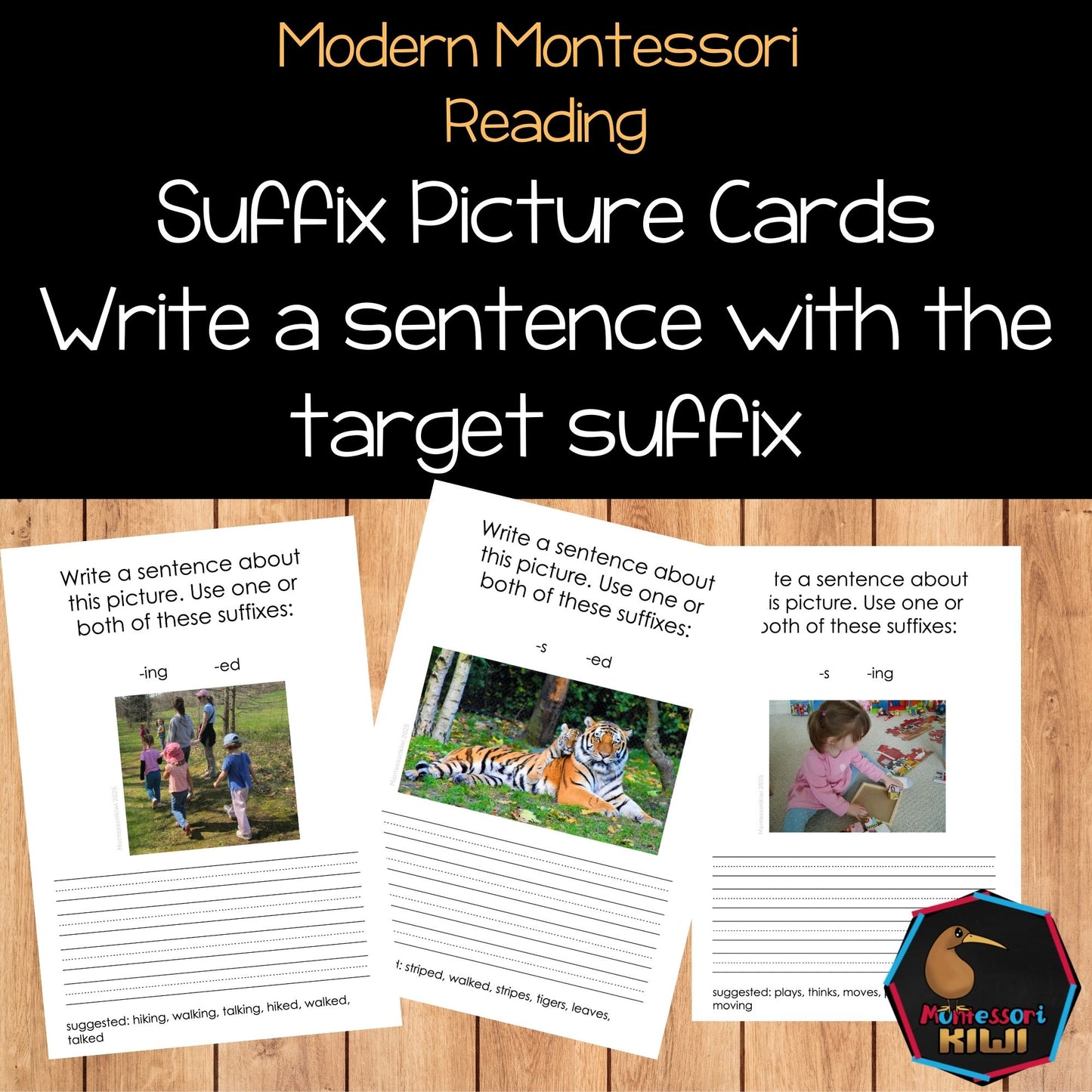
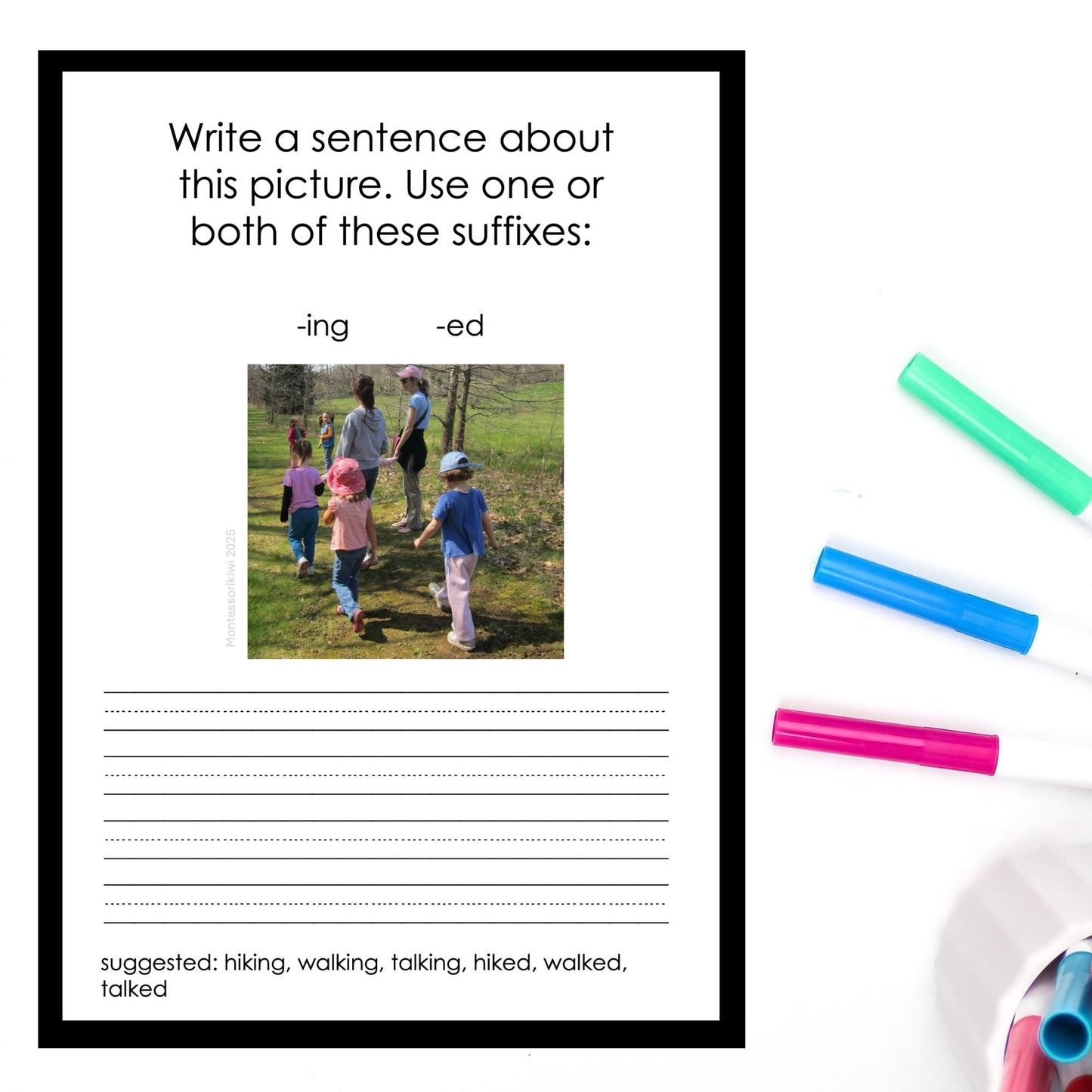
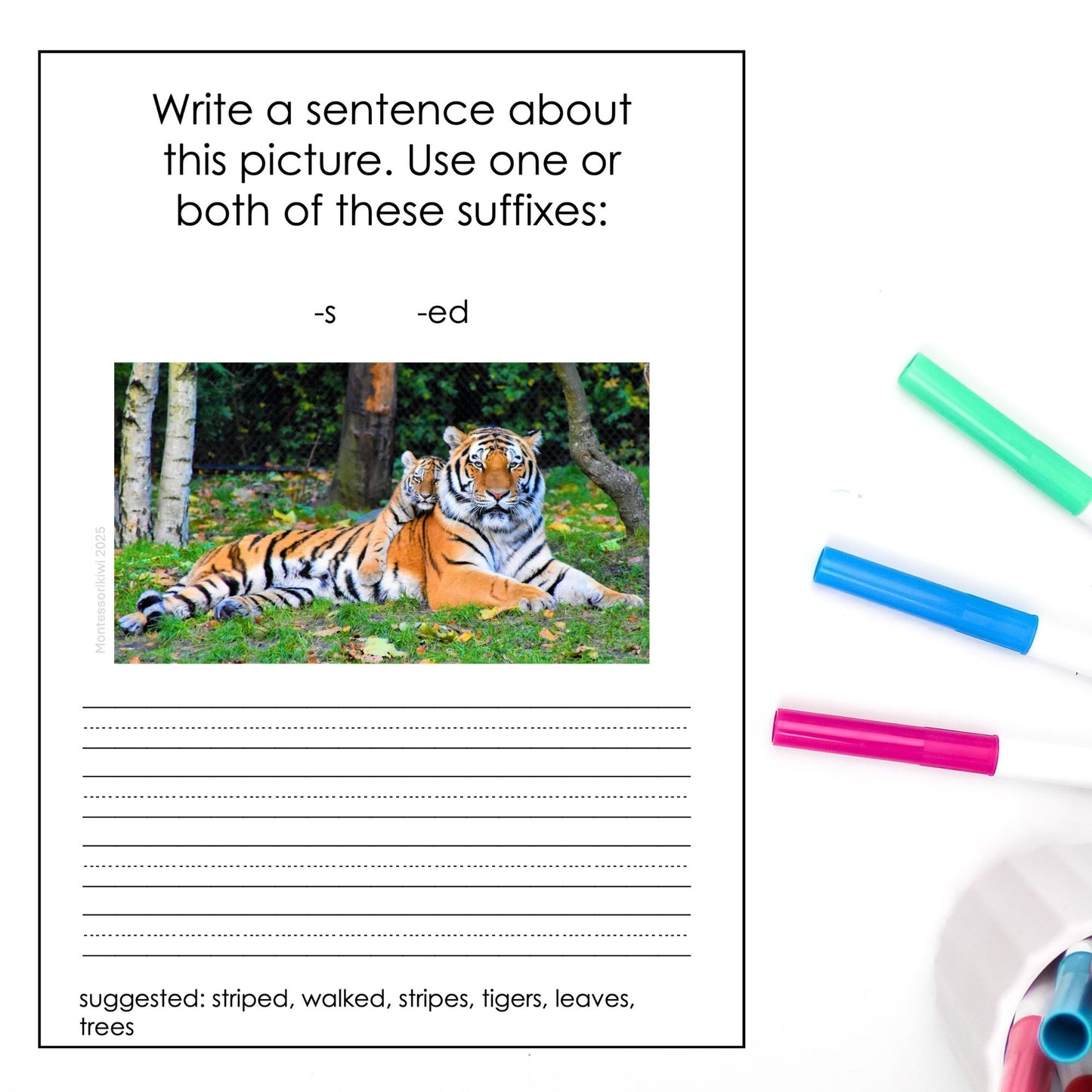
These Suffix Sentence Writing Prompts give children structured practice using suffixed words in context through 12 illustrated writing activities.
Each page provides a clear picture prompt and a helpful word bank, giving children enough scaffolding to begin writing without removing the challenge of constructing their own sentence.
Children observe what is happening in the picture, discuss the action, choose suitable words and create a sentence that uses suffix knowledge meaningfully.
Designed for Montessori classrooms, Science of Reading-aligned literacy instruction, morphology lessons, structured literacy, intervention and homeschool learning, this resource helps children move beyond identifying suffixes and towards using them confidently in real language.
🌿 At a Glance
✔ 12 illustrated suffix writing activities
✔ Each picture acts as a prompt for meaningful sentence creation
✔ Helpful word banks on every page
✔ Includes step-by-step teacher guidance
✔ Helps children connect base words and suffixes
✔ Supports morphology, sentence building, vocabulary and writing fluency
✔ Can be placed in plastic sleeves and reused with dry-erase pens
✔ Designed for guided modelling followed by independent practice
✔ Ideal for Montessori shelves, literacy centres, small groups and homeschool learning
📚 What's Included?
This printable suffix writing resource includes:
- 12 picture-based writing pages
- A clear illustrated prompt on each page
- Helpful suggested words and word banks
- Step-by-step teacher guidance
- Opportunities for modelling and guided practice
- Independent sentence-writing practice
The pages can be printed and placed inside plastic sleeves so children can write with dry-erase pens and revisit the activities multiple times.
Why Can Suffixes Be Tricky?
A child may be able to identify that -ing, -ed, -ful or -less is a suffix and still find it difficult to use a suffixed word naturally in a sentence.
That is because knowing about a word part does not automatically mean the child can apply that knowledge in real language.
Children need opportunities to:
- Recognise the base word
- Notice the suffix
- Understand how the suffix changes meaning or grammatical function
- Select a word that fits the picture
- Use the word inside a meaningful sentence
This activity helps bridge that gap.
From Word Study to Real Writing
Suffix lessons are often taught through isolated word lists or sorting tasks.
Those activities are useful, but children also need opportunities to use morphological knowledge in authentic language.
This resource supports a clear progression:
observe the picture → identify what is happening → choose a suitable suffixed word → build a complete sentence → write it independently.
This brings together:
- Morphology
- Vocabulary
- Grammar
- Oral language
- Sentence composition
- Writing fluency
Why Use Picture Prompts?
Some children know what they want to say but struggle to generate a topic from a blank page.
A picture gives them somewhere concrete to begin.
Instead of having to invent an entire idea, the child can focus on:
- Who or what is in the picture?
- What is happening?
- Which words describe the action?
- Which suffixed word would make sense?
- How can I turn that idea into a sentence?
This reduces the cognitive load of coming up with a topic while keeping the actual writing task meaningful.
Why Include Word Banks?
The word banks provide scaffolding without giving children a complete sentence to copy.
This is particularly helpful for learners who:
- Know the concept but struggle with word retrieval
- Need support generating vocabulary
- Become overwhelmed by open-ended writing
- Benefit from visual prompts
- Need a smaller number of choices
The child still has to select the appropriate words and combine them into a sentence.
This keeps the writing task structured but not passive.
From Guided Modelling to Independence
The resource includes step-by-step teacher guidance so the activity can be introduced gradually.
You might begin by presenting one picture and discussing what is happening.
For example:
The girl is looking at the dog.
You can then draw attention to the subject, action and object and model how to choose words from the bank to create a meaningful sentence.
After guided practice, the child can work on another picture independently.
This creates a useful progression:
model together → practise with support → use the word bank → write independently.
Why Teach Suffixes Through Meaning?
Suffixes are not simply letter endings to memorise.
They carry meaning and can change how a word works.
For example, a suffix might:
- Change a verb into a noun
- Change a noun into an adjective
- Show an action is happening now
- Show something happened in the past
- Change or extend the meaning of the base word
When children use suffixed words inside meaningful sentences, they begin to understand morphology as part of real language rather than an isolated spelling exercise.
Why This Matters for Reading and Writing
Understanding word parts can help children approach unfamiliar words more strategically.
Instead of seeing a long word as one unknown block, they can begin to notice:
- The base word
- The suffix
- How the suffix affects meaning
- How the word is functioning within a sentence
That supports both reading comprehension and written expression.
What Skills Does This Resource Support?
Children will practise:
- Using suffixes in context
- Recognising base words and suffixes
- Morphological awareness
- Vocabulary development
- Sentence structure
- Grammar
- Oral language
- Sentence composition
- Writing fluency
- Independent writing confidence
More Than a Writing Worksheet
The goal is not simply for children to fill a page with words.
The deeper learning progression is:
notice what is happening → identify the language needed → choose a suitable suffixed word → construct a meaningful sentence → write it independently.
This makes the resource particularly useful for children who have already been introduced to suffixes but need more support transferring that knowledge into real writing.
Support for Different Learners
The structure can be particularly helpful for children who benefit from:
- Clear visual prompts
- Reduced open-endedness
- Vocabulary support
- Explicit modelling
- Small, manageable writing tasks
- Opportunities to revisit the same skill
The word banks provide support, while the open sentence construction still allows children to make genuine choices.
Reusable for Repeated Practice
Print the pages and place them inside plastic sleeves to create reusable writing activities.
Children can use dry-erase pens to:
- Try different sentence structures
- Rewrite a sentence after feedback
- Return to the same picture later
- Compare different ways of describing the same event
This makes the resource practical for Montessori shelves, intervention, small groups and literacy centres.
How to Use the Activity
- Choose one illustrated page.
- Talk together about what is happening in the picture.
- Identify the subject, action and other key details.
- Look at the suggested words in the word bank.
- Discuss which suffixed word could be used meaningfully.
- Model a complete sentence if needed.
- Invite the child to write independently.
- Gradually reduce support as confidence develops.
A Clear Morphology-to-Writing Progression
This resource fits particularly well after children have had explicit experience identifying and sorting suffixes.
A useful learning sequence might be:
identify the suffix → understand its meaning → compare suffixed words → choose a word that fits a picture → use it in a sentence → write independently.
This helps children move from isolated word study into genuine application.
🌿 Perfect For
- Montessori language shelves
- Science of Reading-aligned literacy instruction
- Structured literacy
- Morphology lessons
- Suffix practice
- Sentence writing
- Literacy centres
- Small-group instruction
- Writing intervention
- Independent shelf work
- Neurodivergent learners who benefit from structured prompts
- Homeschool literacy lessons
Help Children Move From Knowing the Suffix to Using It
A child may be able to identify a suffix correctly without yet knowing how to use that word naturally in their own writing.
These illustrated prompts provide a manageable next step:
observe the picture → identify what is happening → select a useful suffixed word → build a complete sentence → write independently.
That makes this resource a practical bridge between morphology instruction and real written language.
🔗 Related Resources
Continue building children's understanding of suffixes, morphology and sentence-level language with these related Montessori literacy resources:
🌿 Suffix Sorting Activities
Help children explore 13 common suffixes through sorting mats, meanings, word cards, self-correcting answers and a movement game.
Explore the Suffix Sorting Activities →
🌿 Contractions Folding Activity
Help children physically see how two words combine, which letters disappear and where the apostrophe belongs.
Explore the Contractions Activity →
🌿 Story Sequencing Sentence Cards
Help children read individual sentences, compare meaning and place them into a logical story sequence.
Explore the Story Sequencing Sentence Cards →
🌿 Simple Reading Comprehension Task Cards
Build sentence-level understanding by asking children to decode, use meaning and select the word that completes each sentence.
Explore the Reading Comprehension Task Cards →
🌿 Modern Montessori Reading Collection
Explore hands-on resources for phonological awareness, phonics, spelling, morphology, sentence writing, reading and comprehension.
Explore the Modern Montessori Reading Collection →
🌿 Modern Montessori Science of Reading Bundle
Explore a wider Montessori-aligned literacy sequence covering phonological awareness, decoding, spelling patterns, syllables, morphology, sentence reading, writing and comprehension.
Created by Lisa, a Montessori-trained teacher, NZ registered teacher, school principal and former homeschooler. My resources are designed with real learners in mind—including neurodivergent children—and focus on practical, affordable, low-prep materials that support independence.
Share
-
Items are secured / Terms of Use
Our items are secured. They are not able to be altered. We secure our items because they are our intellectual property and because we use art from artists who require that we secure our files.
You may not:
-resell our items or use them for commercial gain
-claim these items as your own
-modify this resource
-share them with others by any means e.g. electronic or hard copy
-
All Items are instant downloads
You will not get a printed product in the mail.
-
All prices are in USD
Due to the international nature of our customers our prices are all in USD. If you wish to work out the conversion before you buy we recommend www.xe.com