


montessorikiwi
Suffix Sorting Activities | Montessori Science of Reading Word Study
Suffix Sorting Activities | Montessori Science of Reading Word Study
Couldn't load pickup availability
Your students can read a word such as careless or enjoyment—but do they understand how the suffix changes the base word’s meaning or grammatical role?
Suffixes are often taught as lists to memorise. Children may underline the ending correctly without recognising the meaningful word parts inside it—or using that knowledge to decode, spell and understand unfamiliar words.
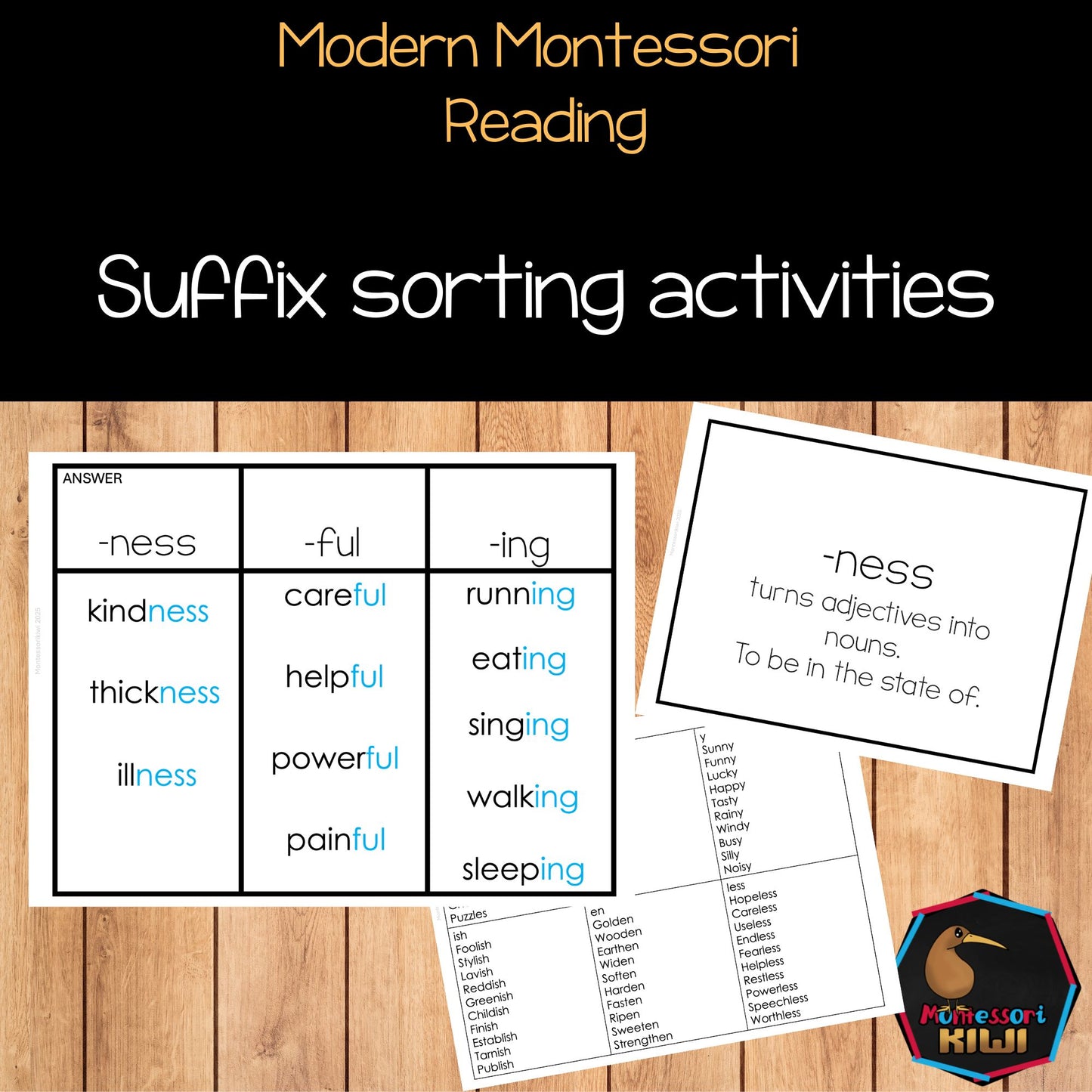
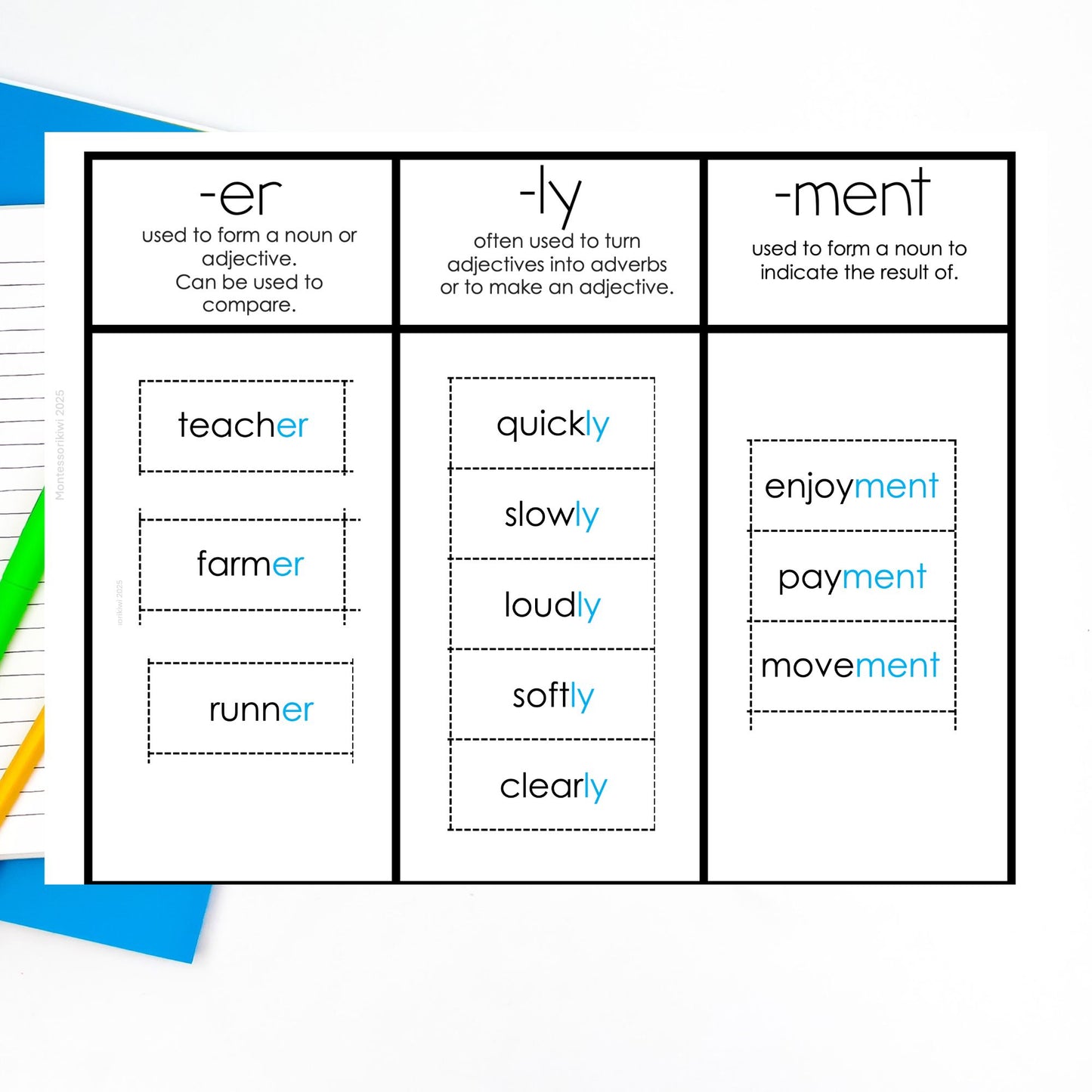
These Montessori Suffix Sorting Activities make morphology visible. Children read words, identify the suffix, consider its meaning and sort the word beneath the appropriate heading. The blue suffix highlighting helps learners see where the base word ends and the added morpheme begins.
At a Glance
- Learning focus: Suffixes, morphology, spelling and vocabulary
- Suffix categories: 15
- Includes: Five sorting sets, word cards, answer charts, movement posters and reference lists
- Best for: Montessori elementary, Science of Reading, structured literacy and homeschool
- Suggested ages: Approximately 7–11 years
- Use for: Language shelves, literacy centres, intervention and word study
- Length: 36 printable pages
- Format: Instant digital PDF download
Move Beyond Spotting the Last Few Letters
Morphology helps children understand that words are built from meaningful parts. For example:
- hope + less means without hope;
- care + ful means full of care;
- enjoy + ment forms a noun connected with the result or state of enjoying; and
- quick + ly changes an adjective into an adverb.
By sorting complete words under suffix headings, learners connect spelling with meaning rather than treating each longer word as something entirely new.
Particularly Helpful for Neurodivergent Learners
The blue suffix colour provides a consistent visual cue, while each sorting mat limits the number of categories being compared. Children can handle and move one word at a time, use the answer control privately and repeat the activity without completing a crowded worksheet. A movement version is also included for learners who concentrate more successfully when language work involves the whole body.
Suffixes Included
- -s — more than one
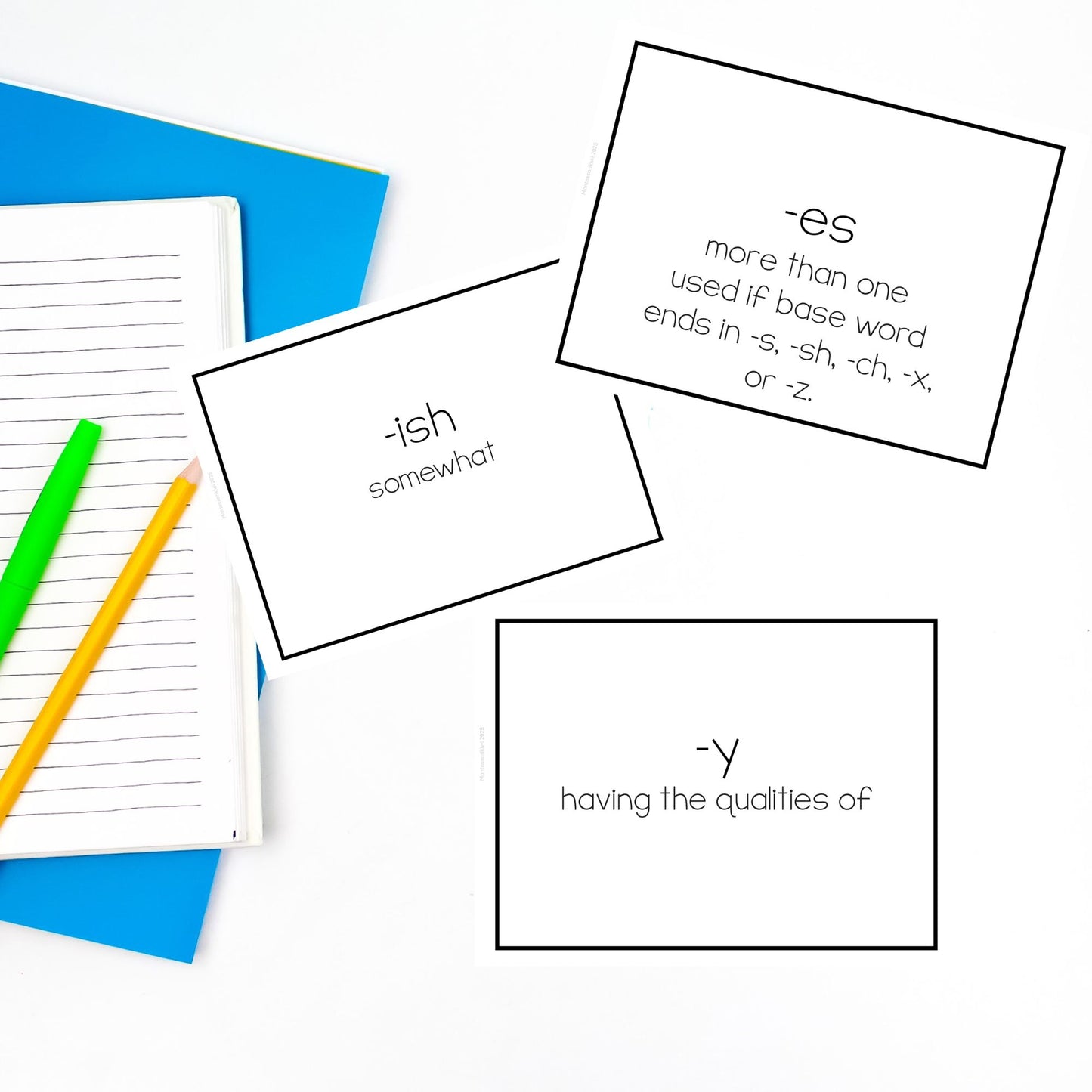
- -es — plurals after words ending in patterns such as s, sh, ch, x or z
- -y — having the qualities of
- -ish — somewhat
- -en — a change in state
- -less — without
- -er — used to form a noun or adjective and sometimes to compare
- -ly — often changes adjectives into adverbs
- -ment — forms a noun indicating a result or state
- -ness — forms a noun expressing a state or quality
- -ful — full of or characterised by
- -ing — present participles and gerunds
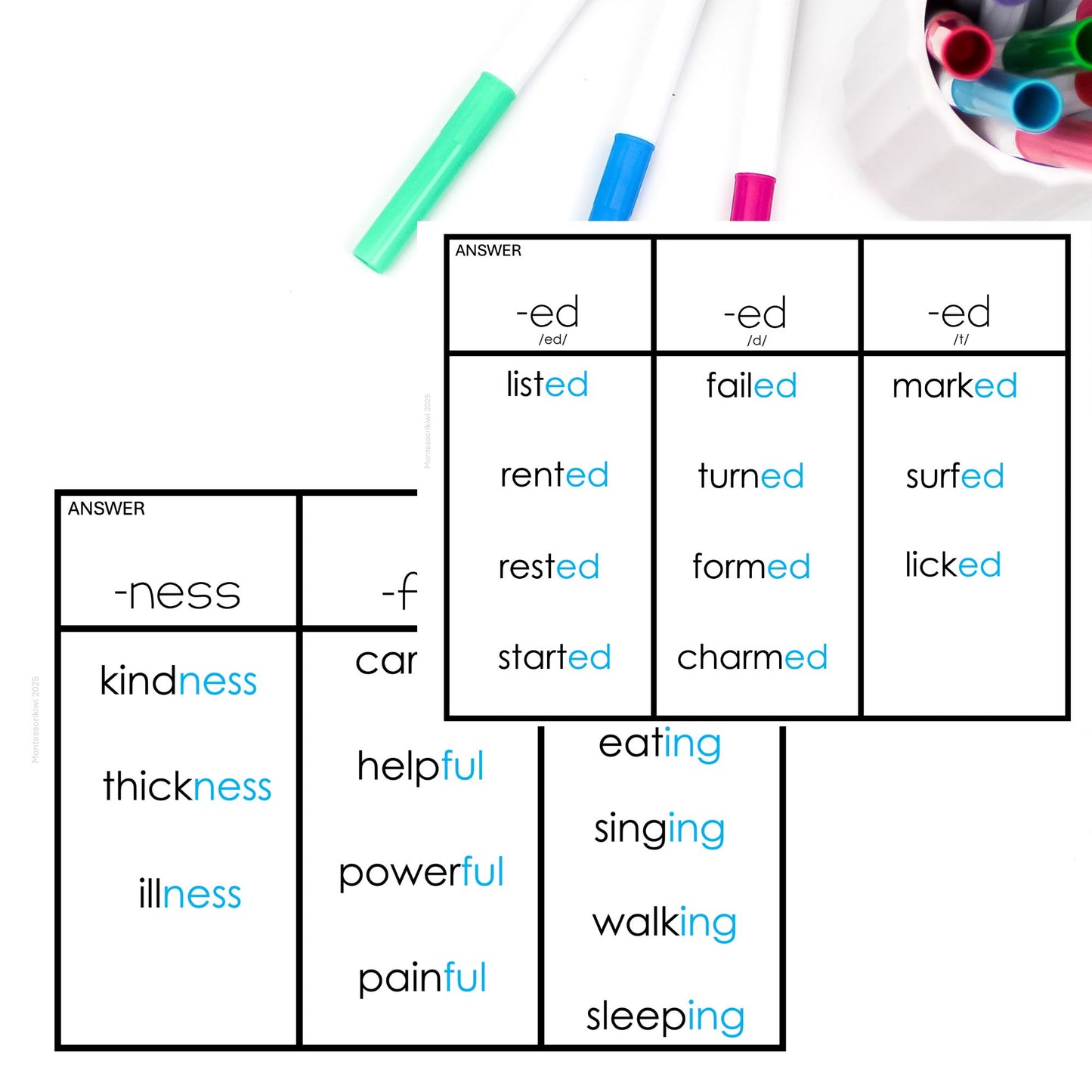
- -ed pronounced /ĭd/
- -ed pronounced /d/
- -ed pronounced /t/
What Is Included?
Five Hands-On Sorting Sets
Each set compares three suffix categories and includes:
- a blank sorting chart with suffix meanings;
- individual word cards for cutting and sorting; and
- a completed answer chart for independent checking.
The word totals are intentionally uneven so children must read every card rather than assume each column receives the same number.
Large Movement-Activity Posters
Fifteen full-page suffix headings can be placed around the room. The teacher says a word, and children move to the suffix category that matches it.
The activity can be made more multisensory by asking children to touch their tummy when saying the base word and their knees when saying the suffix.
Extended Teacher Word Lists
Three reference pages provide additional examples for every suffix category. These can be used to:
- extend the whole-class movement game;
- create new word cards;
- support spelling dictation;
- develop vocabulary discussions; or
- provide more challenging examples for older learners.
A Practical Teaching Sequence
- Introduce the suffix meanings. Compare only two or three suffixes at first.
- Model word analysis. Identify the base word and read the highlighted suffix.
- Discuss the meaning. Ask how the suffix changes the original word.
- Sort the cards. Place each word under the relevant heading.
- Check independently. Compare the completed work with the answer chart.
- Build selected words. Use two colours of the movable alphabet—one for the base and one for the suffix.
- Extend through movement. Use the large posters for active oral practice.
Supports Reading, Spelling and Vocabulary
As children analyse the words, they practise:
- recognising meaningful morphemes;
- identifying base words and suffixes;
- reading longer multisyllabic words;
- understanding how word meaning changes;
- noticing grammatical changes;
- building vocabulary through word families;
- learning plural and past-tense conventions; and
- applying spelling knowledge across multiple words.
This makes the activity useful beyond a single grammar lesson. Morphological knowledge supports both word recognition and comprehension as texts become more complex.
Ways to Use This Resource
- Montessori word-study shelves
- Science of Reading morphology lessons
- Structured literacy intervention
- Spelling and vocabulary groups
- Literacy centres
- Whole-class movement games
- Movable alphabet work
- Partner sorting
- Homeschool language study
- Grammar and parts-of-speech follow-up
Please Note
This resource focuses on sorting and analysing selected suffixes. It is not a complete morphology curriculum and does not explicitly teach every spelling change that may occur when a suffix is added.
Physical movable alphabets, storage materials and laminating supplies are not included.
Created for Real Literacy Instruction
I’m Lisa—an NZ registered teacher, Montessori-trained educator, school principal and former homeschooler. I create Montessori-compatible literacy resources informed by structured literacy and the Science of Reading, with particular attention to learners who need explicit teaching, visual clarity and meaningful repetition.
Continue the Morphology Sequence
-
Montessori Suffix Writing Activity
Move from identifying suffixes into constructing and recording words with meaningful endings. -
Montessori Suffix Word Sort
Explore further suffix examples through additional Montessori-inspired sorting and word-study work. -
Assimilated Prefix Activities
Extend morphology learning into prefixes that change form according to the base word.
Need a Complete Montessori-Compatible Reading Pathway?
The Modern Montessori Science of Reading Bundle includes structured resources for decoding, spelling, advanced phonics, morphology, fluency and comprehension.
Choose the bundle when you need a broad intervention and literacy toolkit rather than one focused suffix-sorting activity.
Looking for Wider Montessori Language Work?
The Montessori Grammar and Language Bundle brings together grammar, word study, vocabulary, sentence work and independent language-shelf materials for approximately ages 5–9.
Explore More Modern Montessori Reading
Browse the Modern Montessori Reading Collection for phonics, morphology, spelling, sentence reading, fluency and comprehension resources.
Help Children See How Words Are Built
Turn suffix study into meaningful, hands-on morphology work through sorting, colour coding, movement and independent checking.
Download the Montessori Suffix Sorting Activities and help learners connect spelling, grammar and vocabulary through meaningful word parts.
Share
-
Items are secured / Terms of Use
Our items are secured. They are not able to be altered. We secure our items because they are our intellectual property and because we use art from artists who require that we secure our files.
You may not:
-resell our items or use them for commercial gain
-claim these items as your own
-modify this resource
-share them with others by any means e.g. electronic or hard copy
-
All Items are instant downloads
You will not get a printed product in the mail.
-
All prices are in USD
Due to the international nature of our customers our prices are all in USD. If you wish to work out the conversion before you buy we recommend www.xe.com