

montessorikiwi
CVC Word Sorting by Category | Montessori Science of Reading Vocabulary Activity
CVC Word Sorting by Category | Montessori Science of Reading Vocabulary Activity
Couldn't load pickup availability
Can your child read simple CVC words—but do they understand how those words connect by meaning?
Early reading is not only about sounding out words correctly.
Children also need to understand what words mean, notice relationships between concepts and organise vocabulary into meaningful groups.
This hands-on CVC Word Categorizing Activity helps children bring those skills together.
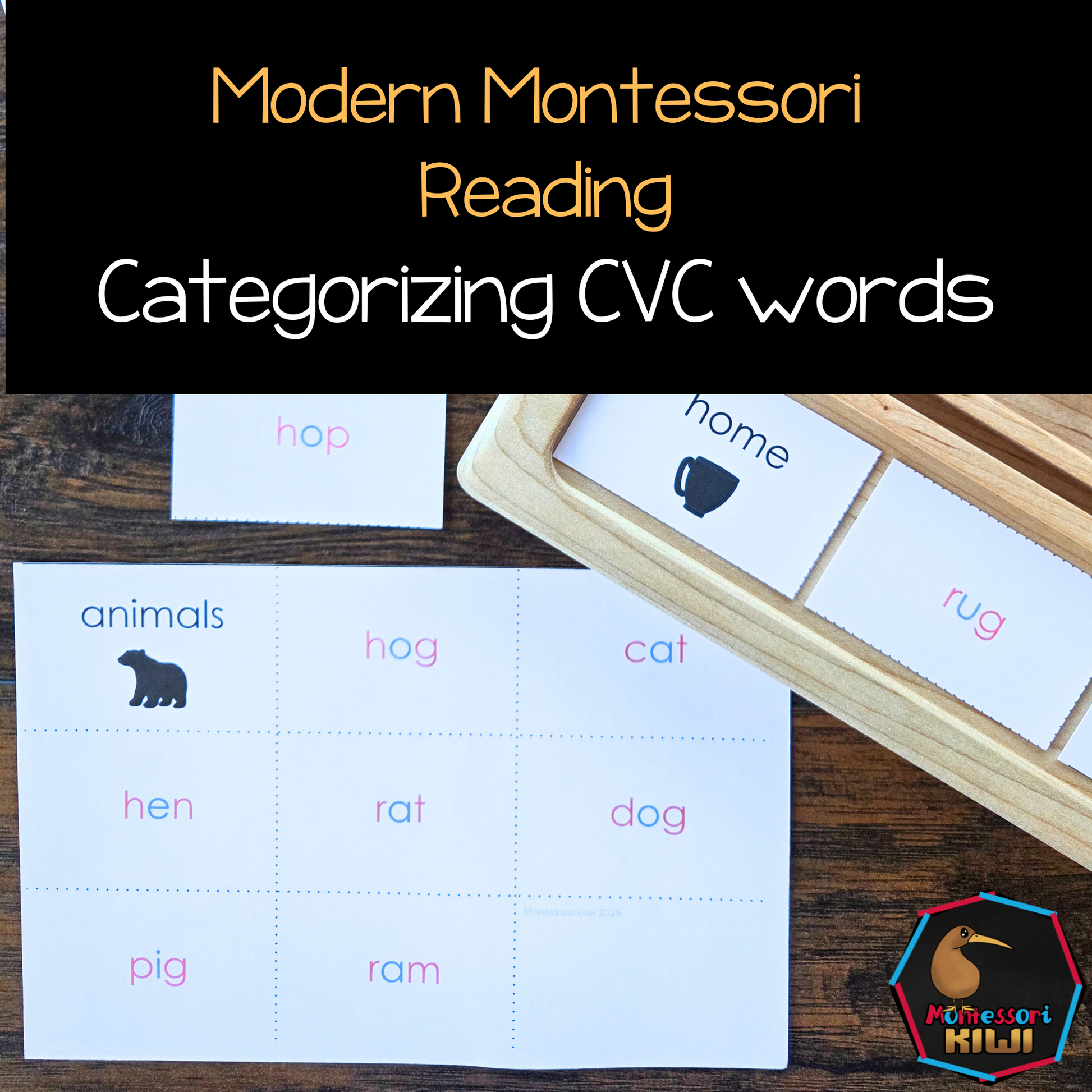
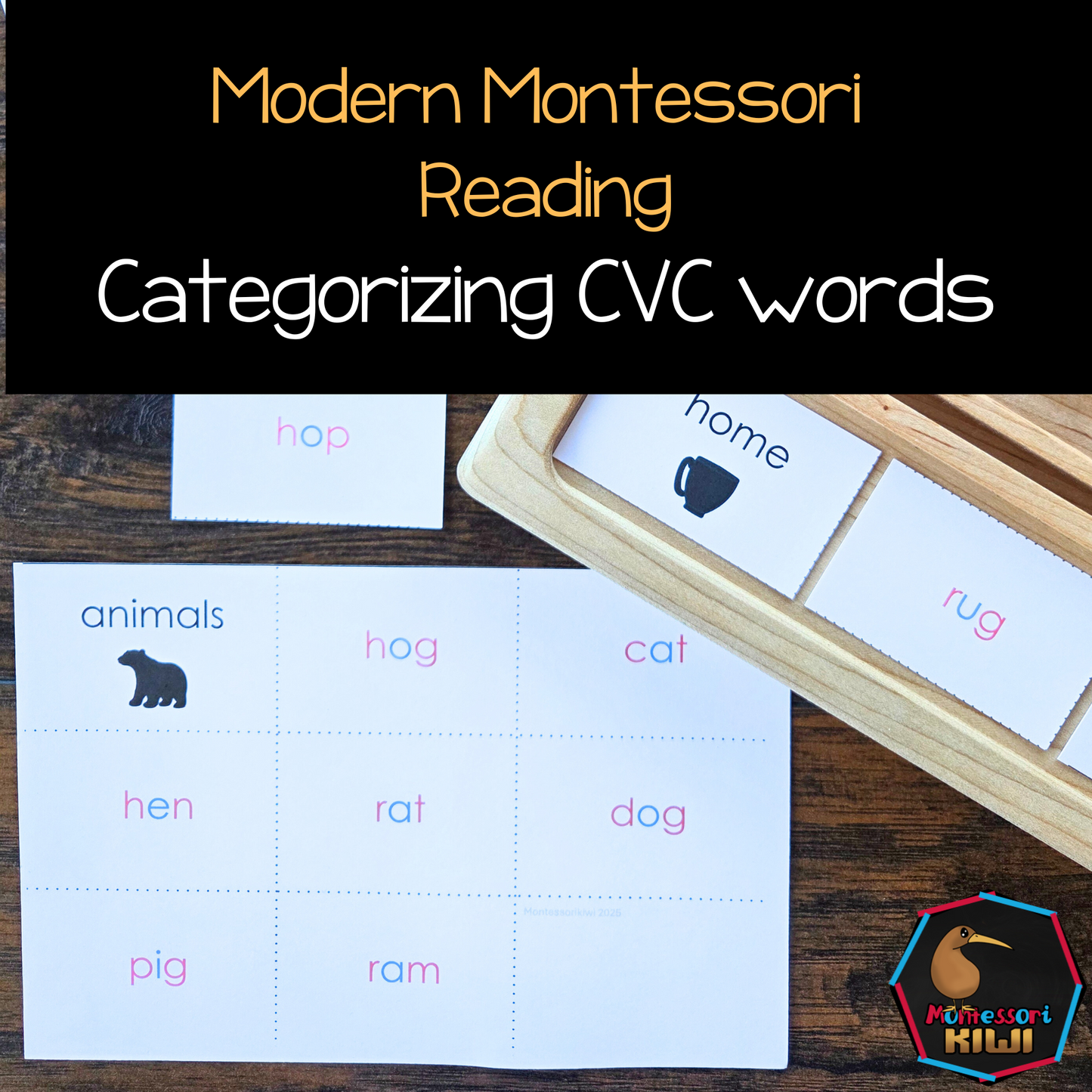
Children first explore the idea that objects can be grouped according to shared features. They then apply that same thinking to written CVC words, reading each word and deciding which category it belongs to.
Designed for Montessori classrooms, Science of Reading-aligned phonics instruction, vocabulary development, literacy centres and homeschool learning, this resource combines decoding, classification and language in one purposeful activity.
🌿 At a Glance
✔ 5 categories
✔ 7 CVC words per category
✔ 35 CVC words in total
✔ Combines phonics, vocabulary and categorisation
✔ Helps children notice similarities and shared features
✔ Supports reading for meaning—not just decoding
✔ Encourages classification and generalisation
✔ Provides indirect preparation for later grammar and parts-of-speech work
✔ Ideal for Montessori shelf work, literacy centres and homeschool learning
📚 What's Included?
This printable CVC word sorting resource includes:
- 5 different categories
- 7 words in each category
- 35 CVC words in total
- Category headings
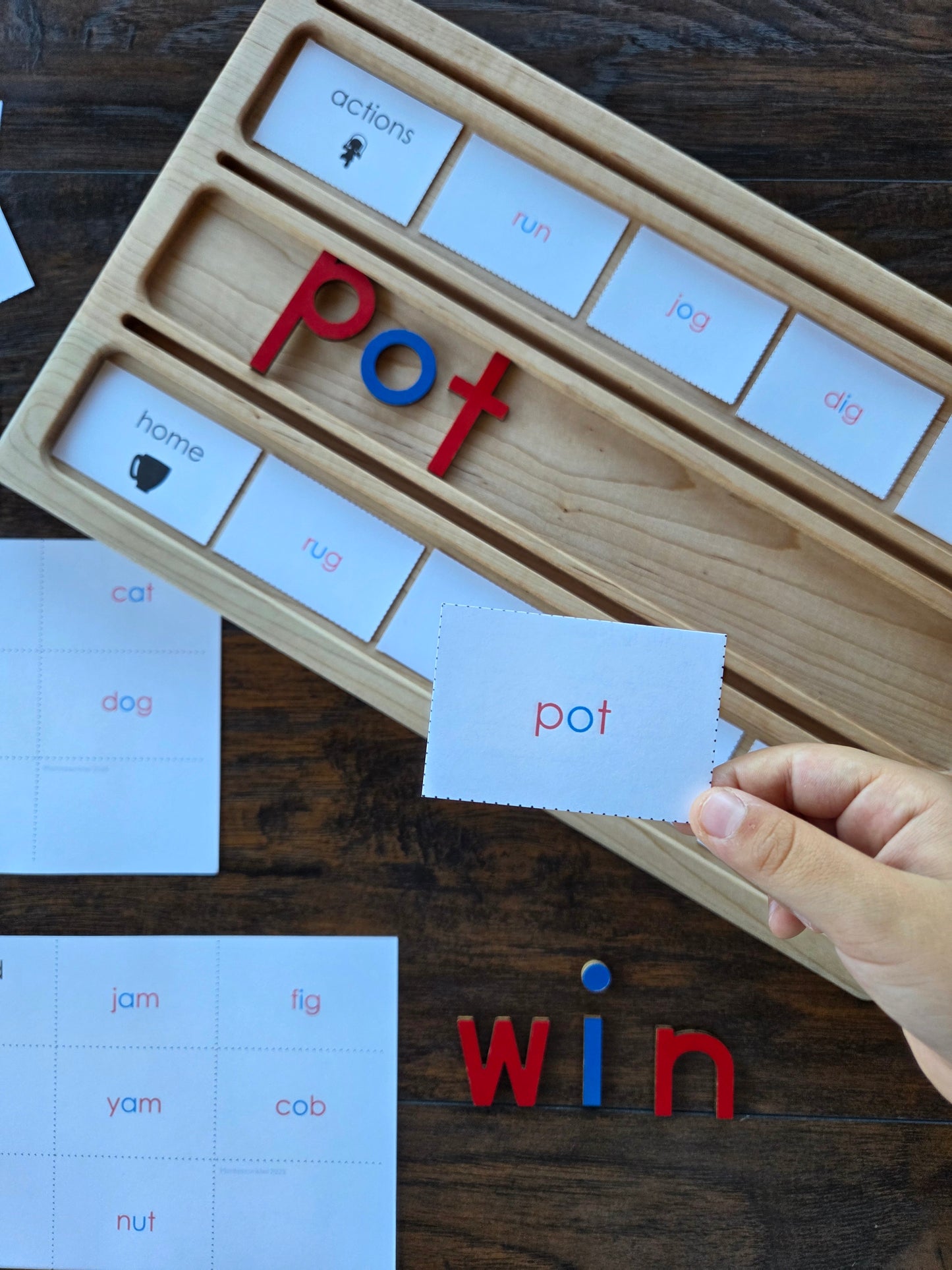
- Hands-on word sorting materials
Children read each CVC word and decide which category it belongs to.
The activity brings together two important ideas:
- Words can be decoded
- Words also carry meaning and can be organised according to shared characteristics
More Than Reading CVC Words
A child may be able to sound out a word accurately without fully thinking about what it means.
This activity encourages a deeper level of processing.
To sort each word successfully, the child needs to:
- Look carefully at the printed word
- Blend the sounds
- Read the complete CVC word
- Understand its meaning
- Compare it with the available categories
- Decide where it belongs
This means the child is not simply decoding.
They are reading for meaning, making connections and organising information.
Why Categorisation Matters
Categorisation is an important thinking and language skill.
Children learn to notice:
- What is the same?
- What is different?
- Which items share similar features?
- What makes something belong to one group rather than another?
This type of thinking supports vocabulary development because children begin to understand not only individual words, but also the relationships between them.
For example, rather than knowing several isolated words, the child begins to understand that those words can belong to a broader group or concept.
From Concrete Sorting to Written Words
The activity can begin with concrete objects or pictures.
Children might first group items according to shared characteristics and discuss why each one belongs.
They then transfer that same understanding to written CVC words.
This creates a clear progression:
notice shared features → form a category → read the word → understand its meaning → place it in the correct group.
This progression fits naturally with Montessori practice because it moves from concrete experience towards increasingly abstract language work.
What Skills Does This Resource Support?
Children will practise:
- Reading CVC words
- Blending and decoding
- Vocabulary development
- Reading for meaning
- Categorisation
- Classification
- Making generalisations
- Semantic organisation
- Oral language
- Word relationships
- Independent thinking
Indirect Preparation for Grammar
This activity also gives children early experience with the idea that words can be grouped according to shared characteristics.
That is useful indirect preparation for later language and grammar work.
As children progress, they will encounter increasingly complex ways of grouping words, including:
- Nouns
- Verbs
- Adjectives
- Semantic categories
- Word families
This resource does not formally teach parts of speech, but it does help build the underlying habit of asking:
What kind of word is this, and what does it have in common with these other words?
Why This Works Well in a Montessori Environment
The activity is hands-on, purposeful and open to discussion.
After a clear presentation, children can work through the sort independently or with a partner.
You can extend the activity by asking:
- Why did you put that word there?
- Could this word fit into another category?
- Can you think of another word that belongs in this group?
- What do all the words in this category have in common?
These simple questions help turn a phonics activity into richer language and reasoning work.
🌿 Perfect For
- Montessori language shelves
- Science of Reading-aligned phonics practice
- CVC word reading
- Vocabulary development
- Literacy centres
- Small-group instruction
- Independent shelf work
- Reading intervention
- Early language development
- Homeschool phonics lessons
Help Children Connect Reading With Meaning
Learning to read is not only about accurately sounding out letters.
Children also need to understand what words mean, how concepts connect and how information can be organised.
This activity gives children a simple but purposeful progression:
decode the word → understand the meaning → notice the shared feature → place it in the correct category.
That makes it a useful bridge between early phonics, vocabulary development and more advanced language work.
🔗 Related Resources
Continue helping children connect decoding with meaning, vocabulary and sentence comprehension through these related resources:
🌿 CCVC Word to Picture Matching Cards
Help children move beyond CVC words by decoding words with initial consonant blends and matching each one to meaning.
Explore the CCVC Word to Picture Matching Cards →
🌿 CVC Sentence Frames
Support children as they move from reading individual CVC words towards simple sentence reading and beginning writing.
Explore the CVC Sentence Frames →
🌿 Simple Reading Comprehension Task Cards
Help children read complete sentences, use context and select the word that makes sense.
Explore the Reading Comprehension Cards →
🌿 Advanced Adjectives Clip Cards
Build richer vocabulary and descriptive language by asking children to identify multiple visual examples of advanced adjectives.
Explore the Advanced Adjectives Clip Cards →
🌿 Modern Montessori Reading Collection
Explore hands-on resources for phonological awareness, phonics, vocabulary, spelling patterns, sentence reading and comprehension.
Explore the Modern Montessori Reading Collection →
🌿 Modern Montessori Science of Reading Bundle
Looking for a broader literacy sequence? Explore Montessori-aligned resources covering phonological awareness, CVC and CCVC words, digraphs, silent e, vocabulary, spelling patterns, sentence reading and comprehension.
Created by Lisa, a Montessori-trained teacher, NZ registered teacher, school principal and former homeschooler. My resources are designed with real learners in mind—including neurodivergent children—and focus on practical, affordable, low-prep materials that support independence.
Share


-
Items are secured / Terms of Use
Our items are secured. They are not able to be altered. We secure our items because they are our intellectual property and because we use art from artists who require that we secure our files.
You may not:
-resell our items or use them for commercial gain
-claim these items as your own
-modify this resource
-share them with others by any means e.g. electronic or hard copy
-
All Items are instant downloads
You will not get a printed product in the mail.
-
All prices are in USD
Due to the international nature of our customers our prices are all in USD. If you wish to work out the conversion before you buy we recommend www.xe.com