


montessorikiwi
R-Controlled Vowel Matching Cards | Montessori Science of Reading
R-Controlled Vowel Matching Cards | Montessori Science of Reading
Couldn't load pickup availability
Can your child recognise R-controlled vowel words in isolation—but still hesitate when asked to sort, read and connect them with meaning?
Patterns such as ar, er, ir, or and ur can be tricky because the vowel sound is influenced by the following r.
A child may confidently read simple short-vowel words, then meet words such as star, first, corn, turtle or zipper and need a more explicit way to notice the vowel-r pattern.
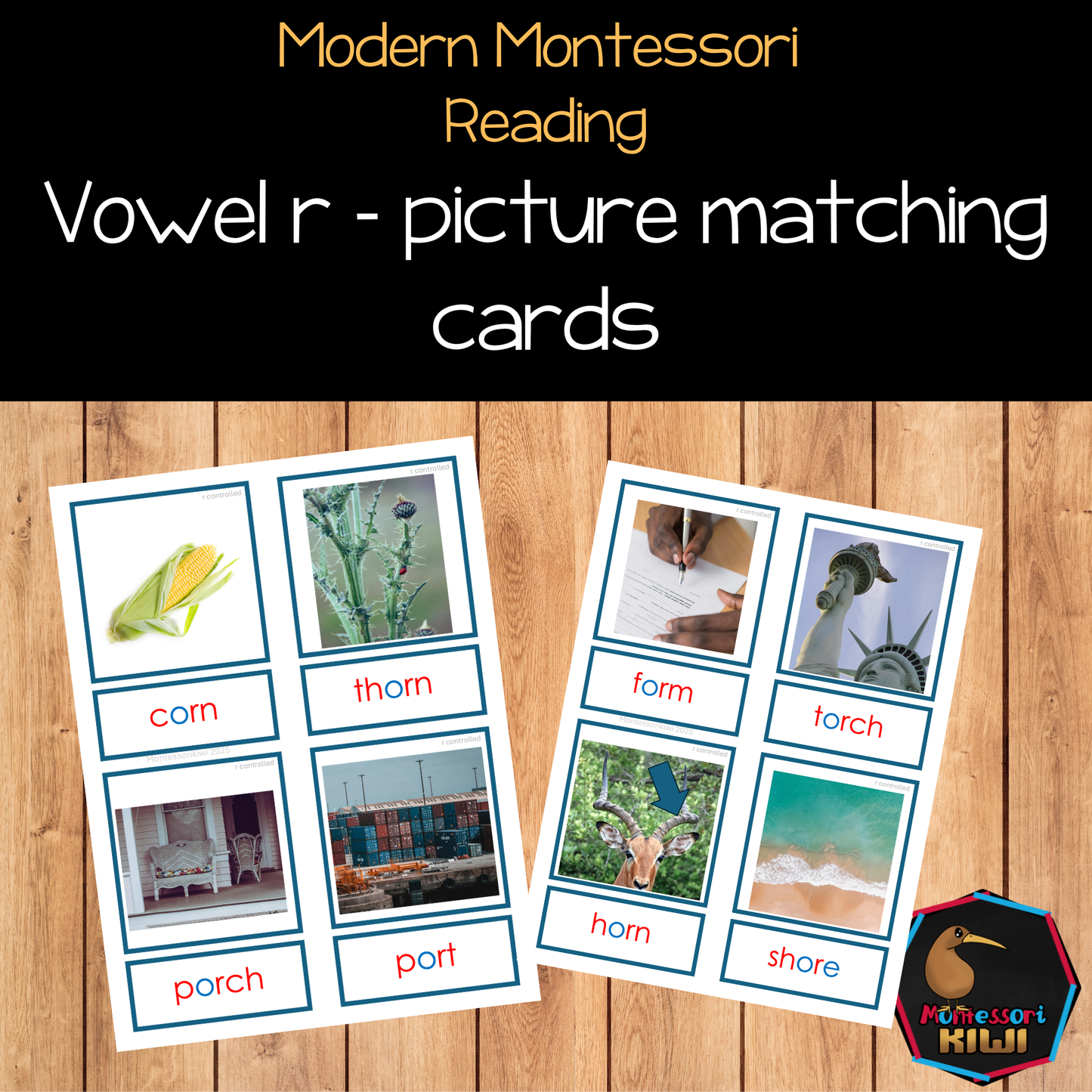
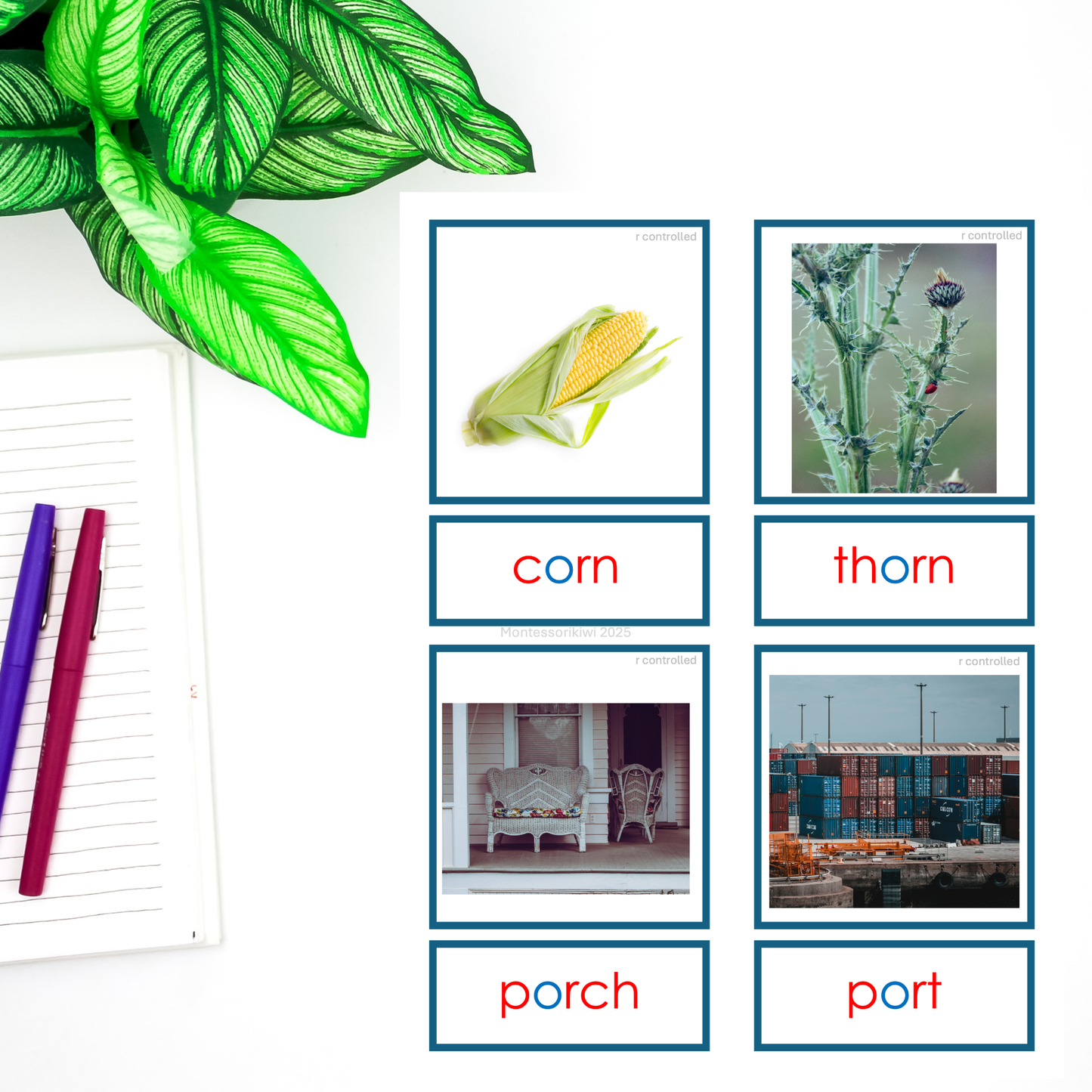
These hands-on R-Controlled Vowel Picture Matching Cards help children read words, match them with pictures and sort them under the correct vowel-r heading.
Children work with 54 words across ar, er, ir, or and ur, allowing them to compare patterns, connect print with meaning and self-check independently.
Designed for Montessori classrooms, Science of Reading-aligned phonics instruction, structured literacy, intervention and homeschool learning, this resource provides a practical bridge between explicit R-controlled vowel teaching and more confident independent reading.
🌿 At a Glance
✔ 54 R-controlled vowel words in total
✔ Includes 12 ar words
✔ Includes 12 er words
✔ Includes 12 ir words
✔ Includes 8 ur words
✔ Includes 10 or words
✔ Header cards for each vowel-r sound
✔ Matching picture and word cards
✔ Self-correcting format for independent checking
✔ Can be extended with the moveable alphabet
✔ Ideal for Montessori shelf work, literacy centres, intervention and homeschool phonics
📚 What's Included?
This printable R-controlled vowel resource includes:
- Header cards for each vowel-r pattern
- 12 ar words, including examples such as star and park
- 12 er words, including examples such as letter and zipper
- 12 ir words, including examples such as first and skirt
- 8 ur words, including examples such as turtle and surf
- 10 or words, including examples such as corn and torch
- Matching picture cards
- Matching word cards
- Self-correcting answers on the reverse
Children read each word, match it with the correct picture and sort it under the appropriate R-controlled vowel heading.
Why Can R-Controlled Vowels Be Tricky?
Children often first become confident with simple short-vowel words.
Then they meet spelling patterns such as:
- ar
- er
- ir
- or
- ur
Now the vowel sound is influenced by the following r.
This means children need to recognise the vowel-r pattern as a unit rather than relying on the vowel's usual short or long sound.
From Isolated Words to Pattern Recognition
A child may read one R-controlled vowel word correctly and still not notice the broader spelling pattern.
This activity supports the progression:
read the word → notice the vowel-r pattern → connect the word with its picture → sort it under the correct heading → self-check.
This helps children move beyond memorising individual words and towards recognising recurring orthographic patterns.
Why Use Picture-to-Word Matching?
Reading is not only about pronouncing the word correctly.
Children also need to connect print with meaning.
To complete each match, the child needs to:
- Read the written word
- Recognise the R-controlled vowel pattern
- Understand the word
- Find the matching picture
- Sort the pair under the correct heading
This makes the activity more meaningful than simply reading a list of isolated words.
Why Sort by AR, ER, IR, OR and UR?
Sorting makes similarities and differences easier to see.
Children can compare:
- Which letters are the same?
- Which vowel-r pattern is present?
- Which words belong together?
- What stays the same across the group?
This supports stronger pattern recognition and helps children organise their phonics knowledge.
The Five R-Controlled Vowel Patterns
AR
Examples include:
- star
- park
ER
Examples include:
- letter
- zipper
IR
Examples include:
- first
- skirt
UR
Examples include:
- turtle
- surf
OR
Examples include:
- corn
- torch
From Reading Into Spelling
Once children are confident matching and sorting the words, the activity can be extended into encoding.
You might invite the child to:
- Choose one picture
- Say the word aloud
- Identify the vowel-r sound
- Build the word with the moveable alphabet
- Compare it with the printed word card
This supports the progression:
meaning → spoken word → sound pattern → written word.
Why Use the Moveable Alphabet?
The moveable alphabet allows children to work with spelling without the additional fine-motor demands of handwriting.
Children can:
- Hear the word
- Analyse its sounds
- Select the correct letters
- Build the word
- Compare it with the control card
This creates a natural link between Montessori language materials and explicit phonics instruction.
Why Self-Correction Matters
The cards are designed so children can check their work independently by turning them over.
This supports:
- Independence
- Persistence
- Immediate feedback
- Self-monitoring
- Reduced dependence on adult correction
This fits naturally with Montessori practice, where a clear control of error supports increasingly independent work.
From Word Matching to Independent Shelf Work
After an initial presentation, children can revisit the resource independently.
A useful progression might be:
- Introduce one vowel-r heading.
- Model matching one picture and word card.
- Invite the child to continue.
- Add a second pattern when ready.
- Gradually increase the number of headings.
- Use the reverse control to self-check.
This makes the activity easy to differentiate in mixed-age Montessori environments.
Why Compare ER, IR and UR?
These spellings can be especially challenging because they may represent very similar or identical sounds depending on accent and dialect.
Sorting the words does not mean children should rely only on sound to decide the spelling.
Instead, the activity helps them become more familiar with the written patterns and build stronger orthographic knowledge through repeated exposure.
What Skills Does This Resource Support?
Children will practise:
- Reading R-controlled vowel words
- Recognising ar, er, ir, or and ur
- Decoding
- Orthographic pattern recognition
- Word classification
- Vocabulary development
- Connecting print with meaning
- Preparation for spelling
- Moveable alphabet word building
- Independent self-correction
A Clear Learning Progression
This resource supports the progression:
recognise the vowel-r pattern → read the word → connect it with meaning → sort it into the correct category → self-check → extend into spelling.
This gives children a practical pathway from explicit phonics instruction towards more independent word recognition and encoding.
Easy to Differentiate
You do not need to offer all five vowel-r sets at once.
You can begin with:
- One pattern
- A smaller number of words
- Two clearly contrasting patterns
- Teacher-guided matching before independent use
As confidence grows, introduce additional headings and larger sorts.
More Than a Matching Activity
The goal is not simply to place a word beside a picture.
The deeper learning progression is:
read the word → notice the R-controlled vowel pattern → understand its meaning → match the picture → classify the word → self-check.
That makes the resource a purposeful phonics and word-study activity rather than a simple matching exercise.
🌿 Perfect For
- Montessori language shelves
- Science of Reading-aligned phonics instruction
- Structured literacy lessons
- R-controlled vowel practice
- Word study
- Literacy centres
- Small-group instruction
- Reading and spelling intervention
- Independent shelf work
- Moveable alphabet extensions
- Homeschool phonics lessons
Help Children See the Pattern Inside the Word
R-controlled vowels can feel unpredictable until children begin to recognise the recurring spelling patterns.
These cards support the progression:
notice the vowel-r pattern → read the word → connect it with meaning → sort it → self-check → extend into spelling.
That makes the resource a useful bridge between explicit R-controlled vowel teaching and more confident independent reading and writing.
🔗 Related Resources
Continue building children's confidence with R-controlled vowels, multisyllabic words and connected sentence reading through these related Montessori literacy resources:
🌿 R-Controlled Vowel Two-Syllable Activities
Help children break longer vowel-r words into manageable syllables and apply their knowledge through word building, dictation, handwriting and sentence work.
Explore the R-Controlled Vowel Two-Syllable Activities →
🌿 R-Controlled Vowel Roll & Read
Move from isolated word reading into repeated sentence practice for greater fluency.
Explore the R-Controlled Vowel Roll & Read →
🌿 R-Controlled Vowel Sentence Scrambles
Help children decode vowel-r words, use sentence clues and rebuild meaningful sentences in the correct order.
Explore the R-Controlled Vowel Sentence Scrambles →
🌿 Open & Closed Syllable Activities
Help children use syllable structure to decode unfamiliar and multisyllabic words more strategically.
Explore the Open & Closed Syllable Activities →
🌿 Modern Montessori Reading Collection
Explore hands-on resources for phonemic awareness, phonics, spelling patterns, syllables, fluency, sentence reading and comprehension.
Explore the Modern Montessori Reading Collection →
🌿 Modern Montessori Science of Reading Bundle
Explore a broader Montessori-aligned literacy sequence covering phonological awareness, decoding, spelling patterns, syllables, morphology, fluency, sentence reading and comprehension.
Created by Lisa, a Montessori-trained teacher, NZ registered teacher, school principal and former homeschooler. My resources are designed with real learners in mind—including neurodivergent children—and focus on practical, affordable, low-prep materials that support independence.
Share
-
Items are secured / Terms of Use
Our items are secured. They are not able to be altered. We secure our items because they are our intellectual property and because we use art from artists who require that we secure our files.
You may not:
-resell our items or use them for commercial gain
-claim these items as your own
-modify this resource
-share them with others by any means e.g. electronic or hard copy
-
All Items are instant downloads
You will not get a printed product in the mail.
-
All prices are in USD
Due to the international nature of our customers our prices are all in USD. If you wish to work out the conversion before you buy we recommend www.xe.com