


montessorikiwi
Open & Closed Syllable Activities | Montessori Science of Reading Phonics
Open & Closed Syllable Activities | Montessori Science of Reading Phonics
Couldn't load pickup availability
Can your child read simple CVC words—but begin guessing when words get longer?
Many children are expected to simply “sound out” longer words without first being shown how those words can be broken into smaller, manageable parts.
Understanding open and closed syllables gives children a practical strategy for working out unfamiliar words instead of relying on memory, pictures or guessing.
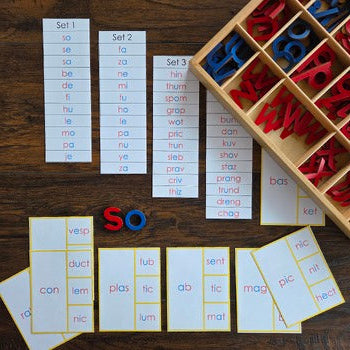
This hands-on Open and Closed Syllable Activity Pack helps children recognise two common syllable types, compare vowel sounds, build two-syllable words and apply their decoding knowledge in meaningful sentence work.
Children move from identifying individual syllables to combining word parts, choosing the correct second syllable, building complete words and unscrambling sentences so they make sense.
Designed for Montessori classrooms, Science of Reading-aligned phonics instruction, structured literacy, intervention and homeschool learning, this resource provides explicit, hands-on practice for children moving beyond simple CVC words into multisyllabic reading.
🌿 At a Glance
✔ Focused practice with open and closed syllables
✔ Includes full teacher notes
✔ Separate open-syllable practice
✔ Separate closed-syllable practice
✔ Includes pseudoword lists for focused vowel-sound practice
✔ Includes hands-on Clip & Flip two-syllable word activities
✔ Children read one syllable and choose the second syllable that completes the word
✔ Includes sentence-unscrambling activities
✔ Self-checking format supports independent work
✔ Supports decoding, vowel-pattern recognition, multisyllabic reading and comprehension
📚 What's Included?
This printable open and closed syllable resource includes:
- Full teacher notes
- Open-syllable practice
- Closed-syllable practice
- Pseudoword lists for practising vowel sounds
- Clip & Flip two-syllable word activities
- Word-part matching activities
- Sentence-unscrambling activities
- Self-checking work
- A Montessori-inspired independent-work format
Children practise reading individual syllables, combining syllables into real words, choosing the correct word part and rearranging mixed-up sentences so they make sense.
Why Can Longer Words Be So Difficult?
A child may confidently read short words such as:
- cat
- sit
- hop
Then they meet a longer word and suddenly try to process the entire word at once.
This can lead to:
- Guessing from the first letter
- Skipping parts of the word
- Relying on pictures
- Losing track of vowel sounds
- Giving up when the word looks too long
Syllable knowledge gives children another strategy.
Instead of asking:
Can I recognise this whole word?
the child can begin asking:
What smaller parts can I see, and what do I know about them?
What Is a Closed Syllable?
A closed syllable ends in one or more consonants, and the vowel commonly represents its short sound.
Examples include:
- cat
- pic
- rob
Recognising this pattern can help children make a more informed decision about how to pronounce the vowel.
What Is an Open Syllable?
An open syllable ends with a vowel, and that vowel commonly represents its long sound.
Examples might include syllables such as:
- me
- go
- hi
When children begin recognising open and closed syllables, longer words can become less intimidating because they can analyse one part at a time.
From Guessing to Pattern Recognition
The key learning progression is:
identify the syllable → notice whether it is open or closed → consider the likely vowel sound → read the syllable → combine it with another syllable → read the complete word.
This helps children move away from guessing and towards using recognisable spelling patterns.
Why Use Pseudowords?
Pseudowords are invented words that follow regular spelling patterns.
Because children cannot rely on having memorised them before, pseudowords can give focused practice applying decoding knowledge.
The child needs to look closely at:
- The vowel
- Whether the syllable is open or closed
- The surrounding consonants
- The sound pattern represented by the spelling
This keeps the attention on decoding rather than memory.
Why Use Clip & Flip Activities?
The Clip & Flip activities provide hands-on two-syllable word practice.
The child:
- Reads the first syllable.
- Examines the possible second syllables.
- Chooses the syllable that completes the word.
- Clips their answer.
- Flips the card to check independently.
This supports a clear progression:
read the first part → compare possible endings → build the complete word → check whether it makes sense → self-correct.
From Syllables to Whole Words
Understanding syllable types is useful because it gives children a way to break longer words down.
Rather than seeing one large block of letters, children can begin noticing smaller units.
They can ask:
- How many syllables can I hear?
- Where might I divide the word?
- Is this syllable open or closed?
- What vowel sound is likely?
- What happens when I blend the syllables together?
This can support more accurate and confident multisyllabic reading.
Why Include Sentence Unscrambling?
Decoding individual words is only part of reading.
Children also need to understand how words work together in meaningful sentences.
The sentence-unscrambling activities ask children to rearrange mixed-up words so that the sentence makes sense.
This supports:
- Sentence structure
- Syntax
- Reading comprehension
- Fluency
- Logical reasoning
It helps move the child from isolated syllable work into connected language.
Why Teach Open and Closed Syllables Explicitly?
Many children are expected to recognise longer words without being shown the internal patterns that can help them decode those words.
Explicit syllable instruction helps make the structure more visible.
Children can begin to notice that:
- A closed syllable commonly contains a short vowel sound
- An open syllable commonly contains a long vowel sound
- Longer words can be divided into smaller parts
- Those smaller parts contain patterns they may already know
This gives children a practical strategy they can apply to unfamiliar words.
What Skills Does This Resource Support?
Children will practise:
- Recognising open and closed syllables
- Short- and long-vowel discrimination
- Decoding unfamiliar syllables
- Reading pseudowords
- Reading two-syllable words
- Combining word parts
- Multisyllabic decoding
- Orthographic pattern recognition
- Sentence structure
- Reading comprehension
- Independent self-correction
A Useful Bridge Beyond CVC Words
This resource is particularly useful for children who are confident with simple CVC words but need a strategy for approaching longer words.
A possible progression is:
CVC words → open and closed syllables → two-syllable word building → multisyllabic decoding → sentence reading.
This gives children a structured path forward rather than simply asking them to tackle increasingly long words without additional support.
More Than a Syllable Sort
The goal is not simply to label a syllable as open or closed.
The deeper learning is:
notice the syllable structure → predict the likely vowel sound → decode the part → combine it with another syllable → read the complete word → use that reading in meaningful sentences.
That makes this a practical decoding and word-analysis resource rather than just a classification activity.
Why Self-Correction Matters
The self-checking activities allow children to receive immediate feedback without needing constant adult correction.
This supports:
- Independence
- Persistence
- Self-monitoring
- Repeated practice
- Confidence
This fits naturally with Montessori practice, where a clear control of error allows children to work increasingly independently.
🌿 Perfect For
- Montessori language shelves
- Science of Reading-aligned phonics instruction
- Structured literacy lessons
- Open and closed syllable practice
- Multisyllabic word reading
- Small-group phonics work
- Reading intervention
- Older struggling readers who need explicit decoding support
- Independent shelf work
- Homeschool literacy lessons
Help Children See How Longer Words Work
Longer words become less intimidating when children know how to break them into parts and recognise familiar patterns inside them.
This resource supports the progression:
identify the syllable → decide whether it is open or closed → choose the likely vowel sound → decode the part → combine the syllables → read the complete word → apply understanding in a sentence.
That makes it a practical bridge from simple CVC reading into more confident multisyllabic decoding.
🔗 Related Resources
Continue building children's confidence with syllable types, longer words and advanced phonics using these related Montessori literacy resources:
🌿 Consonant-LE Two-Syllable Activities
Help children recognise consonant-le endings, combine syllables into complete words and apply their knowledge through dictation, sentences and comprehension.
Explore the Consonant-LE Activities →
🌿 R-Controlled Vowel Two-Syllable Activities
Help children break longer words into manageable syllables and work with vowel-r patterns through reading, writing and sentence activities.
Explore the R-Controlled Vowel Activities →
🌿 Schwa Syllable Sort
Help children compare one-, two- and three-syllable words while noticing unstressed vowel sounds.
Explore the Schwa Syllable Sort →
🌿 CCVC Phonics Booklets
Support children moving beyond simple CVC words into more complex words with two initial consonants.
Explore the CCVC Phonics Booklets →
🌿 Modern Montessori Reading Collection
Explore hands-on resources for phonemic awareness, phonics, spelling patterns, syllables, morphology, sentence reading and comprehension.
Explore the Modern Montessori Reading Collection →
🌿 Modern Montessori Science of Reading Bundle
Explore a broader Montessori-aligned literacy sequence covering phonological awareness, decoding, spelling patterns, syllables, morphology, sentence reading and comprehension.
Created by Lisa, a Montessori-trained teacher, NZ registered teacher, school principal and former homeschooler. My resources are designed with real learners in mind—including neurodivergent children—and focus on practical, affordable, low-prep materials that support independence.
Share


-
Items are secured / Terms of Use
Our items are secured. They are not able to be altered. We secure our items because they are our intellectual property and because we use art from artists who require that we secure our files.
You may not:
-resell our items or use them for commercial gain
-claim these items as your own
-modify this resource
-share them with others by any means e.g. electronic or hard copy
-
All Items are instant downloads
You will not get a printed product in the mail.
-
All prices are in USD
Due to the international nature of our customers our prices are all in USD. If you wish to work out the conversion before you buy we recommend www.xe.com