montessorikiwi
Montessori Elementary Language Assessment | Grammar, Word Study and Punctuation
Montessori Elementary Language Assessment | Grammar, Word Study and Punctuation
Couldn't load pickup availability

This is a digital download. No physical item will be shipped.
Find Out What Each Child Understands—and What to Teach Next
In a mixed-age Montessori classroom, children may have completed very different language presentations. One child can confidently identify the parts of speech but needs work with punctuation. Another may understand prefixes and suffixes but struggle with poetic devices.
Without a clear assessment process, it can be difficult to know which concepts are secure, which need reviewing and where the child should re-enter the Montessori language sequence.
This Montessori Elementary Language Assessment helps you evaluate children’s understanding across three key areas:
- grammar
- word study
- punctuation
The student assessment is accompanied by detailed teacher rubrics that do more than record a score. Each rubric links incomplete knowledge to a practical next teaching step, helping you turn the assessment results into an individualised language plan.
At a Glance
Best for: Montessori elementary classrooms, homeschoolers, tutoring and individual learning plans
Age range: Approximately 7–12 years, depending on previous language instruction
Assesses: Grammar, Montessori grammar symbols, word study, figurative language and punctuation
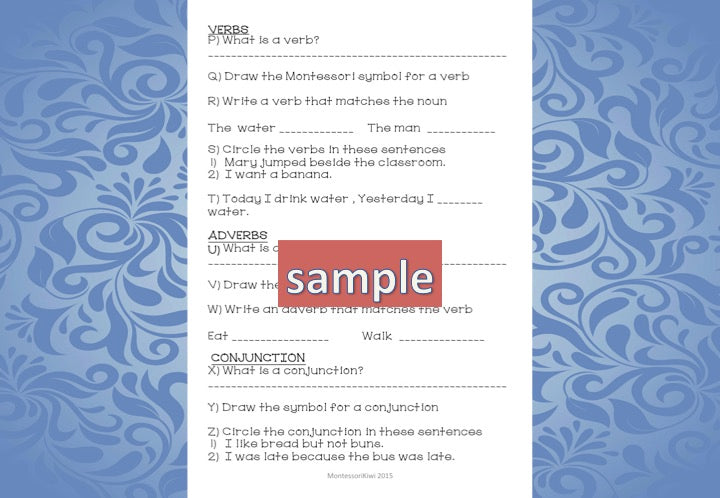
Includes: A 14-page student assessment and four teacher assessment/rubric pages
Use for: Beginning-of-year assessment, progress monitoring, programme planning, reporting and identifying next lessons
Format: 18 printable PDF pages supplied in four files
More Than a Grammar Test
A conventional test may tell you how many questions a child answered correctly. It does not necessarily tell you which Montessori presentation should come next.
This resource was designed to help connect assessment with instruction.
The accompanying rubrics break the language curriculum into specific observable skills. Beneath each skill, you will find suggested follow-up lessons or materials for children whose knowledge is not yet secure.
For example, the assessment may show that a child can define a noun but cannot consistently identify concrete and abstract nouns. The rubric then directs you towards focused classification work rather than repeating the entire noun sequence.
This makes the resource useful for:
- identifying gaps in prior learning
- planning individual or small-group presentations
- monitoring progress over time
- grouping children with similar instructional needs
- supporting parent conferences and written reports
- documenting learning in mixed-age environments
What Is Assessed?
Montessori Grammar
The grammar section assesses children’s knowledge of the major parts of speech and their associated Montessori grammar symbols.
Skills include:
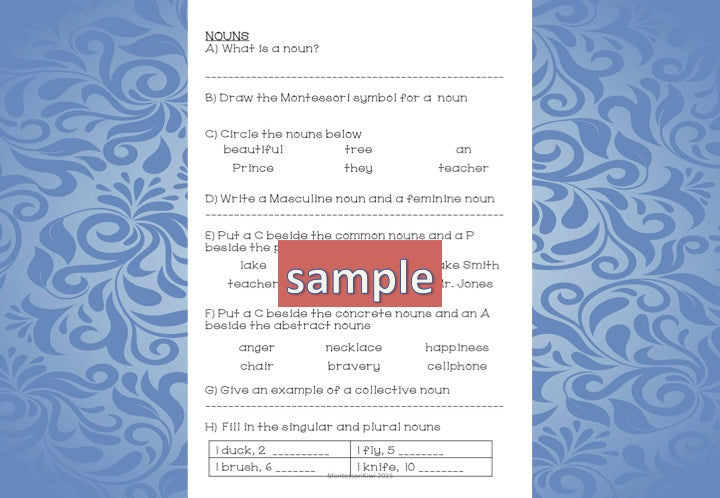
- defining and identifying nouns
- drawing the Montessori noun symbol
- masculine and feminine nouns
- common and proper nouns
- concrete and abstract nouns
- collective nouns
- singular and plural nouns
- articles and the Montessori article symbol
- the three English articles
- adjectives and the adjective symbol
- logical agreement between nouns and adjectives
- positive, comparative and superlative adjectives
- verbs and the verb symbol
- identifying and using verbs
- past-tense verb forms
- adverbs and the adverb symbol
- logical agreement between verbs and adverbs
- conjunctions and the conjunction symbol
- pronouns and the pronoun symbol
- singular, plural, possessive and indefinite pronouns
- interjections and the interjection symbol
Word Study and Figurative Language
The word-study section assesses foundational vocabulary knowledge as well as more advanced language concepts.
Skills include:
- alphabetical order
- syllables
- compound words
- prefixes
- suffixes
- homophones
- homonyms
- homographs
- idioms
- analogies
- similes
- metaphors
- personification
- alliteration
- consonance
- assonance
- hyperbole
- onomatopoeia
Punctuation
The punctuation section moves from basic sentence conventions into more advanced punctuation.
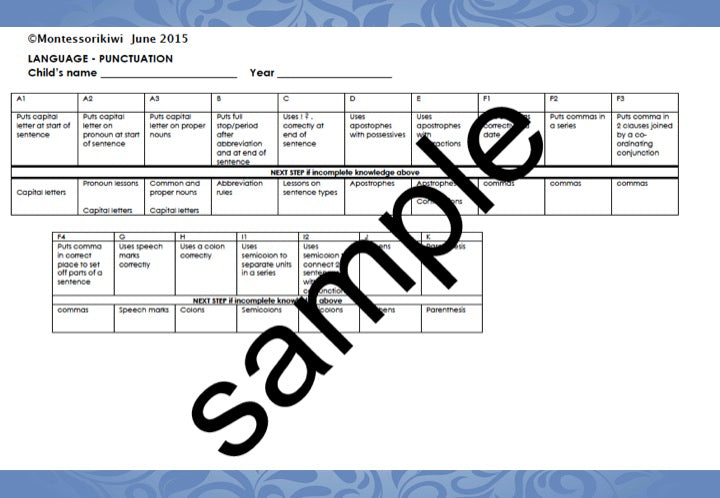
Skills represented on the assessment and rubric include:
- capital letters at the beginning of sentences
- capitalisation of the pronoun I
- capitalisation of proper nouns
- full stops or periods
- question marks and exclamation marks
- possessive apostrophes
- apostrophes in contractions
- commas in dates
- commas in a series
- commas joining clauses
- commas used to set off parts of a sentence
- speech marks
- colons
- semicolons
- hyphens
- parentheses
What Is Included?
14-Page Student Language Assessment
The printable student assessment is divided into three sections:
- Grammar: Children define, identify, symbolise and apply their understanding of the parts of speech.
- Word Study: Children demonstrate knowledge of word structure, word relationships and figurative language.
- Punctuation: Children correct and apply capitalisation, sentence punctuation, apostrophes and commas.
The questions use a mixture of short answers, classification, sentence completion, editing and written examples. This allows children to demonstrate knowledge in several different ways.
Four Teacher Assessment and Planning Pages
- Two-page grammar rubric
- One-page word-study rubric
- One-page punctuation rubric
Each rubric provides space for the child’s name and year level. The skills are arranged individually so you can mark what the child has demonstrated and identify the most appropriate follow-up lesson.
Use the Assessment Without Turning Montessori Into Test Preparation
This resource is intended to inform teaching—not to replace observation, conferencing or the child’s daily classroom work.
You may choose to administer the full assessment, but it can also be used flexibly:
- complete one section at a time
- assess only the areas relevant to the child
- use selected questions during an individual conference
- record skills already demonstrated through classroom observation
- repeat a section later to monitor progress
This flexibility is particularly valuable in Montessori classrooms where children do not all follow the same language sequence at the same time.
Suggested Assessment Process
- Review existing observations. Consider the presentations and follow-up work the child has already completed.
- Select the appropriate assessment sections. You do not need to assess every skill in one sitting.
- Allow the child to work independently where possible. Note where instructions or vocabulary require clarification.
- Compare the responses with the rubrics. Record secure, developing and incomplete skills.
- Identify a small number of next steps. Avoid trying to address every gap at once.
- Plan targeted presentations and shelf work. Use the suggested lessons beneath each rubric item as a starting point.
- Reassess through observation or selected questions. Monitor whether the child can apply the skill independently.
Useful for Mixed-Age and Neurodivergent Learners
Elementary language knowledge is rarely completely even. A child may have sophisticated oral language and strong reading comprehension while still needing explicit instruction in punctuation or grammatical terminology.
The skill-by-skill rubrics help you see this uneven profile more clearly.
They can be particularly useful for:
- children entering Montessori from another educational setting
- learners whose previous presentations are unknown
- children who need explicit and cumulative language instruction
- neurodivergent learners with an uneven pattern of strengths and needs
- older children who require targeted intervention without repeating an entire programme
- homeschool families planning an individualised language sequence
Ways to Use the Results
The completed rubrics can help you create:
- individual language goals
- small-group lesson plans
- term or semester progress summaries
- parent-conference notes
- individual education plan evidence
- a record of presentations still required
- a targeted shelf-work plan
Continue Your Montessori Language Programme
- Browse Montessori Literacy Resources – find grammar, word study, reading and writing follow-up materials ```
- Montessori Elementary Resources for Ages 6–12 – explore language materials alongside maths, science, geography and Cosmic Education
- Montessori Upper Elementary Resources – find advanced grammar, writing and word-study work for older learners ```
Created for Real Montessori Classrooms
I am a Montessori-trained teacher, New Zealand registered teacher, school principal and former homeschooler.
I create resources from real experience teaching mixed-age elementary learners, including neurodivergent children and children with varied literacy profiles.
My materials are designed to help educators identify what a child understands, teach the next necessary concept and preserve the individualised progression at the heart of Montessori education.
Important Information
- This is a digital download supplied as four PDF files.
- The complete resource contains 18 printable pages.
- No physical product will be mailed.
- The assessment is intended to support teacher judgement and should be considered alongside observation and classroom work.
- The resource uses Montessori grammar terminology and symbols.
- Purchase permits use by one classroom or one homeschool family.