


montessorikiwi
TCH vs CH Spelling Clip Cards | Montessori Science of Reading Phonics
TCH vs CH Spelling Clip Cards | Montessori Science of Reading Phonics
Couldn't load pickup availability
Does your child hear the final /ch/ sound clearly—but still wonder whether to spell it with ch or tch?
For many developing spellers, hearing the sound is not the difficult part.
The challenge is knowing which spelling pattern to choose.
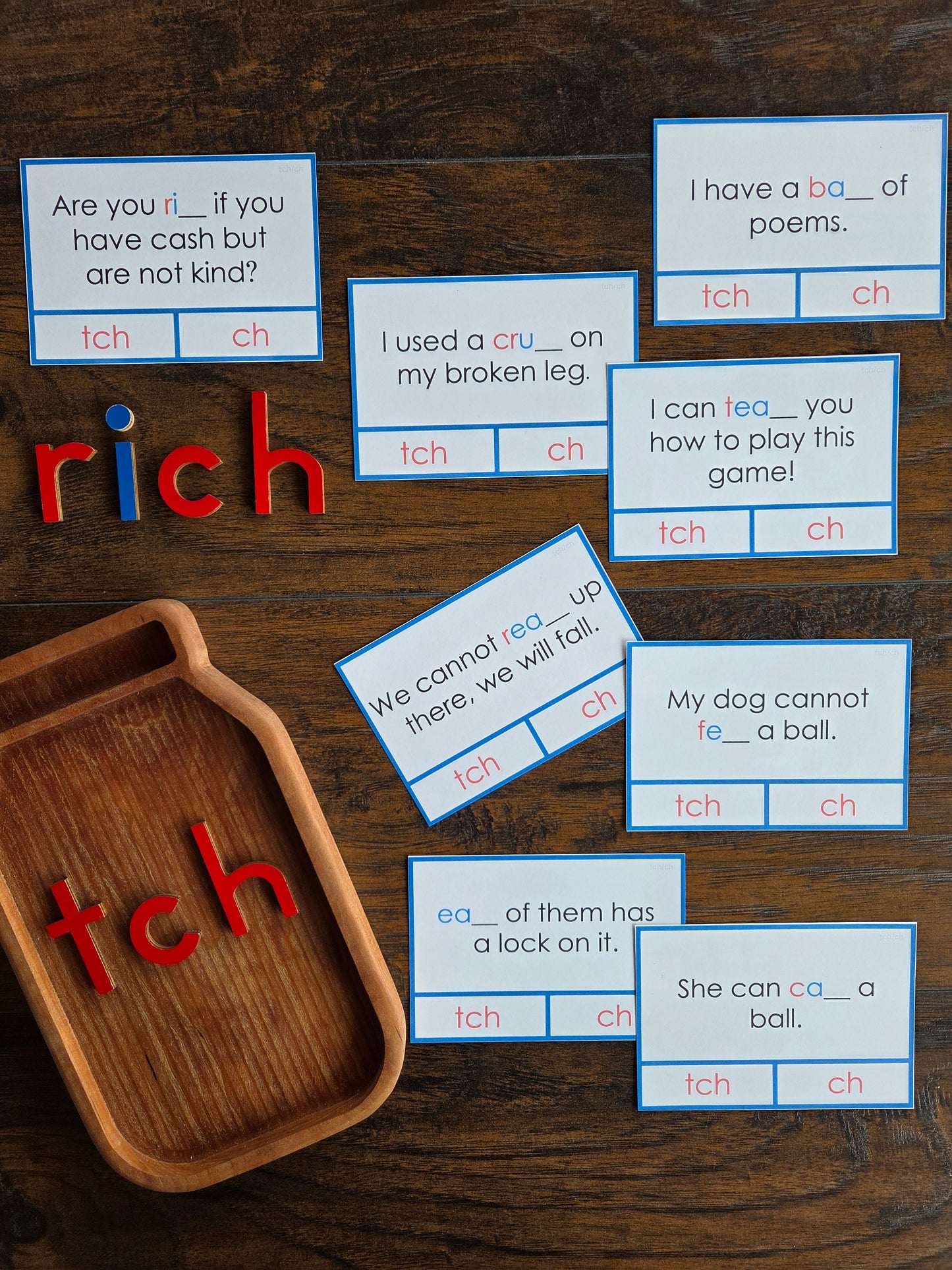
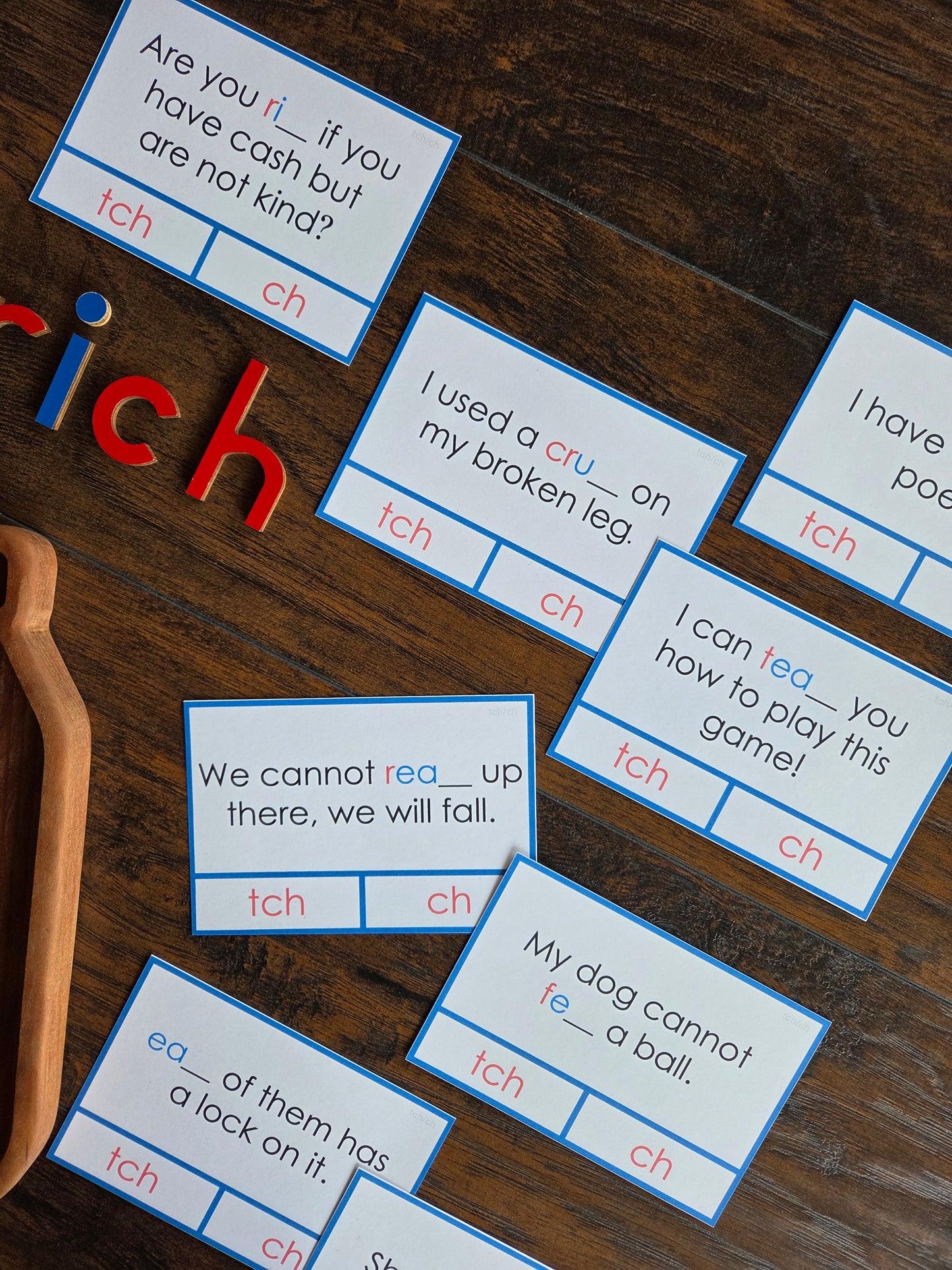
These hands-on TCH vs CH Spelling Clip Cards help children notice and apply an important English spelling generalisation: tch is usually used after a short vowel in a one-syllable word.
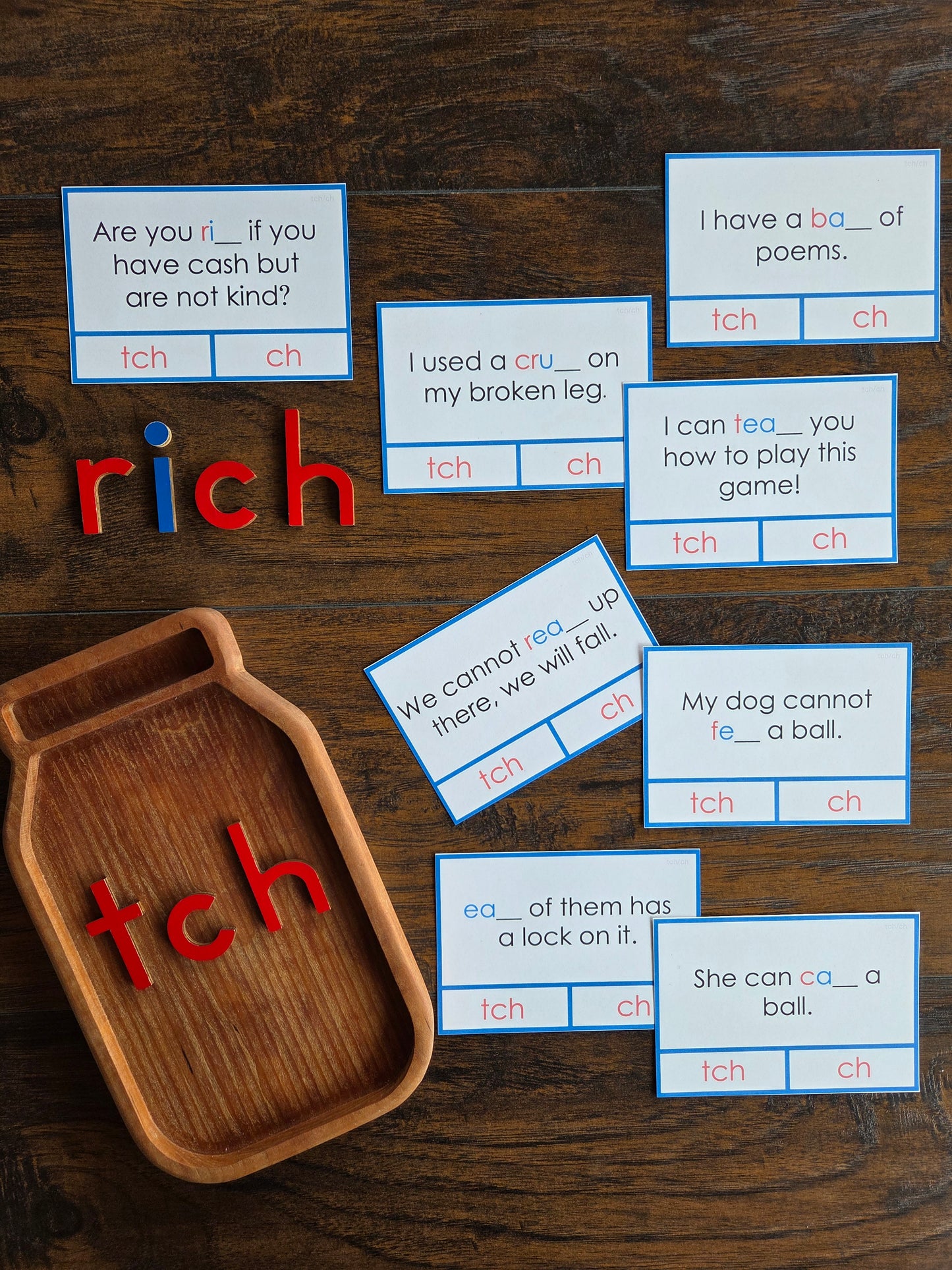
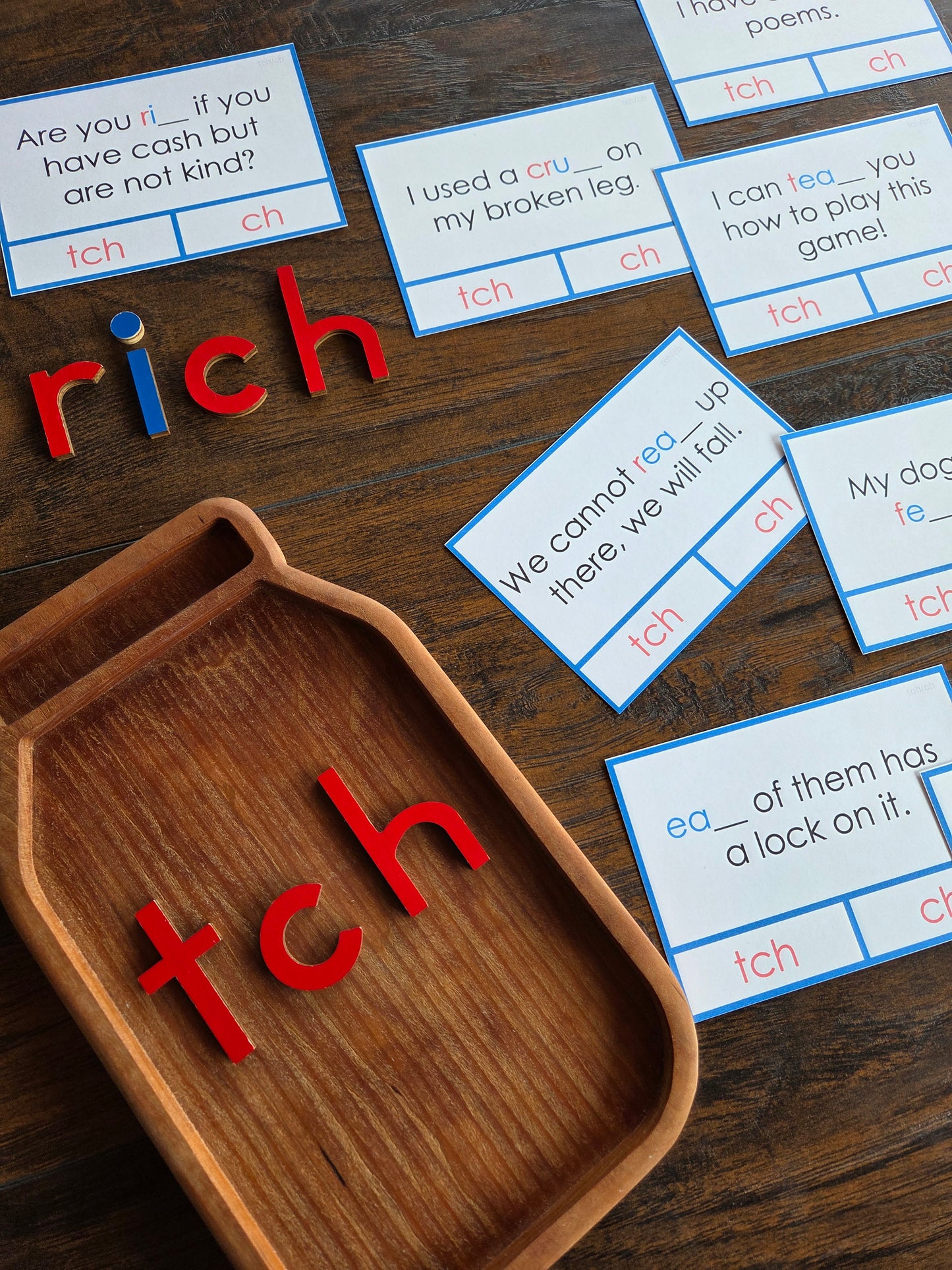
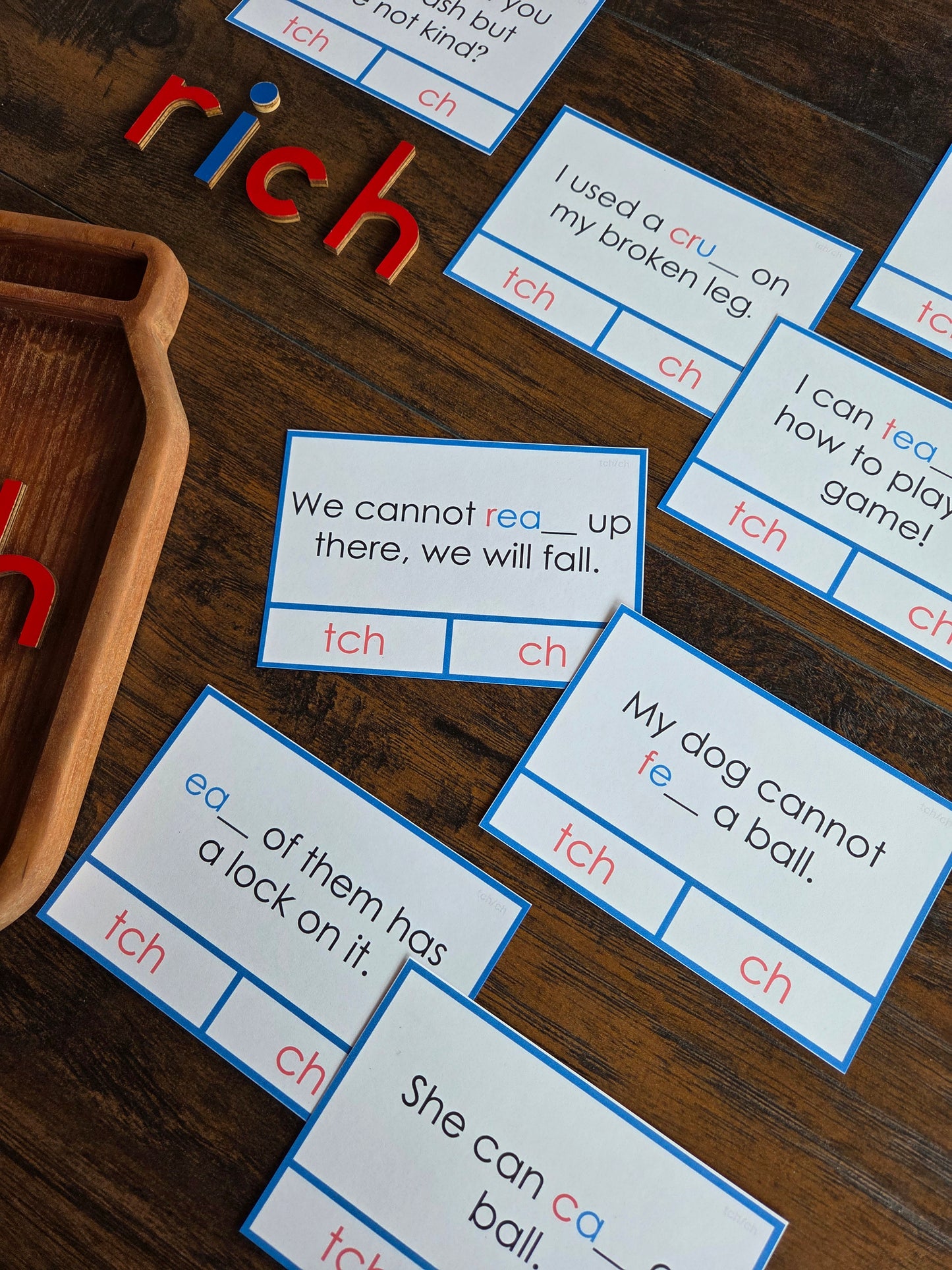
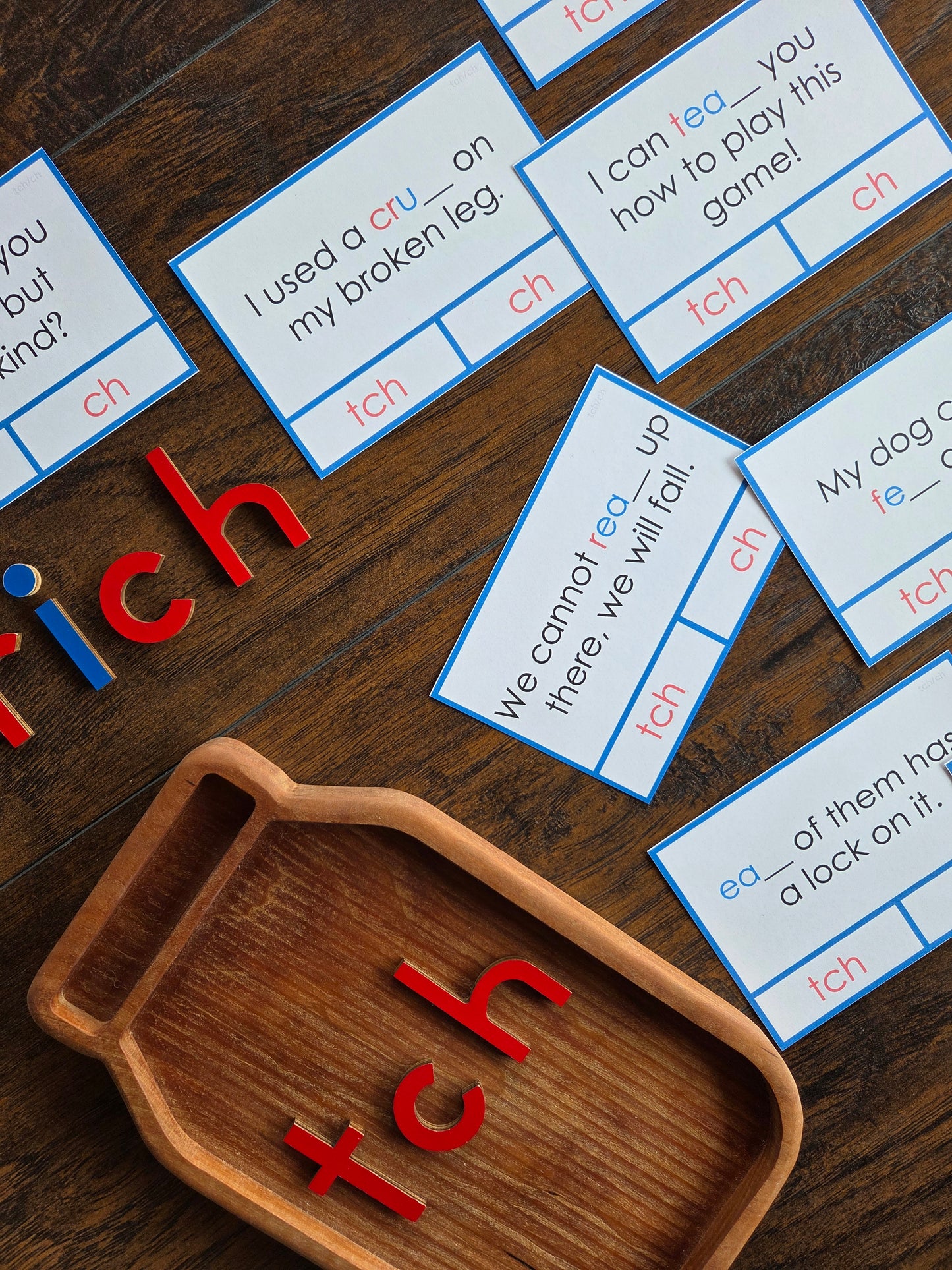
Children read a sentence with a missing word, consider whether the word should end in ch or tch, clip their answer with a peg and then flip the card over to check their work independently.
Designed for Montessori classrooms, Science of Reading-aligned phonics instruction, structured literacy, spelling intervention and homeschool learning, this resource helps children move beyond guessing and towards making more informed spelling choices.
🌿 At a Glance
✔ 24 double-sided TCH vs CH clip cards
✔ Focuses on when to use ch and when to use tch
✔ Teaches the generalisation that tch is usually used after a short vowel in a one-syllable word
✔ Uses sentence context for meaningful spelling practice
✔ Self-correcting clip-and-flip format
✔ Supports decoding, spelling and orthographic pattern recognition
✔ Ideal for Montessori shelf work, literacy centres, intervention and homeschool phonics
📚 What's Included?
This printable spelling resource includes:
- 24 double-sided phonics clip cards
- Practice distinguishing ch and tch
- Sentence-level cloze activities
- Self-checking answers on the reverse
- A peg-based clip-and-flip format
Children read each sentence, decide which spelling completes the missing word and clip their answer.
They can then flip the card over to check their work independently.
Why Are CH and TCH So Tricky?
A child may clearly hear the final /ch/ sound in a word and still not know how to spell it.
They may reasonably ask:
- Should I use ch?
- Should I use tch?
- How can I tell the difference?
This is where explicit spelling instruction helps.
In many one-syllable words, tch is used after a short vowel.
For example:
- catch
- fetch
- pitch
- hutch
Learning this pattern gives children a more useful strategy than simply trying to remember how each individual word looks.
From Hearing the Sound to Choosing the Spelling
This activity encourages children to work through a clear process:
hear the final /ch/ sound → identify the vowel → notice whether it is short → decide between ch and tch → check independently.
That helps children connect:
- Phonemic awareness
- Decoding
- Encoding
- Spelling patterns
- Sentence meaning
Why Use Sentence-Level Cloze Practice?
Reading and spelling words in isolation can be useful—but children also need opportunities to apply patterns in meaningful context.
The cloze format asks the child to:
- Read the sentence
- Decode the possible answers
- Consider the vowel sound
- Apply the ch/tch pattern
- Check whether the word makes sense in the sentence
This brings together phonics, spelling and comprehension in one focused activity.
What Skills Does This Resource Support?
Children will practise:
- Distinguishing ch and tch
- Short-vowel awareness
- Final consonant spelling patterns
- Decoding
- Encoding
- Orthographic pattern recognition
- Sentence-level reading
- Using context clues
- Independent self-correction
Help Children Move Beyond Guessing
Without an understanding of spelling patterns, children may rely on memory alone or simply guess whether a word ends in ch or tch.
This activity gives them a more useful question to ask:
Is this a one-syllable word with a short vowel before the final /ch/ sound?
That does not eliminate every exception in English, but it gives children a reliable generalisation they can apply to many words.
Why the Clip-and-Flip Format Works Well
The format is simple and purposeful.
Children:
- Read the sentence.
- Consider the spelling choices.
- Clip the answer.
- Flip the card over.
- Check independently.
This means children receive immediate feedback without waiting for an adult to correct every response.
It also fits naturally with Montessori practice, where children are encouraged to work independently with materials that include a clear control of error.
🌿 Perfect For
- Montessori language shelves
- Science of Reading-aligned spelling instruction
- Structured literacy lessons
- CH vs TCH spelling practice
- Literacy centres
- Small-group instruction
- Spelling intervention
- Independent shelf work
- Morning work
- Homeschool phonics lessons
Turn a Tricky Spelling Choice Into a Pattern Children Can Understand
The final /ch/ sound does not have to feel random.
These cards help children slow down, notice the short vowel and use that information to make a more informed spelling choice.
The progression is clear:
hear the sound → notice the vowel → apply the pattern → choose ch or tch → self-check.
That makes the activity a useful bridge between basic phonics and more advanced spelling knowledge.
🔗 Related Resources
Continue building children's understanding of English spelling patterns with these related Montessori and Science of Reading resources:
🌿 DGE vs GE Phonics Clip Cards
Help children decide whether the final /j/ sound should be spelled with dge or ge.
Explore the DGE vs GE Clip Cards →
🌿 C, K or CK Spelling Rule Posters
Give children a clear visual reference for deciding whether the /k/ sound is represented by c, k or ck.
Explore the C, K or CK Posters →
🌿 FLOSS Rule Spelling Sort
Help children recognise when final f, l, s and z are doubled after a short vowel in a one-syllable word.
Explore the FLOSS Spelling Sort →
🌿 Soft C & Soft G Clip Cards
Help children apply soft c and soft g patterns before e, i and y within meaningful cloze sentences.
Explore the Soft C & G Clip Cards →
🌿 Modern Montessori Reading Collection
Explore hands-on resources for phonological awareness, phonics, spelling patterns, decoding, sentence reading and comprehension.
Explore the Modern Montessori Reading Collection →
🌿 Modern Montessori Science of Reading Bundle
Looking for a broader literacy sequence? Explore Montessori-aligned resources covering CVC words, digraphs, silent e, vowel teams, spelling generalisations, syllables, decoding and comprehension.
Created by Lisa, a Montessori-trained teacher, NZ registered teacher, school principal and former homeschooler. My resources are designed with real learners in mind—including neurodivergent children—and focus on practical, affordable, low-prep materials that support independence.
Share
-
Items are secured / Terms of Use
Our items are secured. They are not able to be altered. We secure our items because they are our intellectual property and because we use art from artists who require that we secure our files.
You may not:
-resell our items or use them for commercial gain
-claim these items as your own
-modify this resource
-share them with others by any means e.g. electronic or hard copy
-
All Items are instant downloads
You will not get a printed product in the mail.
-
All prices are in USD
Due to the international nature of our customers our prices are all in USD. If you wish to work out the conversion before you buy we recommend www.xe.com