


montessorikiwi
Montessori Plate Tectonics Activities for Cosmic Education (Ages 6–12) (geography) (science)
Montessori Plate Tectonics Activities for Cosmic Education (Ages 6–12) (geography) (science)
Couldn't load pickup availability
You have presented the formation of the Earth—but what meaningful work comes next?
Plate tectonics should be one of the most fascinating parts of elementary Earth science.
It explains why mountains rise, volcanoes erupt, earthquakes shake the ground, islands form and entire continents slowly move.
Yet it can easily become a lesson filled with difficult vocabulary, disconnected diagrams and worksheets that children complete without truly understanding the bigger picture.
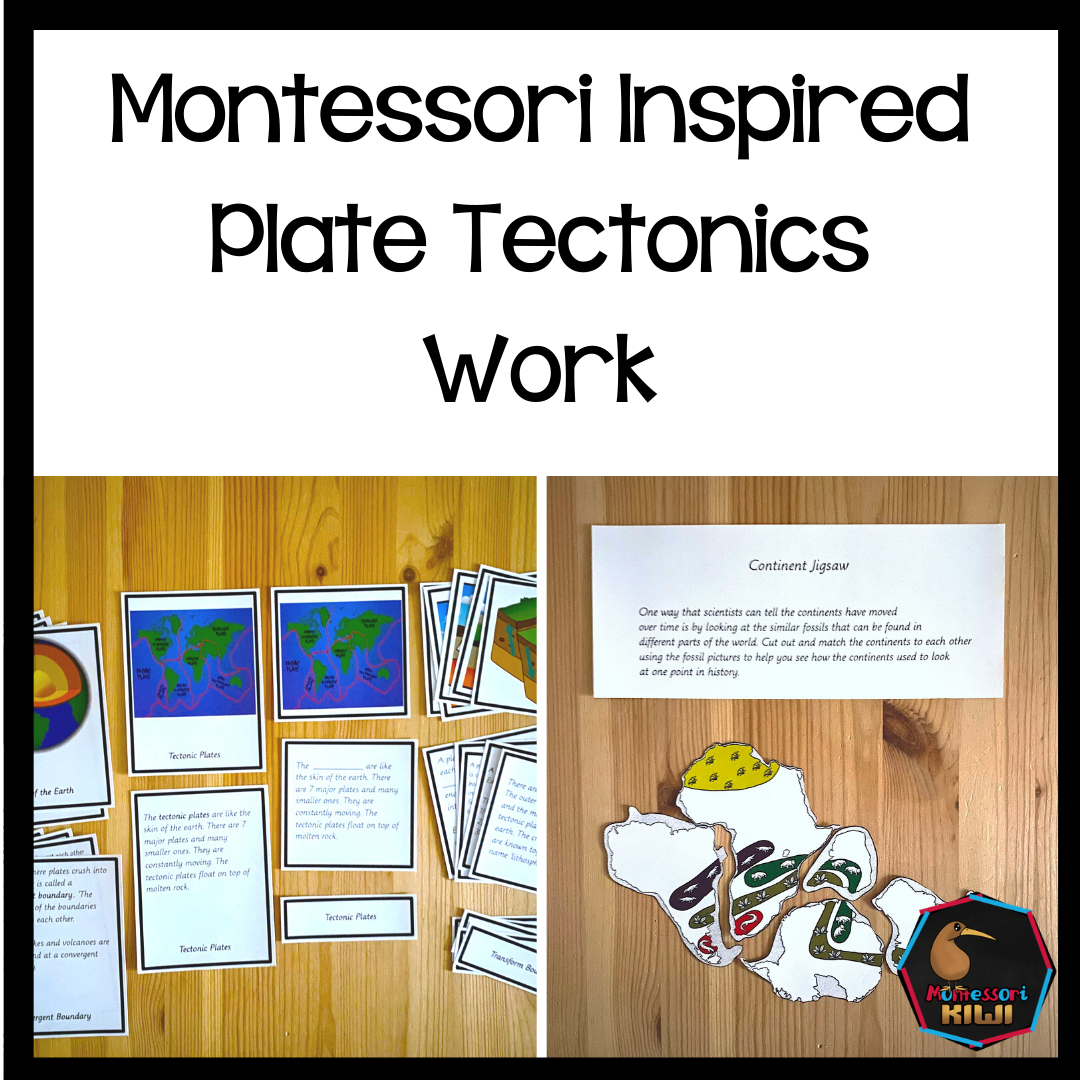
This Montessori Plate Tectonics Unit helps children explore the dynamic Earth through reading, mapping, matching, research, discussion and hands-on follow-up work.
Instead of memorising isolated definitions, children investigate one powerful central idea:
The surface of the Earth is always changing.
Designed for children aged approximately 6–12, this resource provides a rich follow-up to the First Great Story and supports both younger elementary learners who need accessible, visual materials and older children who are ready for deeper research.
Use it to turn children's natural curiosity about earthquakes, volcanoes and mountains into purposeful Montessori geography and Cosmic Education work.
🌿 At a Glance
✔ Complete Montessori-inspired plate tectonics unit for ages 6–12
✔ Ideal follow-up to the First Great Story
✔ Beginner and advanced reading passages
✔ Reading-comprehension activities
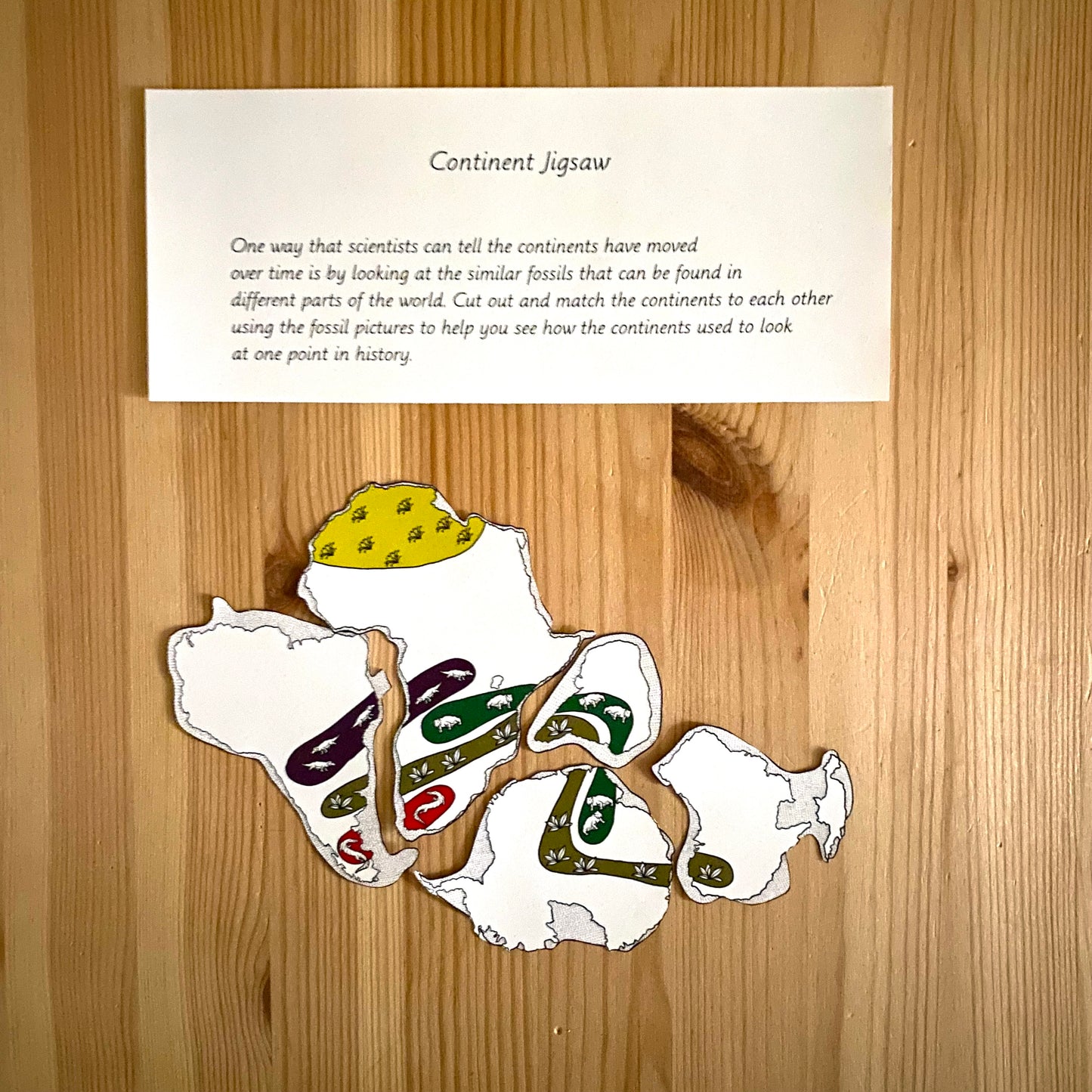
✔ Plate tectonics puzzle work
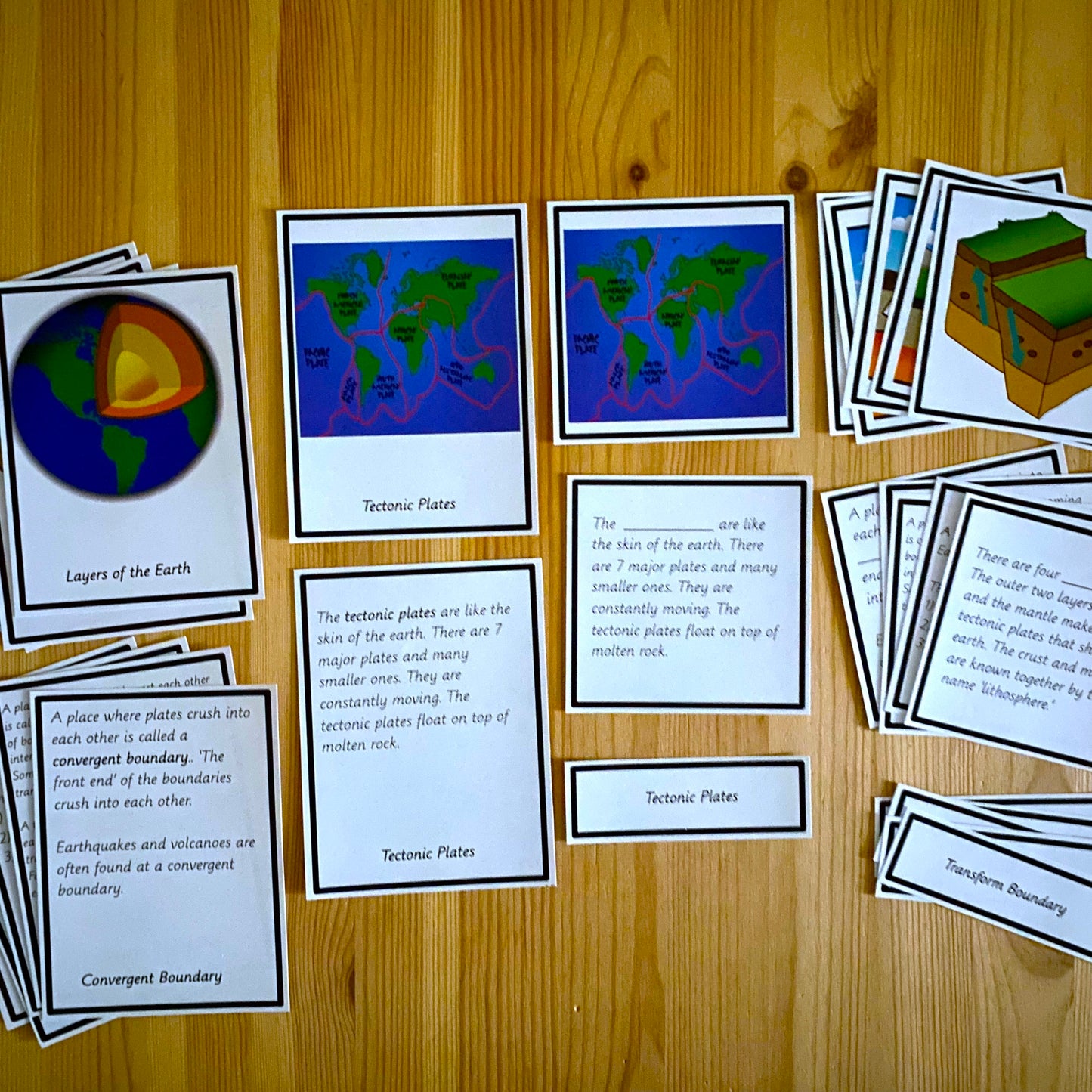
✔ Montessori four-part cards
✔ Research prompts and independent inquiry activities
✔ Studies how tectonic movement creates mountains, ocean basins, volcanoes, islands and earthquakes
✔ Ring of Fire reading, mapping and booklet work
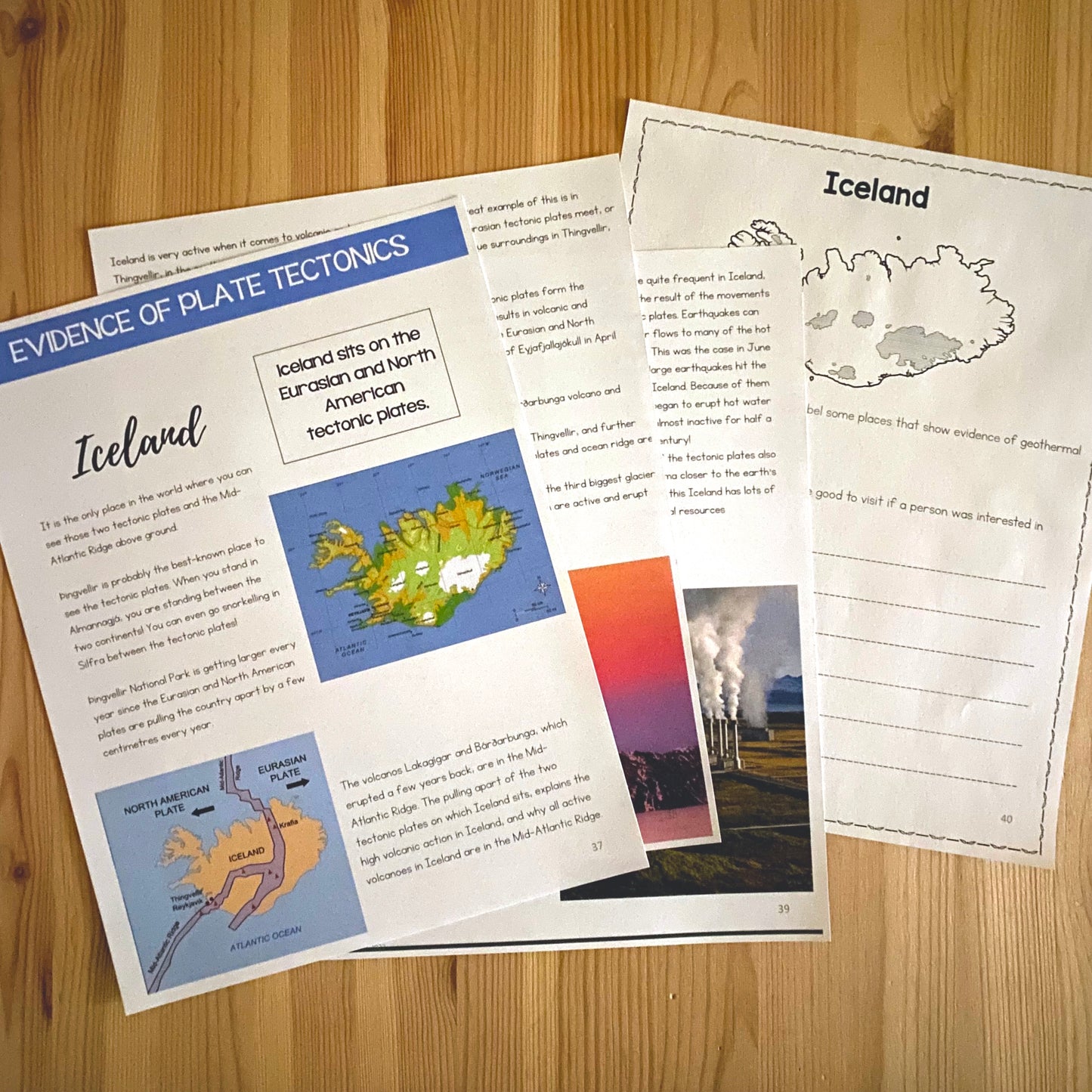
✔ Real-world evidence from New Zealand and Iceland
✔ Includes Indigenous culture connections
✔ Supports individual, partner and collaborative work
✔ Suitable for mixed-age classrooms, homeschool learning and neurodivergent learners
✔ Combines geography, geology, science, literacy and Cosmic Education
✔ Digital download for use in one classroom or homeschool
🌍 Help Children Understand a Living, Changing Earth
Children often see mountains, oceans and continents as fixed parts of the world.
Plate tectonics reveals something far more exciting:
The Earth beneath our feet is moving.
Continents drift. Plates collide. Ocean floors spread. Mountains rise. Volcanoes form. Earthquakes occur.
Once children understand this central idea, many separate Earth science topics begin to connect.
Volcanoes are no longer an isolated unit.
Earthquakes are no longer a list of vocabulary words.
Mountains, islands and ocean basins become evidence of the same enormous processes shaping the planet over time.
📚 What Is Included?
This comprehensive resource brings together reading, vocabulary, mapping, research and hands-on follow-up work.
What Is Plate Tectonics?
- Beginner reading passages
- Advanced reading passages
- Reading-comprehension activities
- Plate tectonics puzzle work
- Montessori four-part cards
- Indigenous culture connections
How Plate Tectonics Shapes the Earth
Children investigate how tectonic movement contributes to the formation of:
- Mountains
- Ocean basins
- Volcanoes
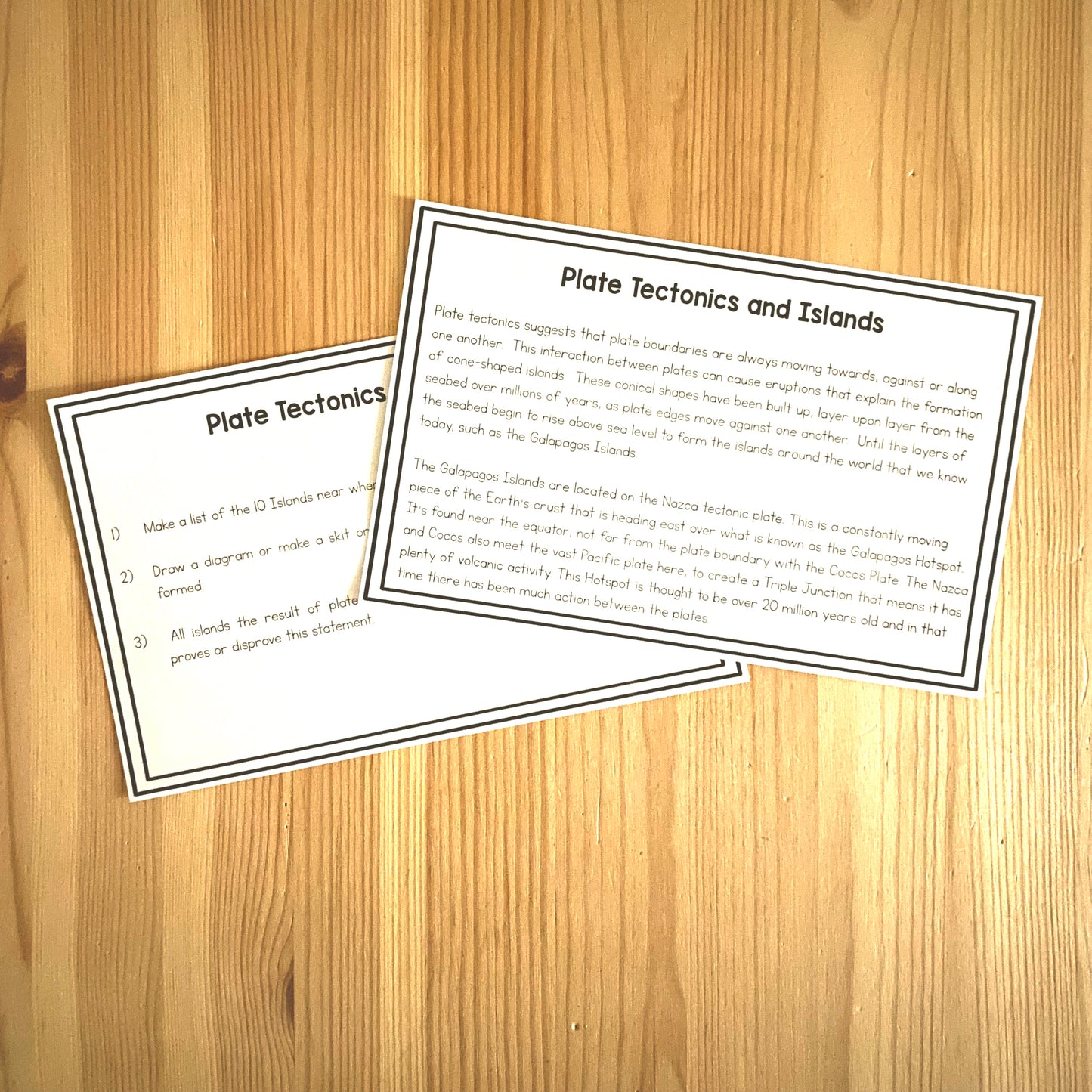
- Islands
- Earthquakes
Each area includes opportunities for follow-up research and independent inquiry.
Ring of Fire Studies
- Ring of Fire reading
- Comprehension work
- Mapping activities
- Cover page and booklet-making work
Evidence for Plate Tectonics
Children explore real-world geographical evidence through case studies connected with:
- New Zealand
- Iceland
These examples help children see that plate tectonics is not simply a diagram in a textbook. It is visible in real landscapes, geological features and communities around the world.
Does Planning Earth Science Feel Fragmented?
You may already have separate lessons about:
- volcanoes
- earthquakes
- mountains
- continents
- the Earth's layers
But without a strong conceptual thread, children can experience these as unrelated topics.
This unit provides that connecting thread.
Children begin with plate movement and then investigate the visible results across the planet.
The learning journey becomes:
understand the moving plates → investigate what happens at their boundaries → connect movement with landforms and natural events → examine real-world evidence → carry out independent research.
Why This Works So Well After the First Great Story
The First Great Story awakens wonder about the formation of the universe and the Earth.
Children hear about forces, particles, heat, cooling, land, water and the long preparation of the planet.
This resource gives them somewhere meaningful to go next.
It allows children to investigate how the Earth continued—and still continues—to change.
Plate tectonics becomes part of the larger Cosmic Education story rather than a disconnected science chapter.
The progression is:
hear the story of Earth's formation → wonder how the planet changes → explore moving plates → investigate mountains, oceans, islands, volcanoes and earthquakes → connect local places with global processes.
From Wonder to Independent Investigation
Elementary children often ask big questions:
- Why do earthquakes happen?
- Why are there so many volcanoes around the Pacific?
- How did mountains form?
- Are the continents still moving?
- Why do some countries experience more earthquakes than others?
This unit gives children enough structure to explore those questions without limiting them to a single worksheet or predetermined answer.
Reading passages establish the foundational knowledge.
Cards and puzzles reinforce vocabulary and relationships.
Maps help children locate patterns geographically.
Research prompts encourage them to follow their curiosity further.
Multiple Entry Points for Mixed-Age Learners
A mixed-age classroom rarely needs every child completing the same work in the same way.
This resource includes beginner and advanced reading so you can offer the same powerful concept at different levels of complexity.
Younger or less confident readers might:
- work with the four-part cards
- complete the puzzle
- read a shorter passage with support
- label a map
- choose one landform to investigate
Older or more independent learners might:
- read the advanced material
- compare plate-boundary processes
- research evidence from New Zealand or Iceland
- investigate the Ring of Fire
- write, present or create a booklet about their findings
This allows children to study a shared topic while working at an appropriate level.
More Than Vocabulary Memorisation
Words such as tectonic plate, mantle, boundary, subduction and continental drift can quickly become abstract.
The aim of this resource is not for children to memorise definitions without understanding them.
Instead, they encounter vocabulary within a meaningful conceptual framework.
The progression becomes:
meet the term → connect it with an image or process → use it while reading → apply it to a map or case study → explain it through research or discussion.
This creates stronger, more useful scientific understanding.
Why Mapping Matters
Maps help children move from an abstract process to visible global patterns.
When children map the Ring of Fire or examine geological activity in different regions, they begin to notice that volcanoes and earthquakes are not randomly scattered.
They can ask:
- Where are earthquakes concentrated?
- Where do chains of volcanoes appear?
- How do these patterns relate to plate boundaries?
- Why are countries such as New Zealand especially geologically active?
This connects physical geography with Earth science and spatial reasoning.
Real-World Evidence From New Zealand and Iceland
Plate tectonics becomes more meaningful when children can connect it with actual places.
The New Zealand and Iceland case studies allow learners to investigate landscapes shaped by active geological processes.
Children can move beyond a generic diagram and begin asking:
- What geological evidence can we see?
- How has plate movement shaped this country?
- How does tectonic activity affect the people living there?
- What similarities and differences exist between the two places?
For New Zealand learners in particular, this gives Earth science immediate local relevance.
Indigenous Knowledge and Cultural Connections
Natural events are not understood only through scientific diagrams.
Communities have observed, interpreted and told stories about the changing Earth for generations.
The included Indigenous culture connections provide opportunities to recognise that geological places and events can hold scientific, historical, cultural and spiritual meaning.
This creates space for children to explore different ways people understand and relate to the land.
Support Reading Across the Curriculum
Science learning often places heavy demands on literacy.
Children need to read unfamiliar vocabulary, extract information, explain cause and effect and organise ideas.
This unit supports literacy through meaningful science content.
Children practise:
- reading informational text
- answering comprehension questions
- identifying key details
- using subject-specific vocabulary
- explaining processes
- carrying out research
- presenting information clearly
Rather than completing generic reading passages, children develop literacy while investigating a genuinely fascinating scientific idea.
Designed for Independence Without Leaving Children Lost
Open-ended research can be exciting for some children and overwhelming for others.
A direction such as “research plate tectonics” may leave a child unsure where to begin, what information matters or how much work is expected.
This unit provides structure through:
- carefully focused reading
- clear topics
- visual materials
- research prompts
- mapping work
- manageable follow-up activities
Children still have choice—but the choice sits inside a prepared pathway.
This can be especially supportive for neurodivergent learners and children who benefit from clear expectations and visual organisation.
How to Use This Resource
As a Follow-Up to a Key Lesson
Present a short lesson about Earth's plates, then place selected cards, passages and mapping work on the shelf for follow-up.
As a Multiweek Earth Science Unit
Move gradually through:
- What plate tectonics is
- How plates move
- How movement shapes land and oceans
- Volcanoes and earthquakes
- The Ring of Fire
- Evidence from New Zealand and Iceland
- Independent research
As Independent Research Work
Allow children to choose one topic—such as volcanoes, islands, mountains or earthquakes—and use the included prompts to guide their investigation.
As Collaborative Work
Small groups can investigate different tectonic processes or regions and then teach one another what they discovered.
For Homeschool Learning
Use the reading and cards for direct teaching, then choose mapping, model-making, research or booklet work according to your child's interests.
Possible Hands-On Extensions
Extend the printable work through activities such as:
- modelling convergent, divergent and transform boundaries
- creating a layered model of the Earth
- building a clay or salt-dough tectonic map
- mapping recent earthquakes or volcanic eruptions
- comparing the geography of New Zealand and Iceland
- creating a model volcano
- investigating local geological features
- making a plate tectonics research booklet
These extensions help children move from reading about a process to representing, testing and explaining it.
What Children Can Learn
This resource supports understanding of:
- tectonic plates
- the changing surface of the Earth
- plate movement
- mountain formation
- ocean-basin formation
- volcanoes
- earthquakes
- island formation
- the Ring of Fire
- geographical patterns
- evidence for plate tectonics
- the geology of New Zealand and Iceland
- connections between science, geography and culture
Skills Supported
Children practise:
- informational reading
- reading comprehension
- scientific vocabulary
- map reading
- research
- classification
- cause-and-effect reasoning
- comparison
- independent learning
- questioning and inquiry
- oral and written communication
🌿 Perfect For
- Montessori elementary classrooms
- Children aged approximately 6–12
- Lower and upper elementary learners
- First Great Story follow-up
- Cosmic Education
- Earth science units
- Physical geography
- Plate tectonics studies
- Volcano and earthquake units
- Geography shelves
- Independent research
- Mixed-age classrooms
- Homeschool learning
- Neurodivergent learners who benefit from structured visual work
Give Children More Than Another Volcano Worksheet
Volcanoes and earthquakes naturally capture children's attention.
This unit helps you take that initial excitement somewhere deeper.
The learning progression is:
wonder about the changing Earth → understand moving tectonic plates → investigate how movement shapes the planet → locate global patterns → examine real-world evidence → follow individual questions through research.
Children come away with more than isolated facts.
They begin to understand that mountains, islands, oceans, volcanoes and earthquakes are all part of the continuing story of a living, changing planet.
🔗 Continue the Learning
Build a deeper Earth science and Cosmic Education study with these related MontessoriKiwi resources:
🌋 Volcano Vocabulary Posters
Introduce and reinforce the language children need to describe volcanoes, eruptions and volcanic processes.
Explore the Volcano Vocabulary Posters →
🗺️ Major Volcanic Eruptions Map
Help children connect volcanic activity with real places through hands-on Montessori map work.
Explore the Major Volcanic Eruptions Map →
🌎 Earthquake Vocabulary Posters
Support clear understanding of earthquake processes and important Earth science terminology.
Explore the Earthquake Vocabulary Posters →
✨ Cosmic Education Collection
Find Great Story follow-up work, Earth science, history, geography and research resources for ages 6–12.
Explore the Cosmic Education Collection →
🔬 Montessori Science Collection
Explore hands-on materials for geology, biology, chemistry, physics and wider scientific inquiry.
📥 Digital Download
✔ Instant digital access after purchase
✔ No physical item will be shipped
✔ Print at home or school
✔ Lifetime access to your purchased files
✔ Licensed for use in one classroom or homeschool
Created by Lisa, a Montessori-trained teacher, NZ registered teacher, school principal and former homeschooler. My resources are tested with real learners—including neurodivergent children—and designed to provide practical, affordable and low-prep materials that support curiosity, independence and meaningful learning.
Share
-
Items are secured / Terms of Use
Our items are secured. They are not able to be altered. We secure our items because they are our intellectual property and because we use art from artists who require that we secure our files.
You may not:
-resell our items or use them for commercial gain
-claim these items as your own
-modify this resource
-share them with others by any means e.g. electronic or hard copy
-
All Items are instant downloads
You will not get a printed product in the mail.
-
All prices are in USD
Due to the international nature of our customers our prices are all in USD. If you wish to work out the conversion before you buy we recommend www.xe.com