montessorikiwi
Major Volcanic Eruptions Map | Hands-On Montessori Geography Activity
Major Volcanic Eruptions Map | Hands-On Montessori Geography Activity
Couldn't load pickup availability
Help Children See That Volcanic Eruptions Form Global Patterns
Children may know the names of individual volcanoes, but that does not always help them understand where volcanic activity occurs around the world or how it connects with plate boundaries.
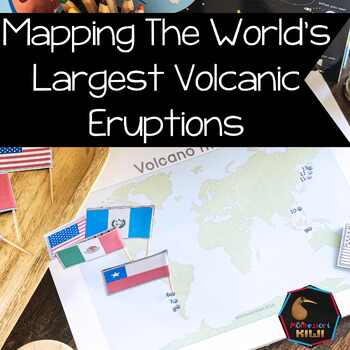
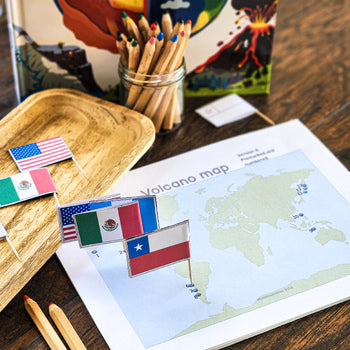
This hands-on Major Volcanic Eruptions Map invites children to locate and mark 13 significant eruptions from around the world using miniature labelled flags.
As children build the three-dimensional map, they move beyond reading disconnected facts. They practise using a world map, locate countries and continents, compare eruption sites and begin noticing geographical patterns in volcanic activity.
At a Glance
Best for: Montessori elementary classrooms, homeschoolers and Earth science units
Age range: Approximately 7–12 years
Topic: Volcanoes, volcanic eruptions, world geography, natural disasters and plate tectonics
Includes: Teacher instructions, completed example, four map options and 13 eruption flags
Printing options: Colour and black-and-white
Use for: Geography shelves, Cosmic Education, independent work, group lessons, revision and substitute-teacher activities
Additional materials needed: Toothpicks plus adhesive tape or reusable putty
From Volcano Facts to Geographical Understanding
It is easy for a volcano study to become a collection of dramatic photographs and isolated facts.
This activity helps children connect those facts to place.
By locating each eruption on a world map, children can begin asking deeper questions:
- Are volcanic eruptions spread evenly around the world?
- Which continents contain several eruption sites?
- Why are many volcanoes located near coastlines?
- How do these locations relate to tectonic plates?
- Which communities may be affected by volcanic activity?
- What patterns can be seen around the Pacific Ocean?
The map creates a concrete starting point for discussion about the Ring of Fire, plate boundaries, changes to the land and the relationship between physical and human geography.
What Is Included?
- Teacher instructions explaining how to prepare and use the activity
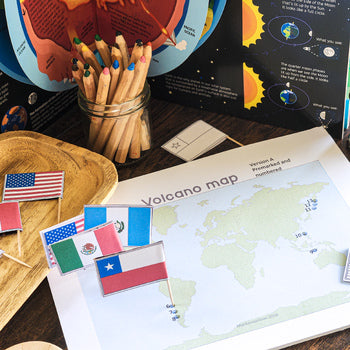
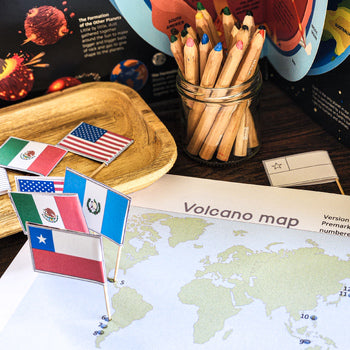
- A photograph of a completed map to support preparation and provide a visual guide
- Four printable world maps with colour and black-and-white options
- Thirteen labelled eruption flags in colour and black-and-white
- Location and year information printed on each flag
The choice of colour or black-and-white pages allows you to select the format that works best for your printing budget and classroom needs.
A Memorable Three-Dimensional Mapping Activity
Instead of simply writing eruption names onto a worksheet, children create small flag markers and position them on the world map.
This gives the work a three-dimensional element that can increase interest and make the completed map suitable for display or further discussion.
To prepare the activity, attach each printed flag to a toothpick using adhesive tape or reusable putty. Children then place the flag at the corresponding location on the map.
You may wish to mount the map on:
- cardboard
- cork
- foam board
- a shallow tray filled with modelling clay
- a classroom display board
Please supervise children appropriately when using toothpicks or substitute another type of safe flagpole where necessary.
How to Use the Volcanic Eruptions Map
- Introduce or review the basic features of volcanoes.
- Show children how to identify continents, oceans and countries on the map.
- Select one eruption flag and read its location and year.
- Find the relevant country or region using an atlas or reference map.
- Place the flag in the approximate location of the eruption.
- Continue until all 13 eruption sites have been mapped.
- Invite children to study the finished map and describe any patterns they notice.
The activity can be presented to a small group and then placed on the geography or science shelf for independent repetition.
Extend the Learning
After completing the map, children could:
- identify the continent and country for each eruption
- research one of the featured eruptions
- compare the dates of the eruptions
- label the Pacific Ring of Fire
- overlay or compare the map with a tectonic plate map
- investigate the effect of an eruption on nearby communities
- compare shield, composite and cinder cone volcanoes
- explore the difference between active, dormant and extinct volcanoes
- add more recent or locally significant eruptions
- compare the eruption map with an earthquake map
Older learners can use the activity as the starting point for research into eruption size, volcano type, casualties, evacuation, environmental effects or long-term changes to the landscape.
Useful for Montessori Cosmic Education
Volcanoes provide a natural link between several areas of the Montessori elementary curriculum.
This activity can be used after the First Great Story or as part of studies involving:
- the formation and structure of the Earth
- plate tectonics
- rapid changes to the land
- physical geography
- countries and continents
- natural hazards
- human adaptation and Fundamental Needs
The map is simple enough to use as a focused standalone activity, while still opening the door to substantial scientific and geographical inquiry.
Build a Deeper Volcano and Plate Tectonics Study
- Montessori Plate Tectonics Activities – explore plate movement, volcanoes, earthquakes, mountain formation, ocean basins and the Ring of Fire
- ```
- Volcanoes of the World Matching Cards – research named volcanoes through pictures, labels, facts, locations and eruption information
- Volcano Vocabulary and Definition Cards – explicitly teach terms including magma chamber, vent, lava, plate boundary and volcano types
- Earthquake Matching and Vocabulary Cards – extend the study into earthquakes, faults, epicentres, aftershocks and seismic measurement
- Browse Montessori Geography Resources – find further map work, cultural geography and Earth science activities
- Browse Montessori Science Resources
- ```
Teaching a Volcano Unit?
Read Volcanoes of the World: Studying Locations and Famous Volcanoes for ideas about connecting volcano studies with countries, flags, measurement, plate tectonics and the Fundamental Needs of Humans.
You can also read Earthquakes and Volcanoes for vocabulary ideas and ways to connect Earth science with real events and geographical inquiry.
Created for Real Montessori Learners
I am a Montessori-trained teacher, New Zealand registered teacher, school principal and former homeschooler.
I create practical resources from real experience teaching mixed-age learners, including neurodivergent children and children with varied reading, writing and attention needs.
My materials are designed to help children see connections across the curriculum while reducing the preparation required from busy teachers and homeschool families.
Important Information
- This is an instant digital download.
- No physical map, flags or toothpicks will be mailed.
- You will need toothpicks and tape or reusable putty to assemble the flags.
- The secured file is intended for use in one classroom or homeschool.
- The locations marked on the map are approximate and are intended for elementary geographical study.
Share
-
Items are secured / Terms of Use
Our items are secured. They are not able to be altered. We secure our items because they are our intellectual property and because we use art from artists who require that we secure our files.
You may not:
-resell our items or use them for commercial gain
-claim these items as your own
-modify this resource
-share them with others by any means e.g. electronic or hard copy
-
All Items are instant downloads
You will not get a printed product in the mail.
-
All prices are in USD
Due to the international nature of our customers our prices are all in USD. If you wish to work out the conversion before you buy we recommend www.xe.com