
montessorikiwi
Rhyming Words Posters | Montessori Science of Reading & Phonological Awareness
Rhyming Words Posters | Montessori Science of Reading & Phonological Awareness
Couldn't load pickup availability
Can your child hear when two words rhyme—or do they still need more opportunities to listen closely to the sounds at the ends of words?
Rhyming may seem simple, but it plays an important role in helping children notice that spoken words can share sound patterns.
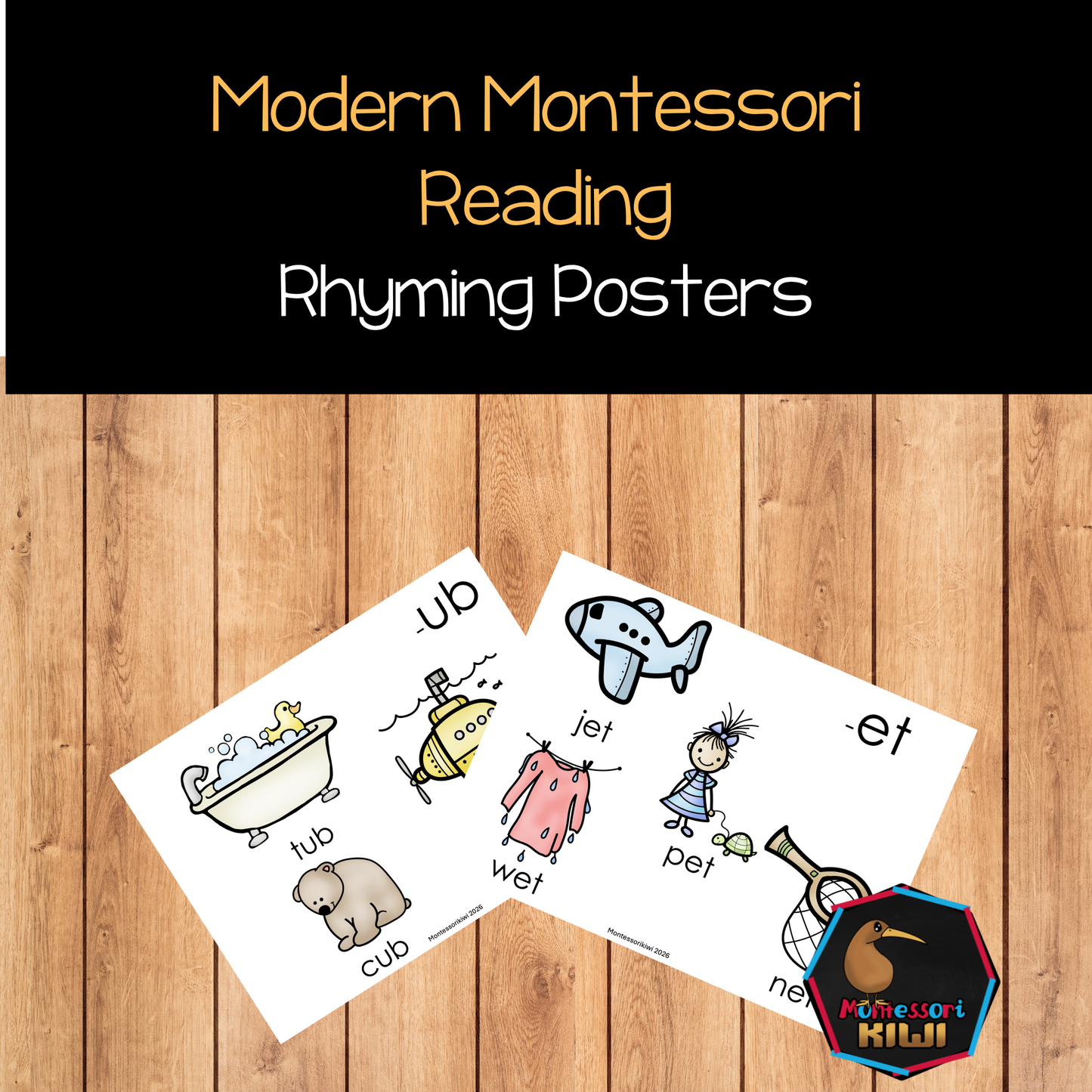
These Rhyming Words Posters provide a clear, visual way to introduce, model and practise rhyme with young learners.
Children can say the rhyming words aloud, listen for the shared ending sound, think of additional rhyming words and even play listening games by identifying the word that does not belong.
Designed for Montessori classrooms, Science of Reading-aligned early literacy, phonological awareness lessons, homeschool learning and small-group instruction, these posters make rhyming practice simple, flexible and easy to revisit.
🌿 At a Glance
✔ Printable rhyming words posters
✔ Supports early phonological awareness
✔ Child-friendly rhyming word prompts
✔ Encourages children to listen for shared ending sounds
✔ Can be used for modelling, discussion and independent review
✔ Easily extended into rhyme-generation and odd-one-out games
✔ Low-prep and ready to print
✔ Ideal for Montessori classrooms, preschool, kindergarten, early primary and homeschool learning
📚 What's Included?
This printable rhyming resource includes:
- Child-friendly rhyming word prompts
- Visual support for introducing and revisiting rhyme
- Flexible material suitable for whole-class, small-group or one-to-one use
- Opportunities to extend learning through oral language and listening games
The posters can be introduced during a phonological awareness lesson and then displayed or added to the Montessori language area for children to revisit.
Why Is Rhyming Important?
Before children can confidently work with letters and written words, they need opportunities to notice and manipulate the sounds in spoken language.
Rhyming helps children hear that words can share the same ending sound even when the beginning sound changes.
For example:
- cat and hat
- log and dog
- sun and fun
This kind of listening work supports broader phonological awareness and prepares children for later work with:
- Onset and rime
- Word families
- Phoneme awareness
- Decoding
- Spelling patterns
Some Children Pick Up Rhyme Naturally. Others Need Explicit Practice.
Some children quickly notice rhyme through nursery rhymes, songs and stories.
Others may know the names of the pictures and enjoy listening to language but still find it genuinely difficult to hear that two words share the same ending sound.
That is where explicit practice can help.
These posters give children a clear visual reference while encouraging them to say the words aloud and listen carefully.
The aim is not simply to memorise rhyming pairs. It is to help children become more aware of the sound structure of spoken language.
How to Use the Posters
There are many ways to use these rhyming posters depending on the child or group.
You might:
- Say each pair of rhyming words aloud together
- Ask the child what they notice about the ending sounds
- Invite the child to think of another word that rhymes
- Mix in a word that does not rhyme and ask the child to find the odd one out
- Use the posters as a quick oral-language warm-up
- Display them in the classroom as a visual reference
- Use them alongside rhyming books, songs and nursery rhymes
Build Listening Skills Before Adding More Print
If a child is struggling with rhyme, more written work is not always the answer.
Sometimes the most helpful next step is to go back to:
- Oral language
- Songs
- Nursery rhymes
- Movement
- Listening games
- Repeated opportunities to say words aloud
These posters can support that process by providing a simple visual focus while keeping the activity centred on listening and speaking.
What Skills Does This Resource Support?
Children can practise:
- Recognising rhyming words
- Phonological awareness
- Listening discrimination
- Oral language
- Vocabulary development
- Generating additional rhymes
- Identifying words that do not belong
- Building confidence with spoken sound patterns
🌿 Perfect For
- Montessori language shelves
- Preschool literacy
- Kindergarten phonological awareness
- Science of Reading-aligned early literacy
- Morning meeting activities
- Small-group instruction
- One-to-one intervention
- Speech and language support
- Homeschool literacy lessons
- Children who need extra practice hearing rhyme
Simple, Purposeful Practice With Spoken Sounds
Rhyming does not need to be complicated.
Children need repeated opportunities to hear words, say them aloud, compare their sound patterns and notice what is the same.
These posters give you a simple way to make that practice visible and easy to revisit.
Use them as a starting point for conversation, songs, games and playful oral-language work that helps children become more attentive to the sounds inside spoken words.
🔗 Related Resources
Continue building strong phonological awareness and early reading skills with these related resources:
🌿 Rhyming Clip & Flip Cards
Give children hands-on practice identifying rhyming words using picture prompts and a self-correcting clip-and-flip format.
Explore the Rhyming Clip Cards →
🌿 CVC Sentence Frames
Support children as they move from early phonological awareness and word reading towards simple sentence reading and beginning writing.
Explore the CVC Sentence Frames →
🌿 Modern Montessori Reading Collection
Explore hands-on resources for phonological awareness, phonics, decoding, spelling patterns, sentence reading and comprehension.
Explore the Modern Montessori Reading Collection →
🌿 Modern Montessori Science of Reading Bundle
Looking for a broader literacy sequence? Explore Montessori-aligned resources covering phonological awareness, CVC words, digraphs, silent e, spelling patterns, decoding and reading comprehension.
Created by Lisa, a Montessori-trained teacher, NZ registered teacher, school principal and former homeschooler. My resources are designed with real learners in mind—including neurodivergent children—and focus on practical, affordable, low-prep materials that support independence.
Share
-
Items are secured / Terms of Use
Our items are secured. They are not able to be altered. We secure our items because they are our intellectual property and because we use art from artists who require that we secure our files.
You may not:
-resell our items or use them for commercial gain
-claim these items as your own
-modify this resource
-share them with others by any means e.g. electronic or hard copy
-
All Items are instant downloads
You will not get a printed product in the mail.
-
All prices are in USD
Due to the international nature of our customers our prices are all in USD. If you wish to work out the conversion before you buy we recommend www.xe.com