


montessorikiwi
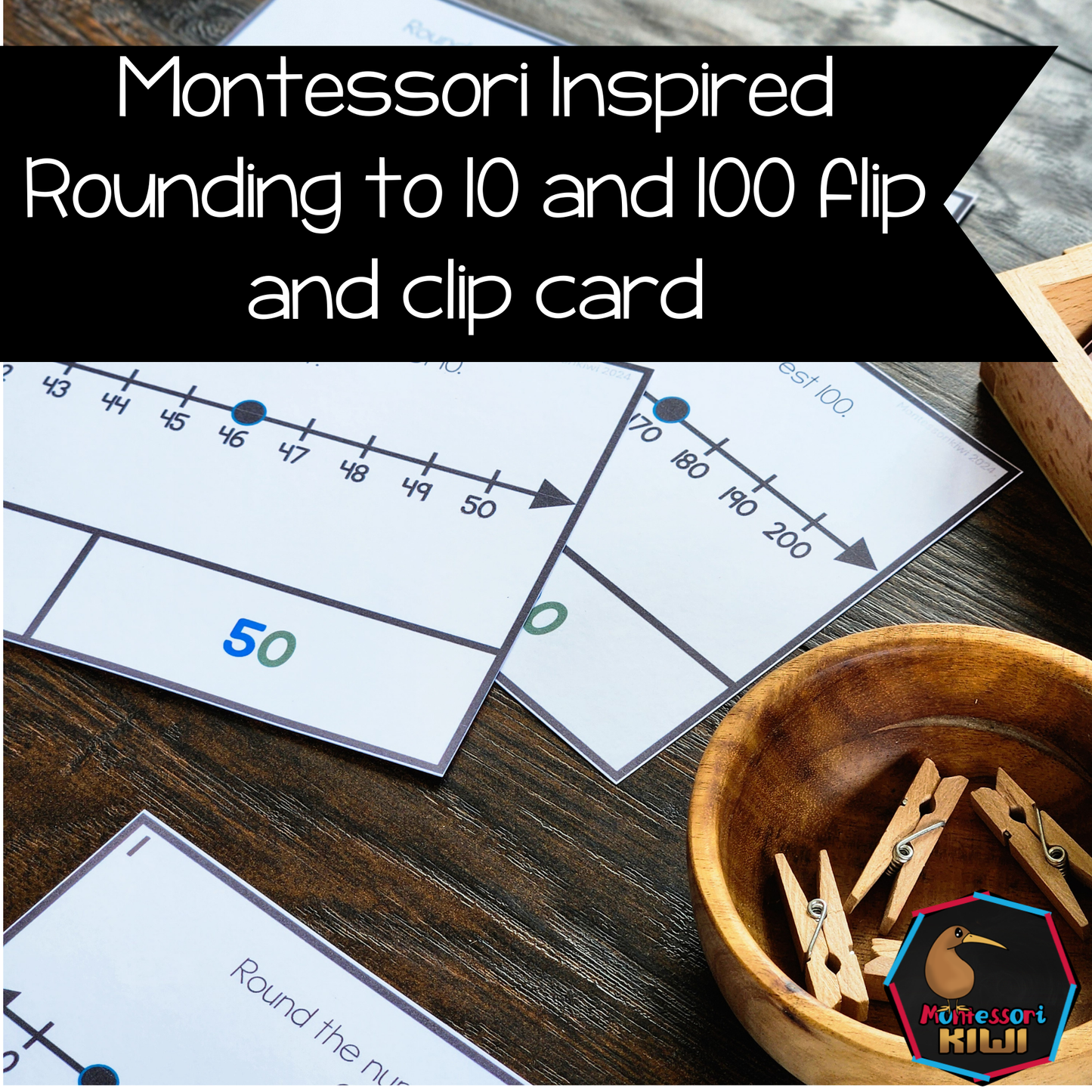
Montessori Inspired Rounding to 10 and 100 flip and clip card
Montessori Inspired Rounding to 10 and 100 flip and clip card
Couldn't load pickup availability
Your child knows the rule “five or more, round up”—but do they understand why a number rounds to one ten or hundred rather than another?
Rounding can easily become a memorised procedure. Children may look only at one digit, repeat a rhyme and produce an answer without understanding the number’s position or which benchmark it is genuinely closest to.
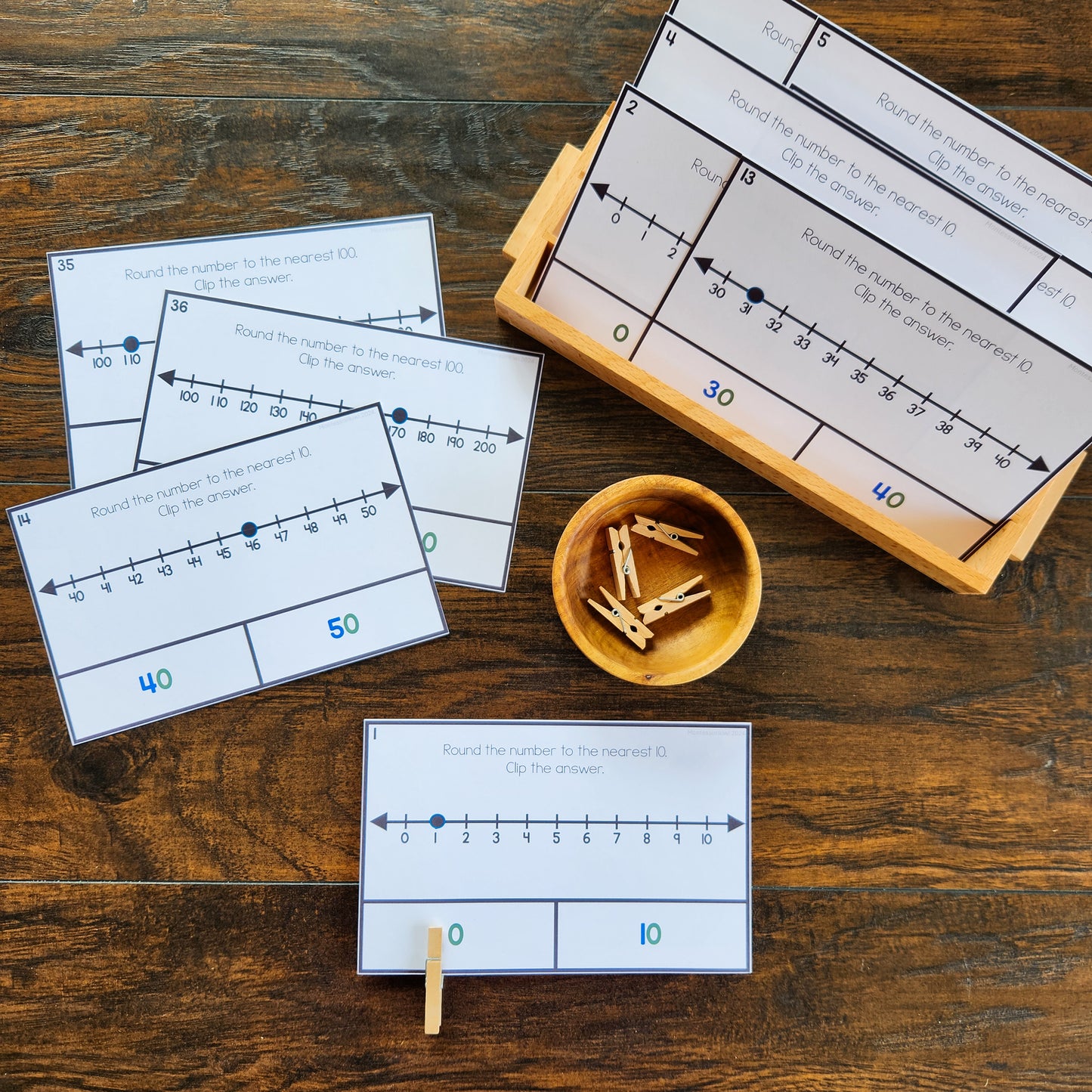
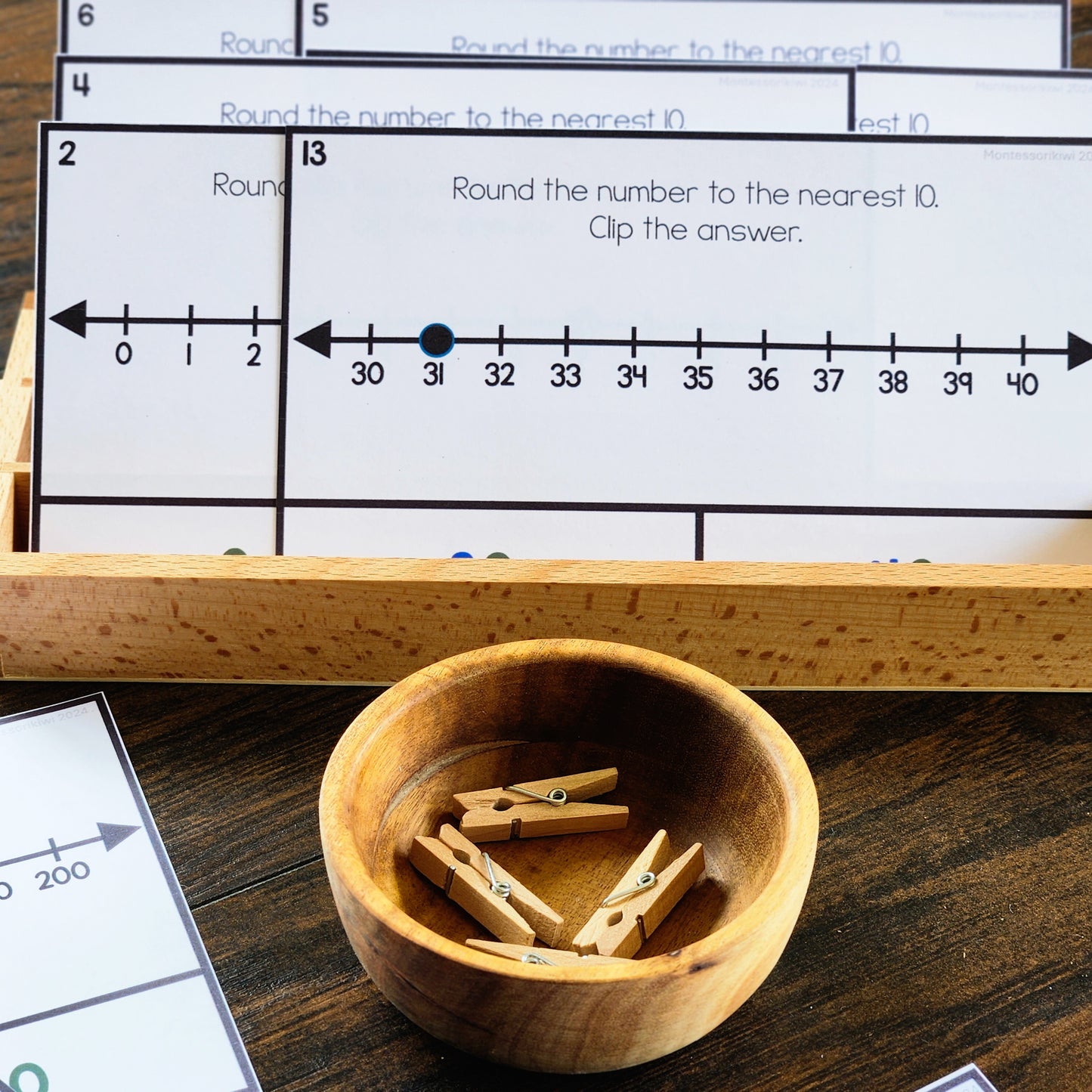
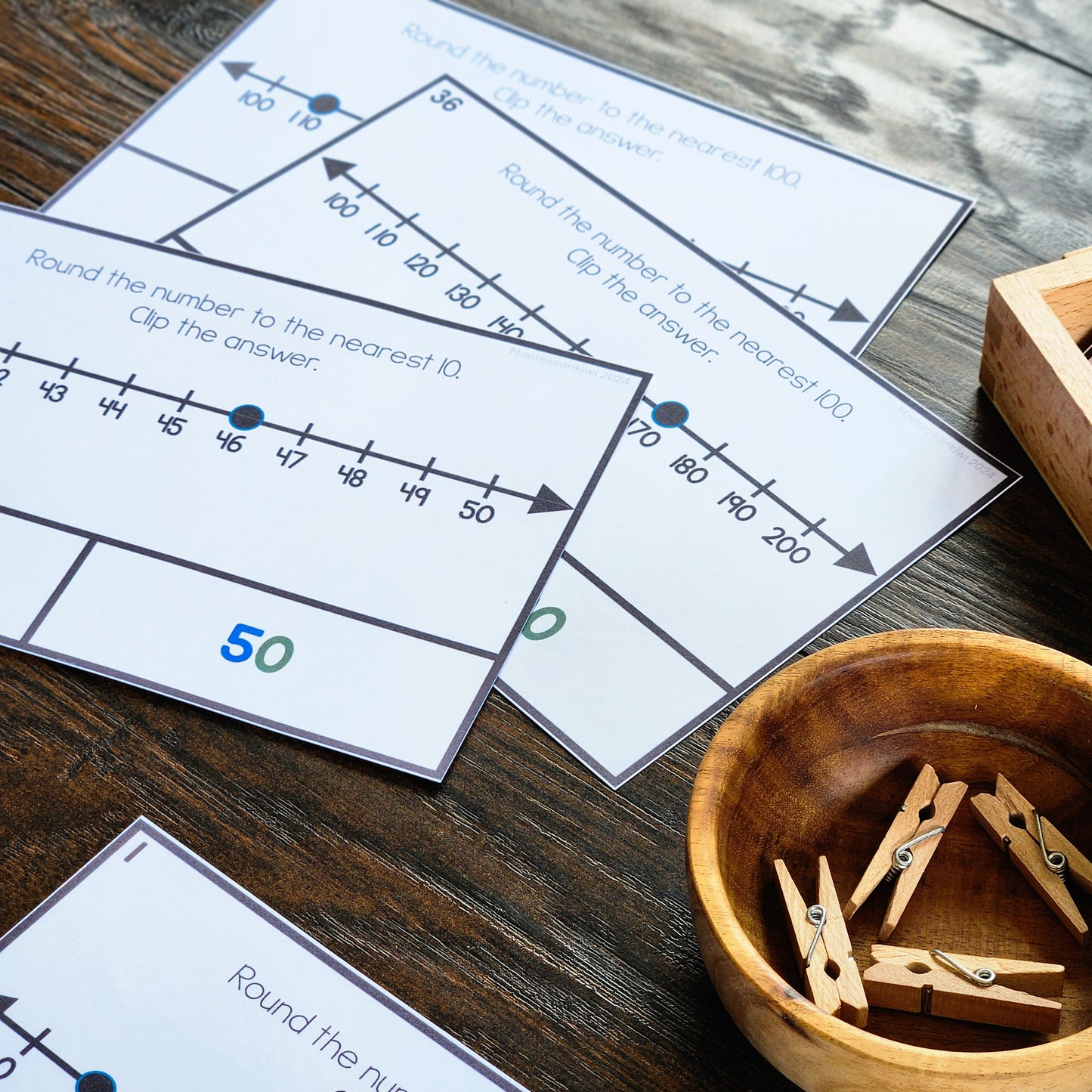
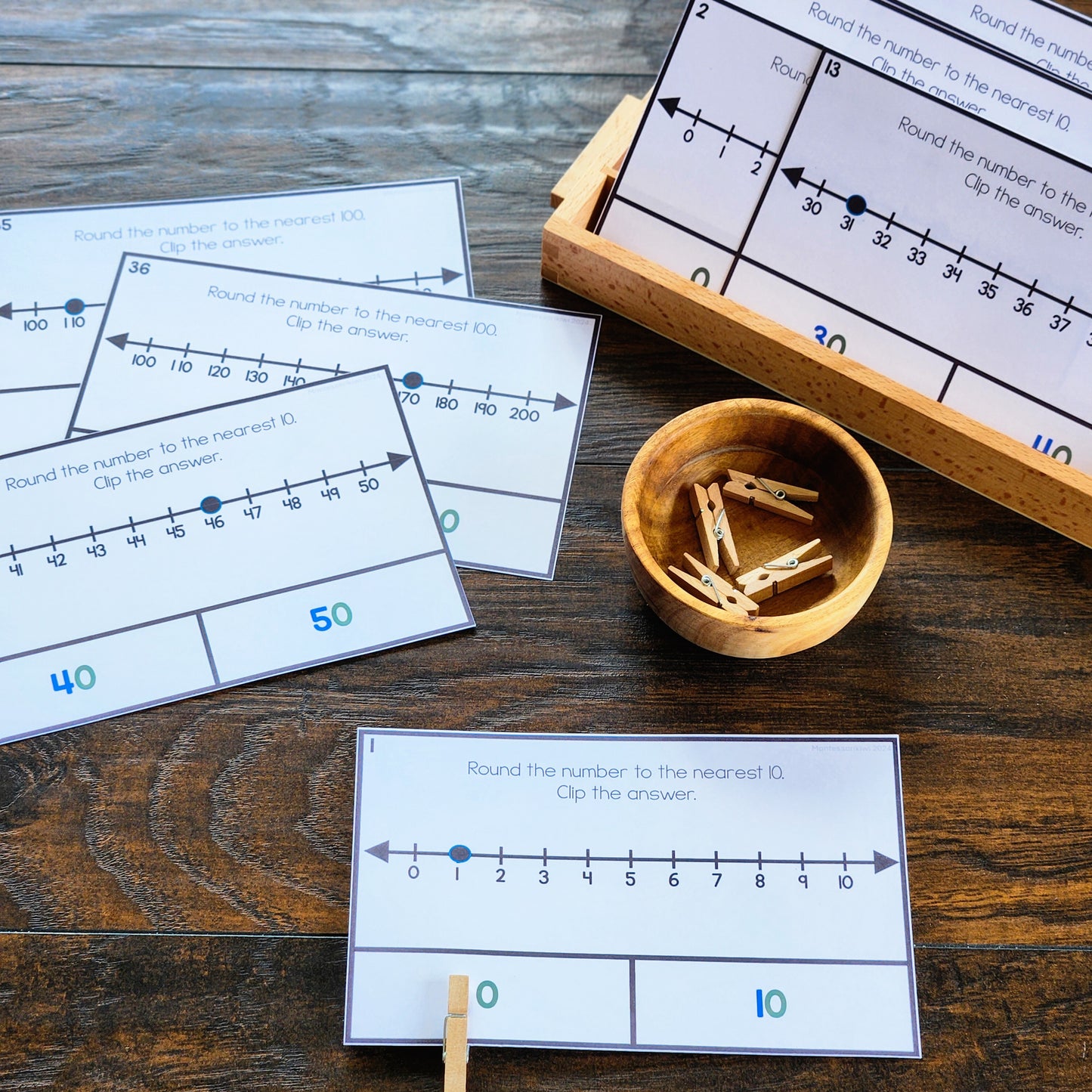
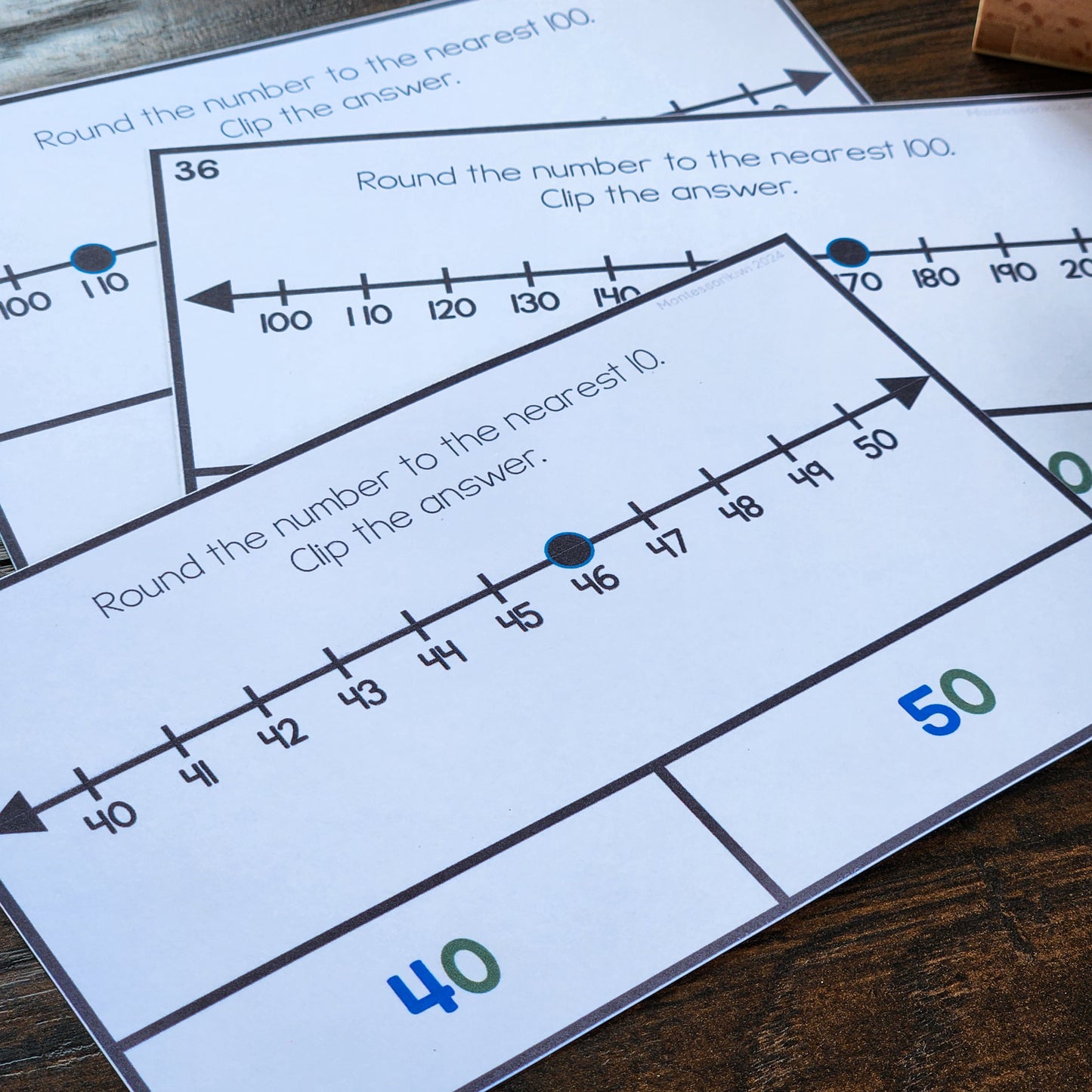
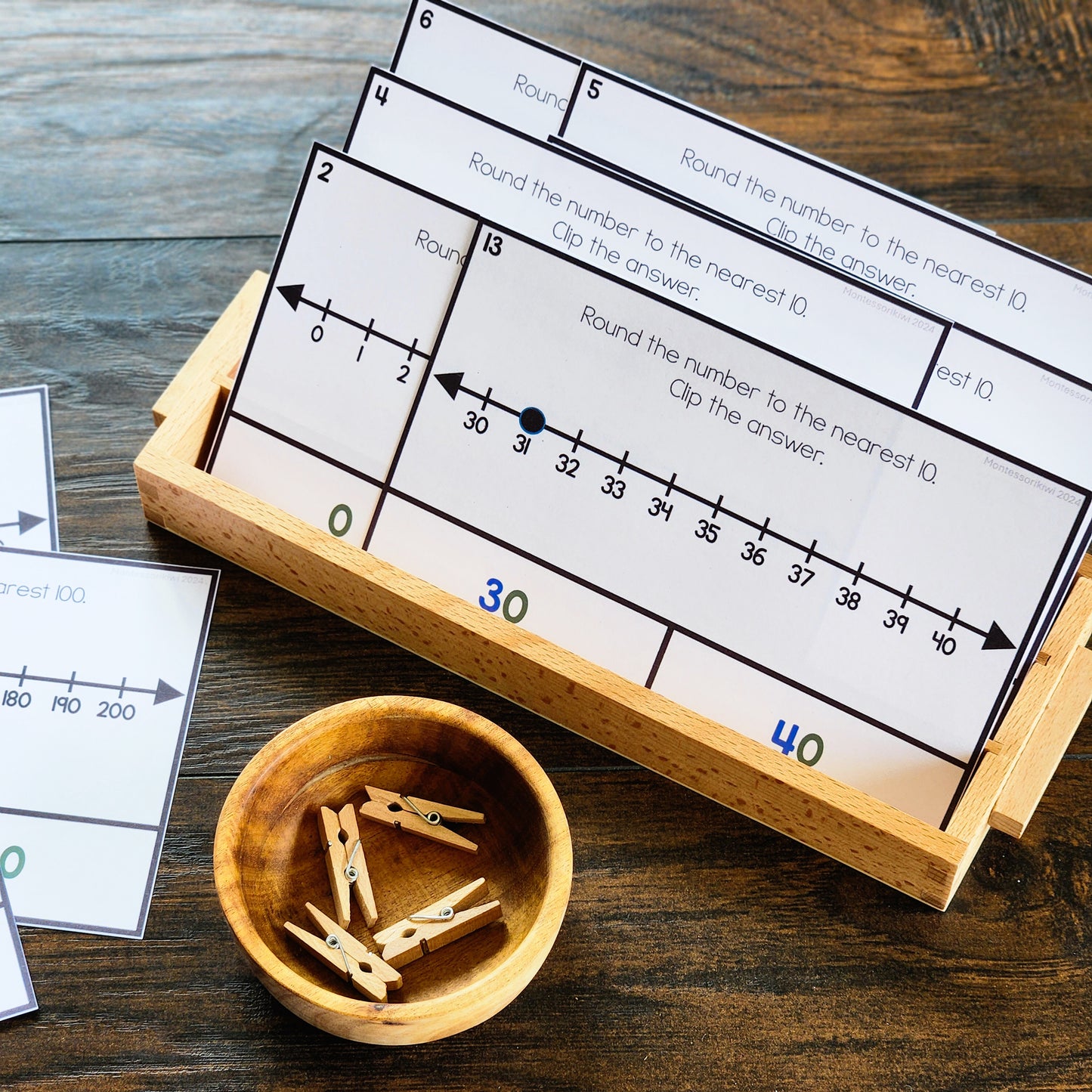
These Montessori Rounding to the Nearest 10 and 100 Clip Cards make the relationship visible. Each card places a number on a number line between two possible multiples. Children compare the distances, clip the closest answer and flip the card to check independently.
At a Glance
- Learning focus: Rounding whole numbers and place-value reasoning
- Includes: 60 printable Flip and Clip cards
- Skills: Rounding to the nearest 10 and nearest 100
- Numbers: Two- and three-digit numbers
- Visual model: Number lines and neighbouring benchmark numbers
- Control of error: Self-correcting answers on the reverse
- Best for: Montessori elementary, homeschool, maths centres and intervention
- Format: Instant digital PDF download
Teach What Rounding Actually Means
When children are told only to inspect the final digit, they may learn a shortcut without understanding the mathematical idea.
Rounding requires a child to identify:
- the two multiples surrounding the number;
- where the number sits between those benchmarks;
- which benchmark is closer;
- what happens when the number is exactly halfway; and
- whether the question asks for the nearest ten or nearest hundred.
The number lines make these decisions visible. Instead of guessing from a rule, children can see the relative position and use distance to justify their answer.
Stop Rounding From Feeling Like an Arbitrary Trick
The visual format gives children a reason for each answer. They can point to the neighbouring multiples, compare the spaces and explain which one is closer. This creates a stronger foundation than asking them to remember a rhyme they may later misapply.
What Is Included?
- 60 rounding task cards
- Cards for rounding to the nearest 10
- Cards for rounding to the nearest 100
- Two- and three-digit number practice
- A number line on every card
- A marked point showing the number’s approximate position
- Two benchmark answers to compare
- Colour coding to help organise the levels
- Answers prepared for independent self-checking
The cards offer substantial repeated practice while keeping each individual task visually clear and manageable.
From Number-Line Understanding to Mental Rounding
A useful teaching progression is:
- Build benchmark numbers. Review multiples of 10 and 100 with number cards, bead material or a hundred board.
- Name the surrounding multiples. For example, identify that 46 lies between 40 and 50.
- Locate the number. Discuss its position on the number line.
- Compare the distances. Decide which benchmark is closer.
- Clip the answer. Use a peg, paperclip or counter to show the choice.
- Flip and check. Correct errors independently.
- Explain the reasoning. Ask the child to state why the number rounds up or down.
- Gradually remove the number line. Move towards mental rounding once the concept is secure.
Particularly Helpful for Neurodivergent Learners
Rounding places several demands on working memory: identifying place value, locating benchmark numbers, recalling a rule and applying it accurately.
These cards reduce that load by presenting:
- one number at a time;
- two clearly defined answer choices;
- a stable number-line model;
- a visible start and endpoint;
- colour-coded activity groups; and
- immediate private feedback.
Learners can work with a small selection rather than an entire worksheet, repeat difficult examples without public correction and use the physical clipping action to record their decision.
Why the Number Line Matters
A number line helps children understand rounding as a question of relative distance.
For example, when a number is positioned between 30 and 40, the learner can see whether it lies:
- closer to 30;
- closer to 40; or
- at the midpoint.
The same structure is then applied to three-digit numbers between neighbouring hundreds.
This helps children connect rounding with wider number concepts, including:
- place value;
- number magnitude;
- multiples of 10 and 100;
- estimating;
- relative position; and
- the use of benchmark numbers.
Self-Correcting Montessori Shelf Work
After preparing the cards, children clip their chosen answer and turn the card over to check.
This control of error supports:
- independent practice;
- immediate feedback;
- private correction;
- repetition without adult marking;
- greater confidence; and
- purposeful Montessori work cycles.
You can offer the nearest-10 cards first and introduce rounding to the nearest 100 once the learner confidently identifies the surrounding tens.
Ways to Use This Resource
- Montessori maths shelf work
- Place-value follow-up
- Rounding lessons
- Maths centres and rotations
- Small-group instruction
- Homeschool maths
- Number-sense intervention
- Independent work cycles
- Early-finisher activities
- Revision and formative assessment
- Preparation for estimation
Easy to Differentiate
For Developing Learners
- Offer only the nearest-10 cards.
- Use a physical number line alongside the card.
- Identify the surrounding multiples together.
- Ask the child to trace the distance with a finger.
- Present only three to five cards at once.
For More Confident Learners
- Mix the nearest-10 and nearest-100 cards.
- Ask the child to name the benchmarks before looking closely at the answer choices.
- Record the rounded number as an equation.
- Explain why the unused answer is incorrect.
- Estimate sums using the rounded values.
Please Note
This is a printable digital resource. Physical pegs, paperclips, counters, number lines and Montessori materials are not included.
The cards are designed for practising rounding after children have received an introduction to place value, multiples of 10 and 100 and the purpose of estimating.
Created by an Experienced Montessori Educator
I’m Lisa—an NZ registered teacher, Montessori-trained educator, school principal and former homeschooler.
I create practical maths resources for mixed-age classrooms and diverse learners, including children who need to see the mathematical relationship before an abstract rule becomes meaningful.
Continue Building Place-Value Understanding
-
Montessori Place Value Task Cards
Strengthen understanding of digit value, expanded form and base-ten number structure before rounding larger numbers. -
Hundred Board Puzzle Task Cards
Develop number position, sequence and recognition of patterns within the hundred chart. -
Montessori Hundred Board Task Cards Bundle
Explore number order, skip counting, place value, patterns and mental maths through independent hundred-board work.
Need a Wider Place-Value Sequence?
The Montessori Place Value Bundle provides a broader pathway through base-ten quantities, expanded form, number comparison, place-value reasoning and work with larger numbers.
Choose the bundle when you need a connected collection of place-value work rather than one focused rounding activity.
Building a Complete Elementary Maths Shelf?
The Montessori Elementary Maths Bundle brings together printable resources for number sense, place value, operations, number facts, fractions, geometry, measurement and problem solving.
Explore More Montessori Maths
Browse the Montessori Maths Collection for place value, number sense, operations, fractions and independent task-card work.
Help Children See Which Number Is Truly Closer
Replace an arbitrary rounding rule with number-line reasoning, benchmark numbers and independent self-checking.
Download the Montessori Rounding Flip and Clip Cards and give learners 60 visual opportunities to round to the nearest 10 and 100 with understanding.
Share
-
Items are secured / Terms of Use
Our items are secured. They are not able to be altered. We secure our items because they are our intellectual property and because we use art from artists who require that we secure our files.
You may not:
-resell our items or use them for commercial gain
-claim these items as your own
-modify this resource
-share them with others by any means e.g. electronic or hard copy
-
All Items are instant downloads
You will not get a printed product in the mail.
-
All prices are in USD
Due to the international nature of our customers our prices are all in USD. If you wish to work out the conversion before you buy we recommend www.xe.com