montessorikiwi
Montessori Equal Sign Activities | Balancing Equations, True or False Math
Montessori Equal Sign Activities | Balancing Equations, True or False Math
Couldn't load pickup availability

Your child can calculate an answer—but do they understand what the equals sign actually means?
Many children interpret = as “work this out” or “the answer comes next.” They may solve 4 + 3 = 7 confidently but become uncertain when the equation is reversed, when two quantities look different, or when they must decide whether a mathematical statement is true.
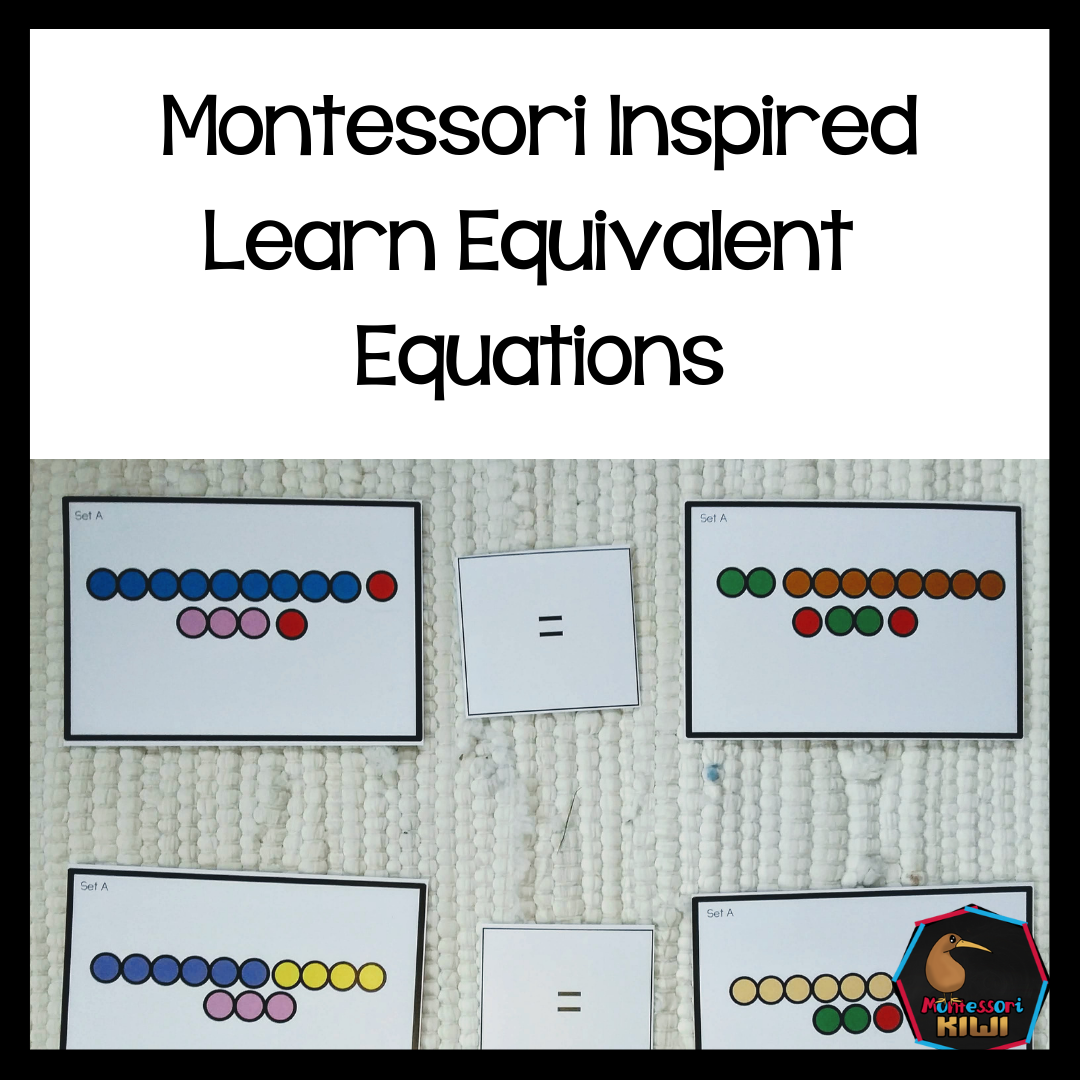
These Montessori Equal Sign and Balancing Equations Activities help children understand that the equals sign means “is the same as.”
Using Montessori coloured beads, Stamp Game pieces, and Golden Bead representations, learners compare quantities, build equivalent equations, sort true and false statements, and check their work independently.
At a Glance
- Learning focus: Equality, equivalence, balanced equations and the equals sign
- Includes: Three progressive Montessori quantity-card sets
- Representations: Coloured beads, Stamp Game and Golden Beads
- Activities: Build equal equations and sort statements as true or false
- Number range: Basic quantities through four-digit place value
- Best for: Montessori elementary, homeschool and maths intervention
- Length: 29 printable pages
- Format: Instant digital PDF download
Move Beyond “The Answer Comes Next”
A learner may be familiar with equations written in one direction:
3 + 4 = 7
But equality also allows us to write:
7 = 3 + 4
Both statements communicate that the values on the two sides are the same.
This resource helps children investigate that relationship with visible quantities before expecting them to reason only from abstract symbols.
- Two cards may use different bead combinations but represent the same total.
- A Stamp Game quantity may match a Golden Bead quantity.
- Two arrangements may look different in size or layout while remaining equal.
- A statement is true only when both sides have the same value.
Build the Understanding Children Need Before Algebra
Children who view the equals sign only as a signal to calculate may struggle when they encounter missing values, reversed equations, equivalent expressions, or variables. These activities give them repeated opportunities to build, test, and prove equality before the equations become more abstract.
What Is Included?
- Three labelled card sets with increasing mathematical complexity
- Set A: Early coloured-bead quantities
- Set B: Larger and more complex coloured-bead combinations
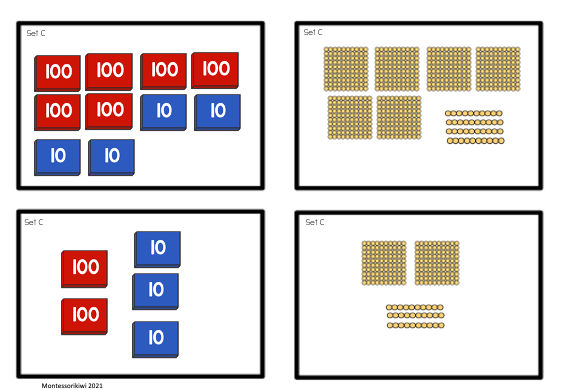
- Set C: Stamp Game and Golden Bead place-value quantities
- Printable equals-sign cards
- True and False sorting labels
- Numerical values printed on the reverse for independent checking
- Teacher directions for two structured activities
Three Progressive Levels
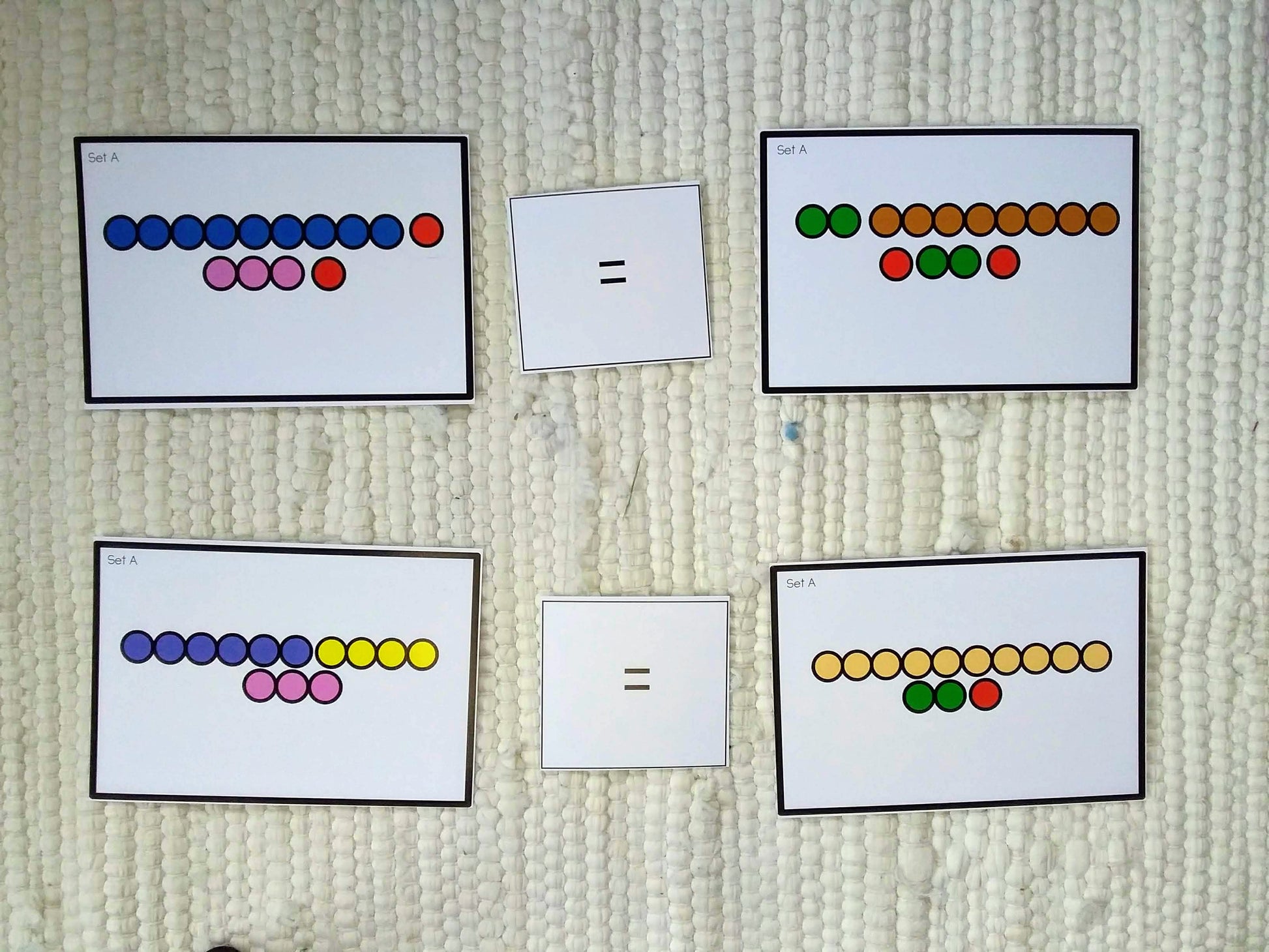
Set A: Build Equality With Coloured Beads
Children compare familiar Montessori bead quantities and find two cards with the same total.
They place an equals sign between the cards and, where possible, recreate both sides with physical coloured bead bars.
This helps learners explore:
- number bonds;
- different ways to compose the same number;
- addition relationships;
- equivalent quantities; and
- the meaning of the equals sign.
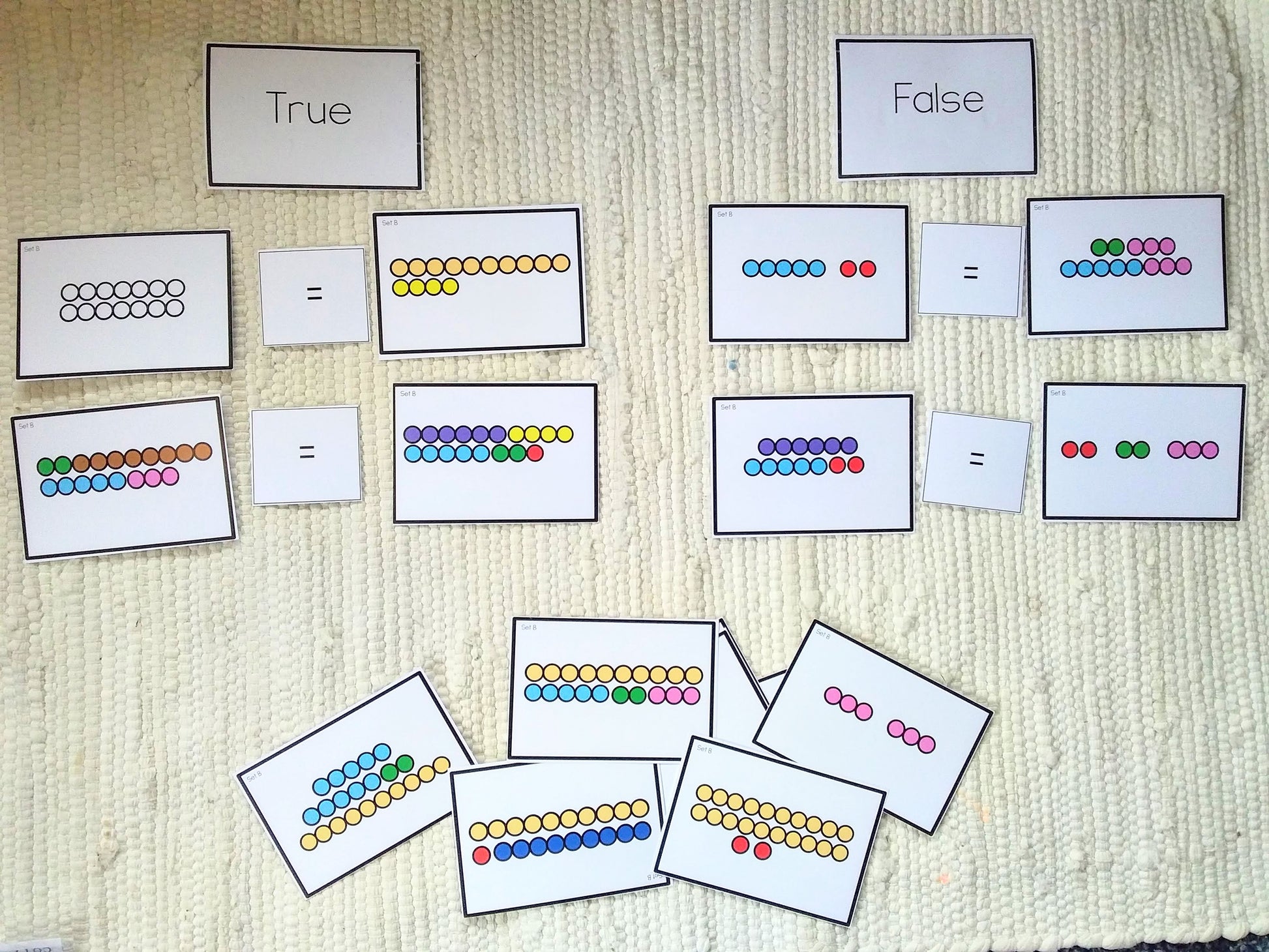
Set B: Compare More Complex Arrangements
The second set uses larger totals and more involved bead combinations.
Because the arrangements do not always look alike, children must determine the value rather than make a decision based on visual length, number of groups, or layout.
Set C: Connect Stamp Game and Golden Bead Quantities
The final set extends equality into place-value work with units, tens, hundreds, and thousands.
Children compare Stamp Game representations with Golden Bead quantities, including numbers extending into the thousands.
This creates a useful bridge between:
- different Montessori maths materials;
- concrete quantity and abstract number;
- place value and equivalence; and
- early arithmetic and later algebraic reasoning.
Activity 1: Make Balanced Equations
- Present the equals sign.
- Ask the learner what they think it means.
- Introduce the wording “is the same as.”
- Select two cards with equal values.
- Place an equals sign between them.
- Rebuild the quantities using Montessori materials.
- Turn over the cards to check their numerical values.
Begin with Set A before progressing into the larger quantities in Sets B and C.
Activity 2: True or False?
Place the printable True and False labels on the work mat.
Choose two quantity cards and place an equals sign between them. The child decides whether the mathematical statement is true or false.
Encourage the learner to explain:
- the value represented on each side;
- whether those values are equal;
- how they checked the quantities;
- why a false statement is incorrect; and
- what could be changed to make it true.
Particularly Helpful for Neurodivergent Learners
The resource turns an abstract mathematical relationship into a visible, moveable task.
It may be especially helpful for learners who:
- interpret symbols very literally;
- benefit from concrete proof rather than verbal rules;
- need stable Montessori colour cues;
- find full pages of equations visually overwhelming;
- need to handle one comparison at a time;
- benefit from private self-correction; or
- understand place value better through materials than written notation.
Offer a small selection of cards and increase the quantity or complexity gradually.
Supports More Than Basic Addition
As children build and compare the equations, they develop foundations for:
- number composition;
- number bonds;
- place-value reasoning;
- equivalent expressions;
- missing-number equations;
- inverse operations;
- true-or-false number sentences;
- balanced equations; and
- early algebra.
Ways to Use This Resource
- Montessori maths shelf work
- Equal-sign presentations
- Coloured-bead follow-up
- Stamp Game or Golden Bead lessons
- Maths centres
- Small-group intervention
- Partner reasoning activities
- Homeschool maths
- Early-algebra preparation
- Formative assessment
Why Does the Equal Sign Need Explicit Teaching?
Many children learn to interpret the equals sign as “the answer follows” rather than “both sides have the same value.” This becomes particularly visible when an equation is reversed or contains an unknown in an unfamiliar position.
Read We Need to Talk About the Equal Sign for more ideas about balanced equations, true-or-false statements, missing values, and teaching equality from the early years.
Please Note
This activity primarily teaches equality and equal/not-equal reasoning.
It does not include a full sequence for teaching the greater-than and less-than symbols, despite the broader language sometimes used around equalities and inequalities.
Print the quantity cards double-sided so the numerical controls appear on the reverse. Physical Montessori beads, Golden Beads, Stamp Game pieces, and storage materials are not included.
Created by an Experienced Montessori Educator
I’m Lisa—an NZ registered teacher, Montessori-trained educator, school principal, and former homeschooler.
I create practical maths materials for mixed-age classrooms and diverse learners, including children who can calculate accurately but need more support understanding the relationships represented by mathematical symbols.
Continue Building Flexible Equation Knowledge
-
Alternative Addition Equation Formats
Help children solve addition relationships when the equals sign and missing value appear in less familiar positions. -
Montessori Number Bonds to 10
Strengthen part-part-whole understanding and explore different combinations with the same total. -
Montessori Fact Families to 10
Connect equivalent number relationships across addition and subtraction. -
Three-Digit Gateway to Algebra Task Cards
Extend equality into missing values, balanced expressions, inverse operations, and early algebraic reasoning.
Need a Complete Number-Facts Pathway?
The Montessori Number Facts Bundle brings together number bonds, fact families, alternative equation formats, addition, subtraction, multiplication, division, doubles, and other fact-fluency materials.
Choose the bundle when you need a broad sequence for number relationships and basic operations rather than one focused equality activity.
Explore More Montessori Maths
Browse the Montessori Maths Collection for place value, number sense, operations, fact fluency, geometry, and mathematical reasoning.
Help Children Understand What “Equal” Really Means
Move from visible Montessori quantities into balanced equations, true-or-false reasoning, and a stronger foundation for algebra.
Download the Montessori Equal Sign Activities and help learners prove that both sides really are the same.


