montessorikiwi
Montessori Grammar Booklet | Parts of Speech Symbols & Sentence Practice (literacy)
Montessori Grammar Booklet | Parts of Speech Symbols & Sentence Practice (literacy)
Couldn't load pickup availability

Children may recognise the Montessori grammar symbols during a lesson—but can they independently explain what each symbol represents and give accurate examples?
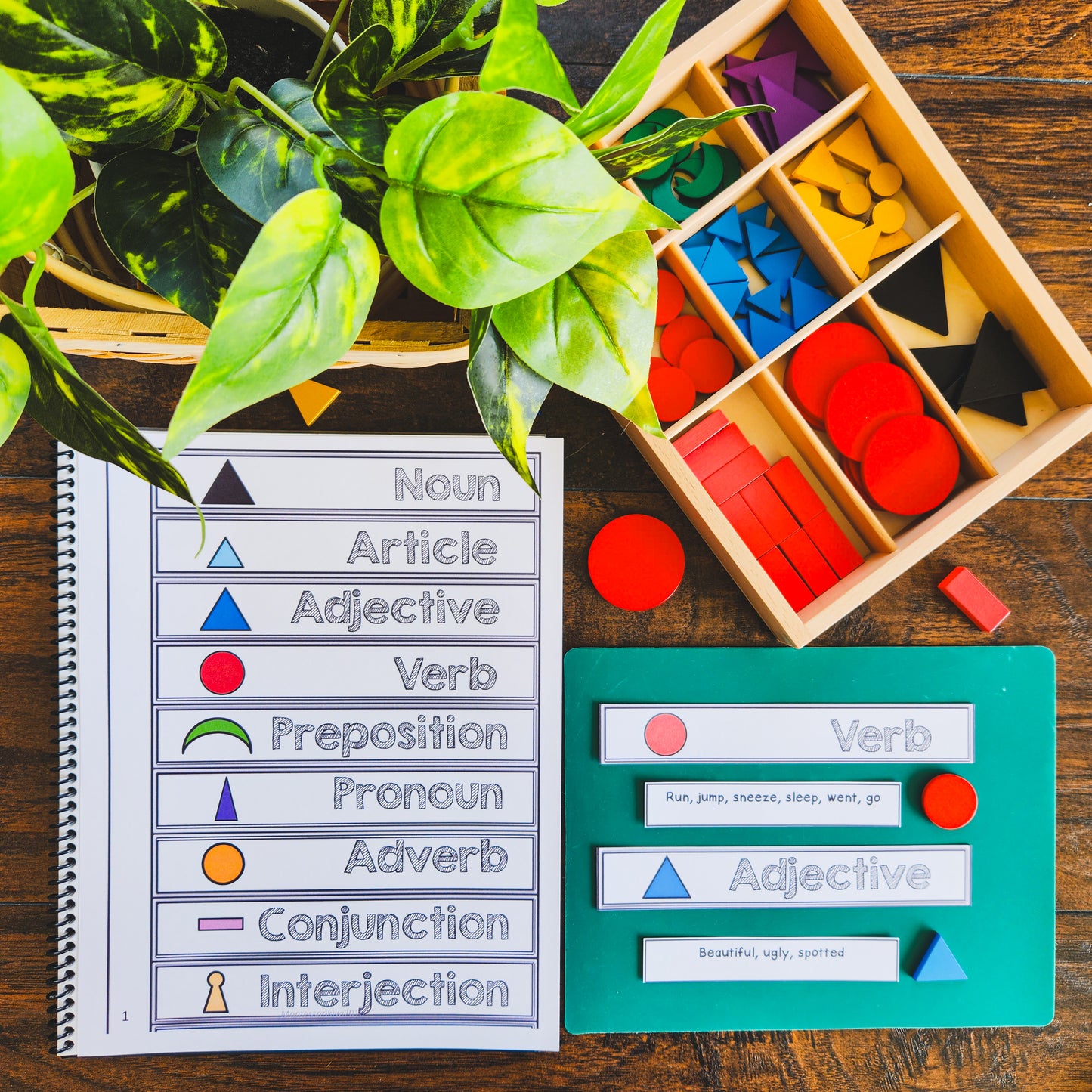
The Montessori Grammar Interactive Notebook gives children a simple, hands-on way to review the nine parts of speech and create a personal grammar reference they can return to during later language work.
Each lift-up section displays the name and traditional Montessori symbol for one part of speech. Beneath the flap, children record its definition and add their own example words.
This makes children active participants in creating the booklet rather than simply reading another completed grammar chart. It is ideal after the parts of speech have already been introduced, or as an informal way to discover what a child remembers before planning further grammar presentations.
At a glance
Suggested age: Approximately 6–12 years
Format: 12-page printable PDF
Focus: The nine parts of speech and Montessori grammar symbols
Includes: Interactive notebook pages, spaces for definitions and examples, optional prepared answers, assembly directions, and colour and black-and-white covers
Best for: Grammar revision, prior-knowledge checks, independent follow-up, language shelves and homeschool literacy
Preparation: Print, assemble and staple or glue the layered pages together
Important: This is designed primarily for children who have already been introduced to the parts of speech
Make grammar knowledge visible
Montessori grammar materials help children experience language concretely. However, children can sometimes match a word with a symbol without being able to explain the function of that word in their own language.
This interactive grammar booklet helps you see whether a child can:
- recognise each Montessori grammar symbol
- name the corresponding part of speech
- recall a useful definition
- generate suitable example words
- distinguish between similar word classes
- organise grammar knowledge into a personal reference tool
Because children write the information themselves, the finished notebook provides a clearer picture of their understanding than a completed reference poster alone.
A useful distinction: This resource is not intended to replace your initial Montessori parts-of-speech presentations. It is a revision, consolidation and informal assessment activity to use after children have encountered the concepts.
All nine parts of speech
The interactive notebook includes sections for:
- Noun
- Article
- Adjective
- Verb
- Preposition
- Pronoun
- Adverb
- Conjunction
- Interjection
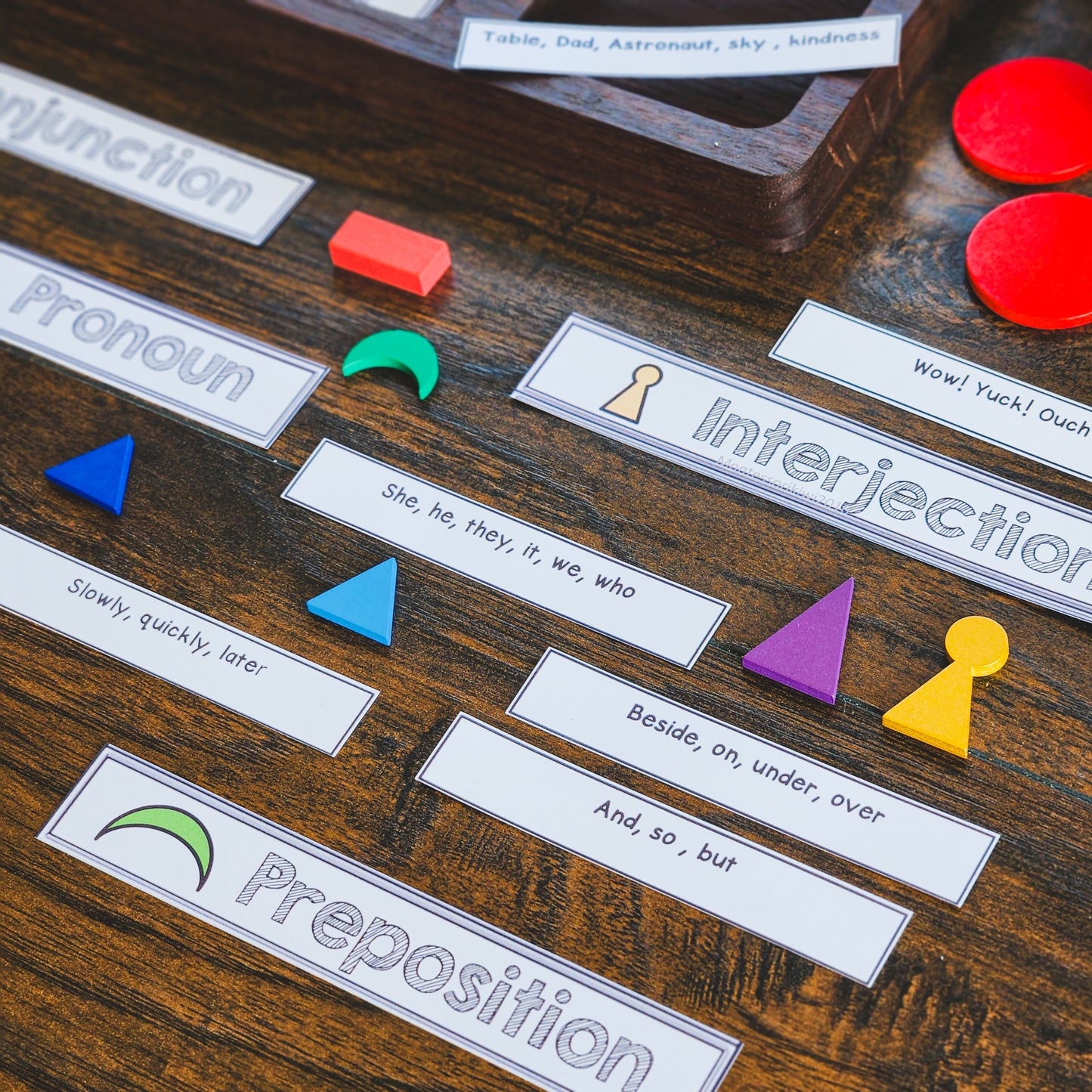
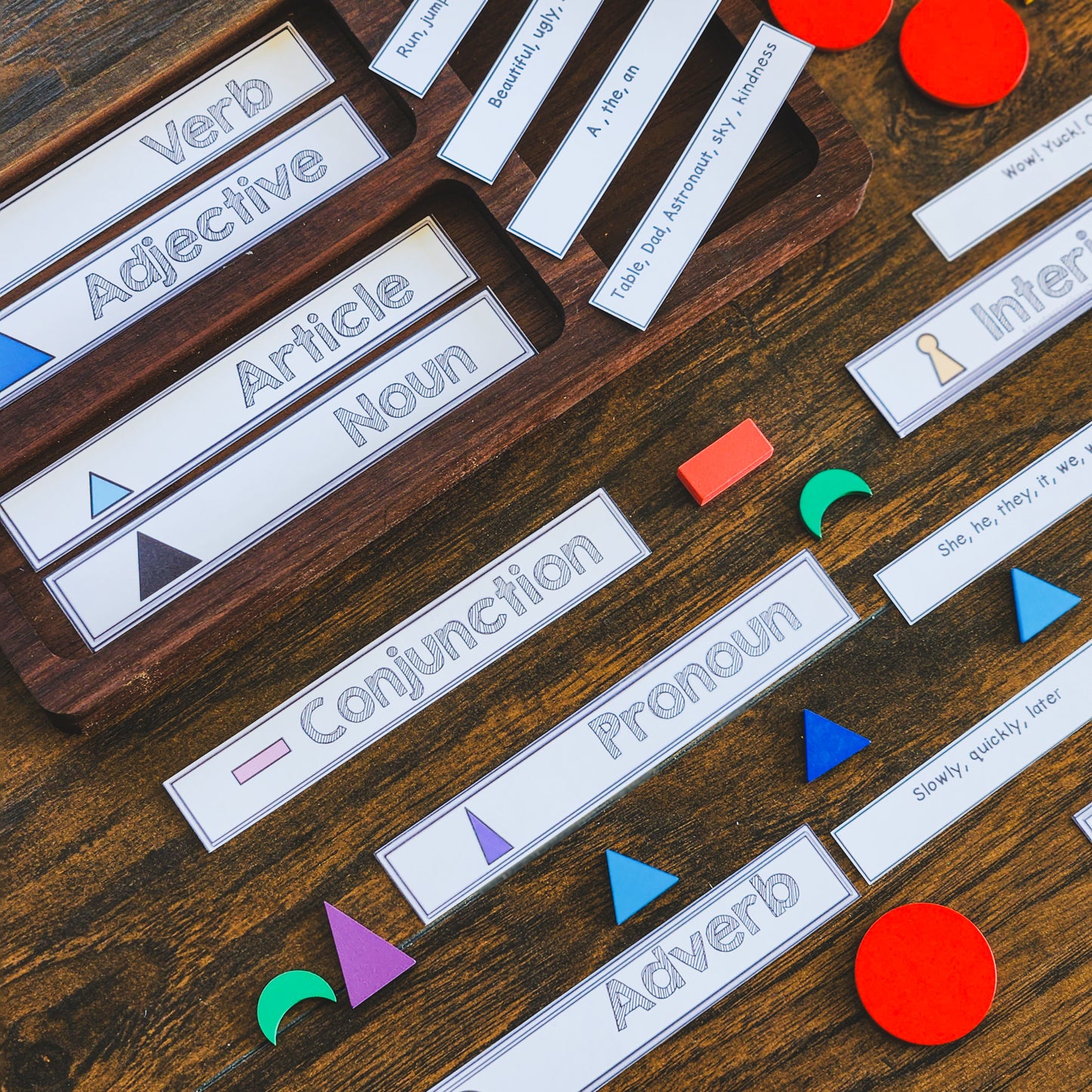
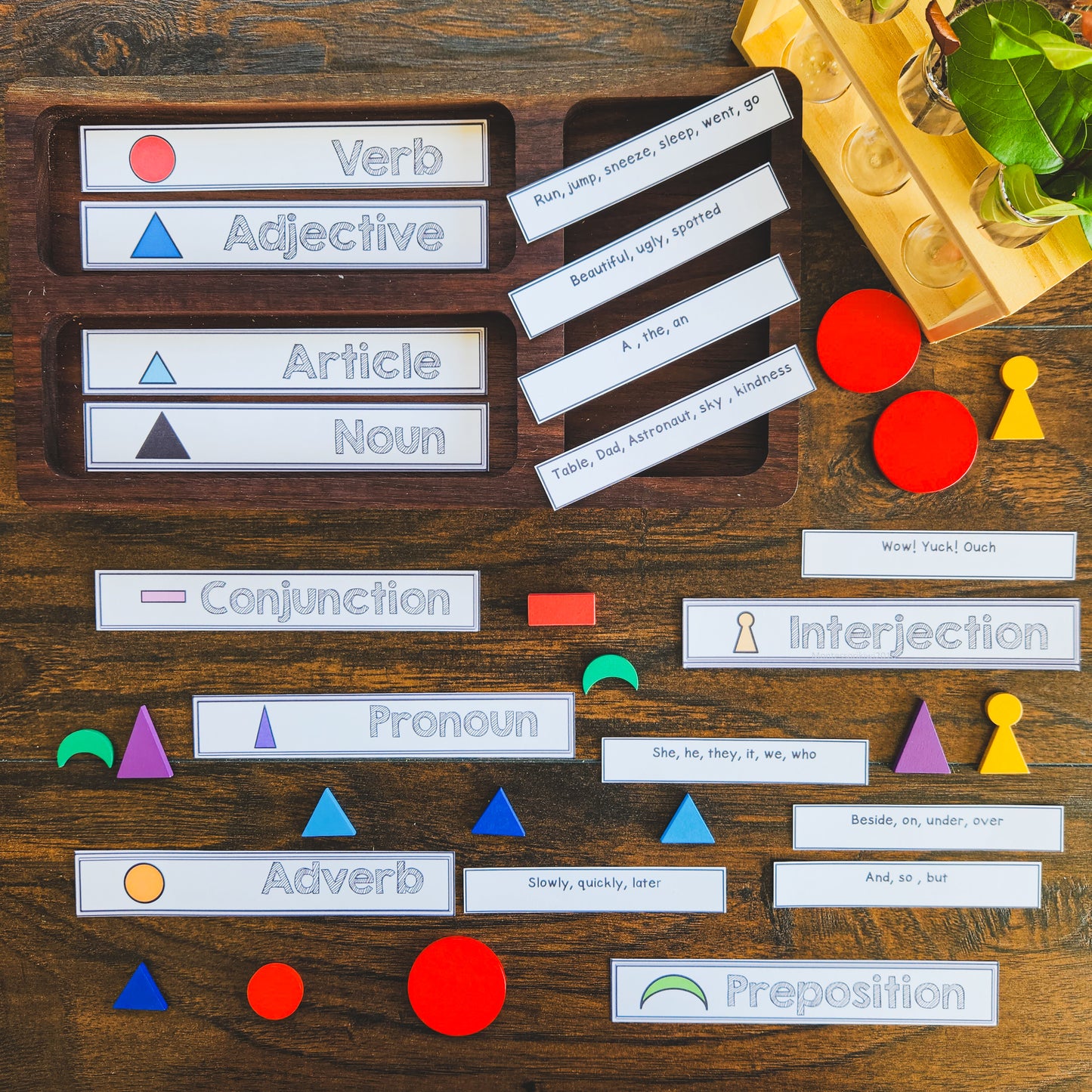
Each label is paired with its familiar Montessori grammar symbol, helping children connect the visual symbol with the grammatical term and its function.
How the interactive notebook works
The finished booklet has a layered, lift-the-flap format.
Children see the nine grammar labels and symbols arranged vertically. Each section lifts to reveal spaces for recording:
- a definition of the part of speech
- relevant example words
For example, a child might record:
- Noun: table, astronaut, sky, kindness
- Article: a, an, the
- Adjective: beautiful, spotted, unusual
- Verb: run, jump, sleep, sneeze
- Preposition: beside, on, under, over
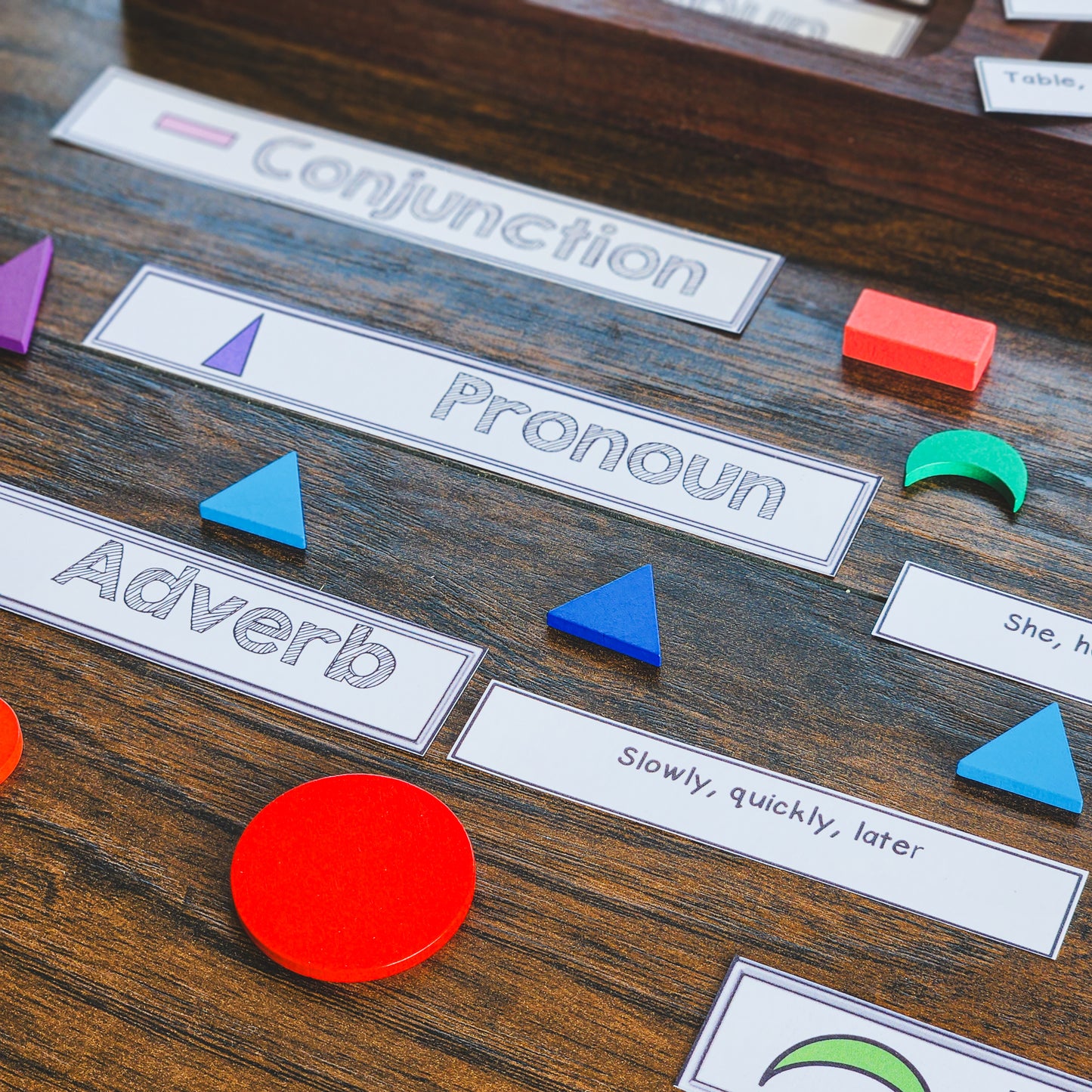
- Pronoun: she, he, they, it, we
- Adverb: slowly, quickly, later
- Conjunction: and, so, but
- Interjection: wow, ouch, yuck
Children can create their own definitions and examples, or use the included prepared pages when more support is needed.
Two ways to use the resource
1. Independent revision
Use the blank definition and example spaces after children have received the relevant Montessori grammar presentations.
Children recall what they know and create their own personal grammar reference. This encourages retrieval, written expression and independent application.
2. Supported reference booklet
Prepared definitions and example words are also included.
These can be:
- used as an answer guide
- offered to children who need additional scaffolding
- cut out and pasted into the booklet
- used to check completed work
- provided after a child has attempted the activity independently
This allows the same material to support children with different writing abilities, levels of recall and degrees of independence.
Use it as an informal grammar assessment
This booklet can also help you identify where further teaching is needed.
Before beginning a new grammar sequence, invite the child to complete as much as possible independently. Their responses may show that they:
- know the symbols but not the grammatical names
- remember a definition but cannot generate examples
- confuse adjectives and adverbs
- need more practice with pronouns, conjunctions or articles
- have retained the earlier presentations confidently
You can then plan presentations and follow-up work according to what the child actually knows rather than repeating the entire sequence unnecessarily.
Why interactive grammar work can help
A completed notebook gives children something concrete and useful to keep.
The format supports:
- Active recall: Children retrieve definitions and examples rather than only rereading them.
- Visual memory: Each term remains connected with its Montessori grammar symbol.
- Organisation: Nine concepts are brought together in one compact reference.
- Independence: Children can revisit the notebook during writing, grammar symbolising and sentence analysis.
- Differentiation: Blank pages allow independent responses, while prepared definitions and examples provide support.
- Ownership: Children create and personalise their own grammar record.
Simple preparation
To assemble the notebook:
- Print the grammar-symbol cover page.
- Print the definition page on the reverse or attach it behind the cover.
- Add the example-word page behind the definition layer.
- Cut along the indicated lines to form the individual flaps.
- Staple or glue the layers together.
- Invite the child to complete each section.
A colour cover and a black-and-white version are included. The black-and-white option can reduce colour-printing costs or allow children to colour the grammar symbols themselves.
Flexible for mixed-age Montessori classrooms
You do not need to use the booklet in exactly the same way with every child.
You might use it:
- after completing the key parts-of-speech presentations
- at the beginning of a new school year to check retained knowledge
- as independent language-shelf follow-up
- during a small-group grammar review
- as part of a homeschool grammar portfolio
- before moving into more complex sentence symbolising
- as a reference during independent writing
- with prepared answers for children who require more support
Younger children may complete only the parts of speech they have already encountered. Older or more-confident children can complete all nine sections independently.
Ideal for
- Montessori lower elementary classrooms
- Montessori upper elementary review
- children approximately 6–12 years old
- mixed-age language environments
- homeschool grammar
- independent language shelves
- parts-of-speech revision
- grammar-symbol recognition
- informal assessment
- children who benefit from visual organisation
- learners who need a personal grammar reference
Build a complete Montessori grammar pathway
Use before or alongside this notebook:
-
Montessori Parts of Speech Posters
Provide a clear visual reference for the nine parts of speech and their grammar symbols. -
Montessori Parts of Speech Workbook
Extend children’s understanding of the function of words with additional written follow-up.
Move into sentence construction and analysis:
-
Montessori Grammar Symbol Strips
Help children use visual grammar-symbol patterns to construct and compare sentences. -
Montessori Grammar Symbolising Activities
Give children meaningful sentences to analyse using the Montessori grammar symbols. -
Advanced Montessori Grammar Symbolising
Extend experienced learners into increasingly complex sentence structures.
Save with a larger collection:
-
Montessori Grammar and Language Bundle
Build a broader language shelf with grammar symbols, parts of speech, phonics, word study, vocabulary and sentence work. - Explore All Montessori Literacy Resources
Related article:
Created by an experienced Montessori educator
I am a Montessori-trained educator, New Zealand registered teacher, school principal and former homeschool parent.
My resources are shaped by experience working with children in Montessori, mainstream and mixed-age environments. They are designed to be practical, affordable and flexible enough to support learners with different abilities and needs, including neurodivergent children.
I created this booklet to provide a manageable bridge between receiving a grammar presentation and independently applying that knowledge in sentence and writing work.
Digital download information
This is a digital printable resource. No physical product will be shipped.
After purchase, you can download the PDF, print the pages and prepare the notebook for your classroom or homeschool.
Purchase includes a licence for use by one teacher in one classroom or by one homeschool family. Please do not share the digital file with other teachers, upload it to shared drives or groups, or distribute it outside your own classroom or household.
Help children turn familiar grammar symbols into knowledge they can explain and use
Create a compact personal reference that supports revision, independent grammar work and more confident sentence analysis.
Download the Montessori Grammar Interactive Notebook and add purposeful parts-of-speech review to your language shelves.