
montessorikiwi
Free Montessori Math Scope and Sequence | Ages 3–12
Free Montessori Math Scope and Sequence | Ages 3–12
Couldn't load pickup availability
It was helpful to find records that are ready to use and easy to print when they are needed. I am so tired of continually making resources, it lovely to shop for what is helpful and needed to assist my students. Thank you!
Very easy to follow. A great resource for the teacher.
math scope and sequence - free
math scope and sequence - free
It's a great help to me because I now have a guideline to help me frame my maths lessons and materials.
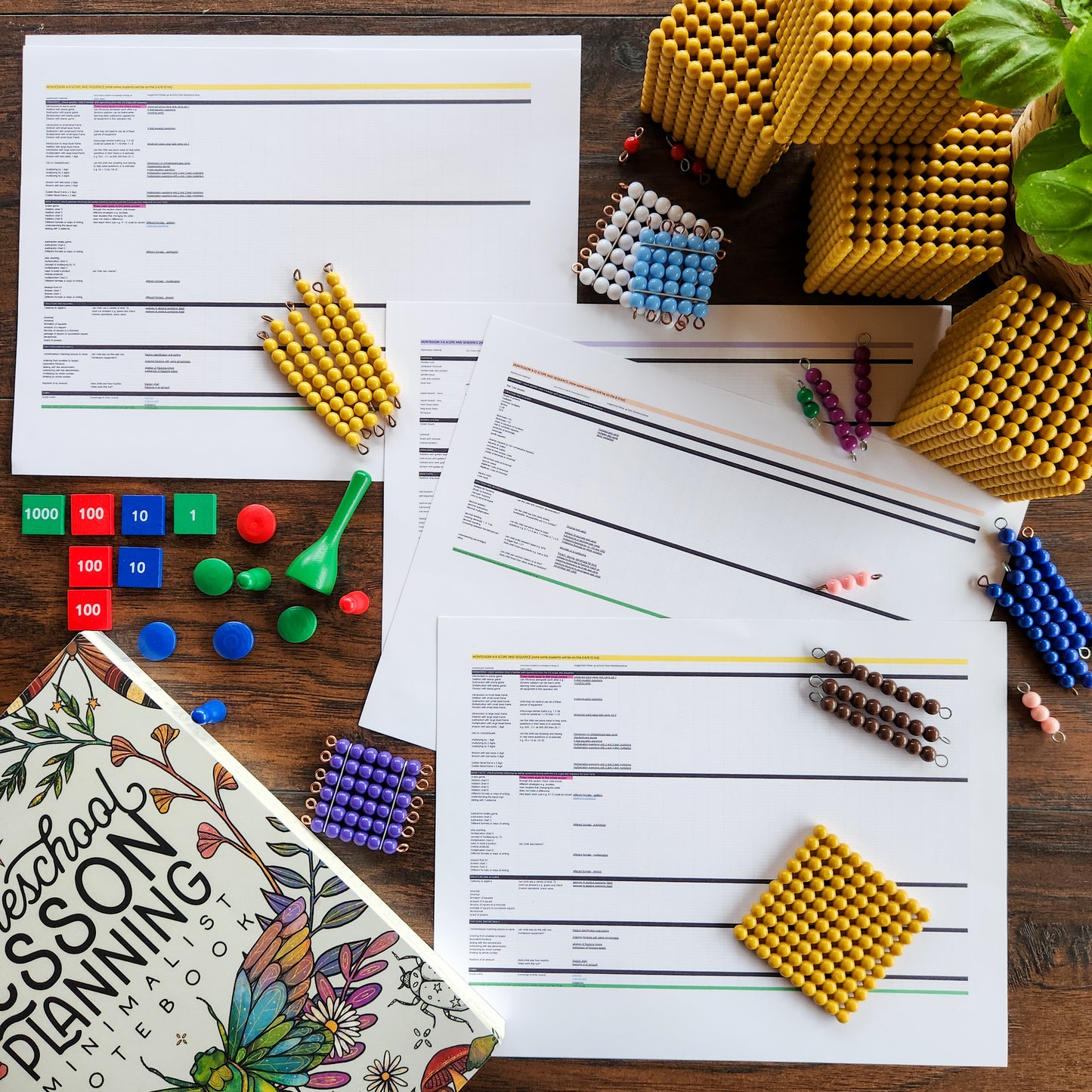
See the full Montessori maths journey from ages 3–12—and plan lessons with greater clarity and confidence with this free resource.
Montessori mathematics is beautifully sequenced, but understanding how all the materials and lessons fit together can feel overwhelming.
You may be wondering:
- Which maths concepts are usually introduced at each age?
- What comes before or after a particular Montessori material?
- How do early concrete lessons lead into abstract mathematics?
- What should I present next?
- How can I plan for children working at different levels?
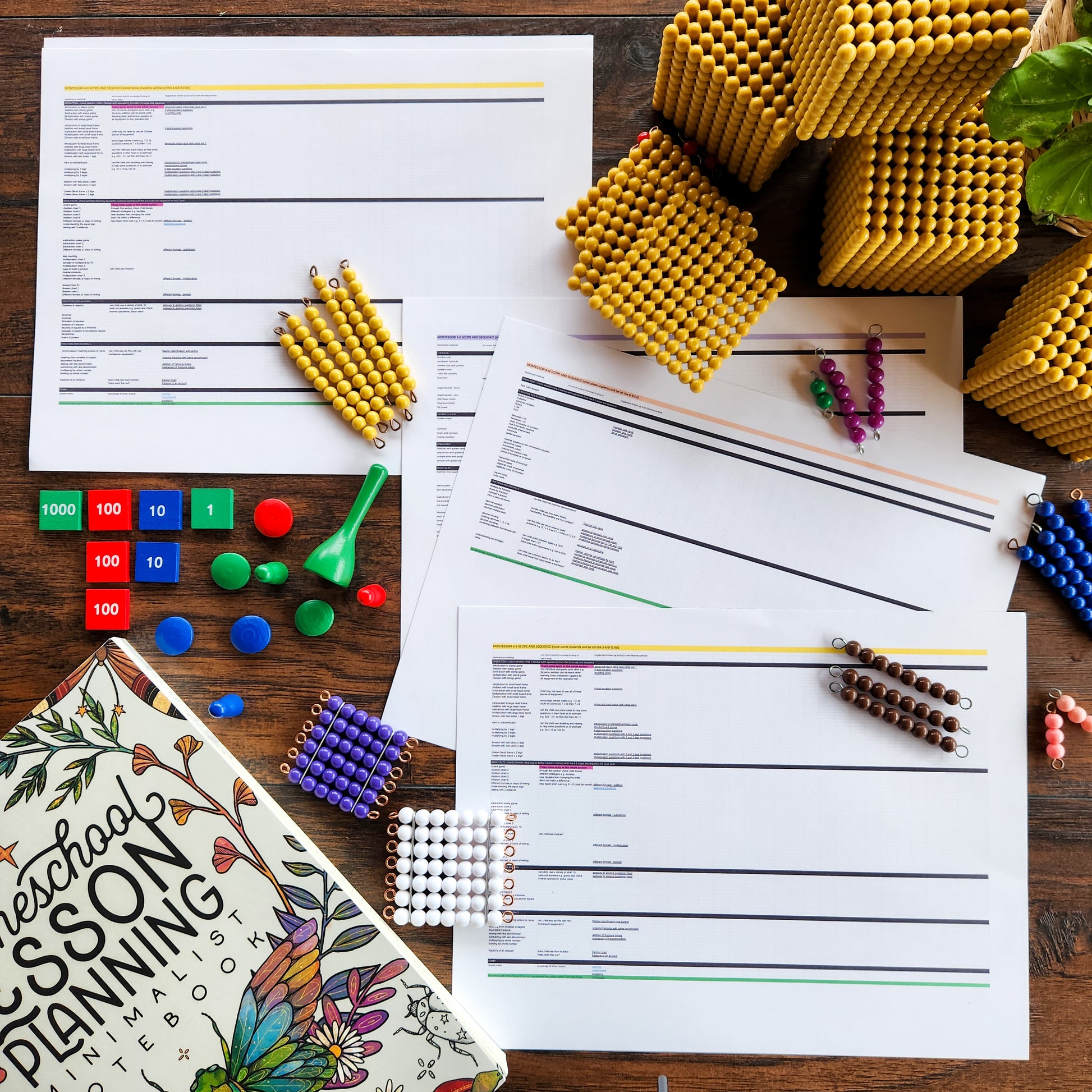
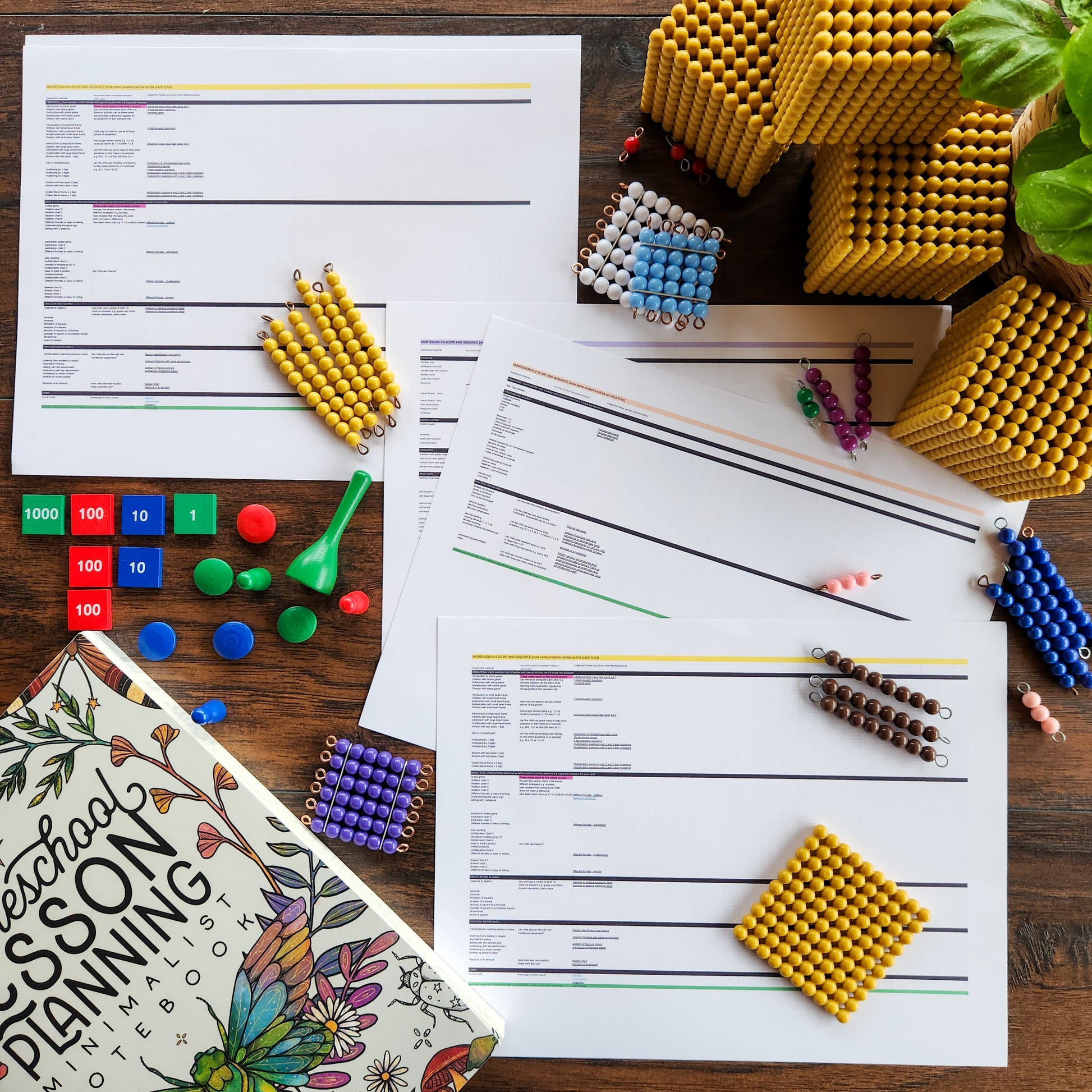
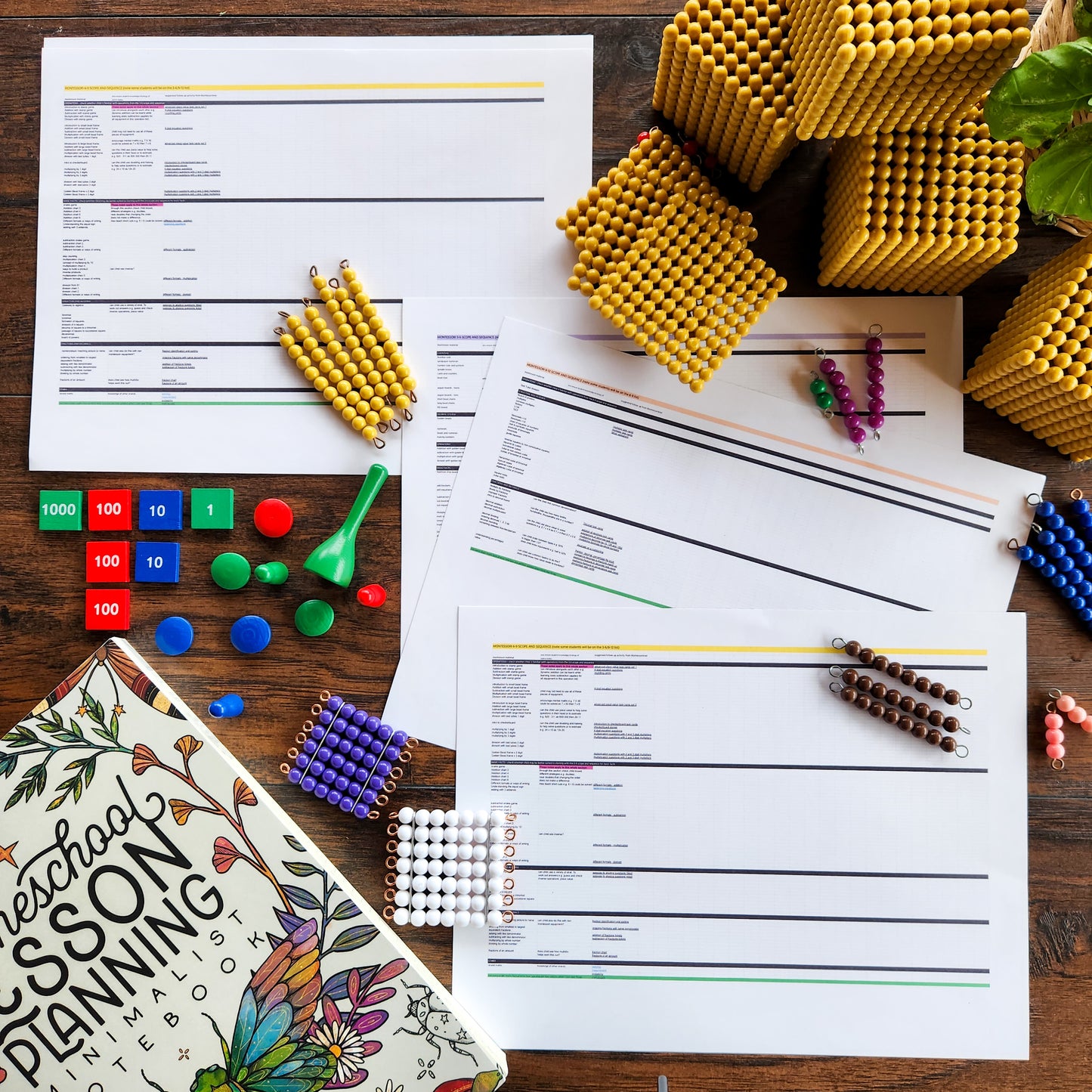
This free Montessori Math Scope and Sequence provides a clear overview of the major maths concepts and lessons commonly presented across the Montessori 3–6, 6–9 and 9–12 cycles.
Use it to understand the bigger picture, identify possible next steps and plan a connected mathematics programme without turning Montessori learning into a rigid checklist.
At a Glance
| Resource type | Digital Montessori planning guide |
| Age range | Approximately ages 3–12 |
| Cycles covered | Montessori 3–6, 6–9 and 9–12 |
| Subject | Montessori mathematics |
| Best for | Classrooms, homeschool programmes, planning and curriculum review |
| Price | Free |
What Is Included?
The scope and sequence is organised into the three main Montessori developmental cycles:
- Ages 3–6: early number, quantity, counting and concrete operations;
- Ages 6–9: place value, operations, memorisation, fractions, measurement and early geometry;
- Ages 9–12: increasingly abstract work with large numbers, fractions, decimals, percentages, geometry, algebraic thinking and problem-solving.
The guide outlines key areas of Montessori mathematics so you can see how concepts build over time.
Depending on the age and readiness of the child, these may include:
- number recognition and quantity;
- counting and number sequence;
- the decimal system;
- place value;
- addition, subtraction, multiplication and division;
- number facts and memorisation;
- skip counting and multiples;
- factors and divisibility;
- fractions, decimals and percentages;
- measurement;
- time and money;
- geometry;
- word problems and mathematical reasoning;
- movement from concrete materials towards abstraction.
Use This Guide To
- understand the overall progression of Montessori mathematics;
- identify concepts that usually come before or after a lesson;
- plan individual and small-group presentations;
- prepare maths shelves for mixed-age learners;
- notice possible gaps in your programme;
- track which areas a child has explored;
- choose suitable follow-up work;
- support children moving from concrete materials to written and abstract work;
- plan a Montessori-inspired homeschool mathematics programme;
- see how early maths experiences support later elementary concepts.
A Guide, Not a Set of Age-Based Rules
Children do not all move through mathematics at the same speed or in exactly the same order.
A child’s age does not automatically determine which material they should be using. It is common for an elementary child to revisit earlier Montessori materials while building confidence or developing a concept that has not yet been fully understood.
For example, a child in a 6–9 environment may still benefit from work commonly associated with the 3–6 sequence. Another child may be ready to move ahead in one area while needing more concrete experience in another.
This is one of the strengths of Montessori education: children can receive lessons based on readiness rather than being restricted to a single whole-class level.
Follow the Child
This scope and sequence shows a general progression, but it should always be used alongside observation.
Look at what the child understands, where they are becoming independent and where concrete materials, repetition or a different presentation may still be needed.
How to Use the Math Scope and Sequence
1. Begin with observation
Notice what the child can do independently, which strategies they use and where misunderstandings occur.
2. Identify the current concept
Use the guide to locate the broad area of maths the child is working within, such as place value, multiplication, fractions or geometry.
3. Look backwards as well as forwards
If a child is struggling, identify the earlier concrete experience that supports the current concept. If the child is secure and confident, look ahead to a suitable extension.
4. Present one clear next step
Avoid introducing several new concepts at once. Choose a lesson that is manageable, purposeful and connected with the child’s current understanding.
5. Provide meaningful follow-up
Offer concrete work, task cards, games, recording activities or real-life applications that allow children to practise without completing pages of repetitive work.
6. Revisit concepts in greater depth
Montessori maths is not always a straight line. Important ideas such as place value, operations and fractions are revisited with larger numbers, new materials and increasing levels of abstraction.
Understanding the Concrete-to-Abstract Progression
Montessori mathematics helps children understand what numbers and operations mean before expecting them to rely only on symbols and procedures.
A typical progression may include:
- Concrete experience: the child physically works with quantities and materials;
- Visual representation: the child uses diagrams, bead colours, charts or images;
- Written recording: the child connects the concrete work with numerals and equations;
- Abstract understanding: the child solves problems without needing the material every time.
The scope and sequence can help you recognise where a child is within this progression and whether they need more concrete experience or are ready to move towards abstraction.
Who Is This Resource For?
This free Montessori maths planning guide is suitable for:
- Montessori early childhood and elementary teachers;
- new Montessori teachers learning the maths sequence;
- experienced teachers reviewing or reorganising their programme;
- homeschooling parents using Montessori maths;
- mixed-age classrooms;
- teachers combining Montessori materials with another curriculum;
- learning-support teachers identifying earlier concepts to revisit;
- anyone wanting to understand how Montessori maths develops from ages 3–12.
Why a Connected Maths Sequence Matters
Mathematical concepts are not isolated.
Early quantity and counting experiences prepare children for place value. Place value supports the four operations. Multiplication connects with factors, fractions, area and algebraic thinking. Fraction work later supports decimals, percentages, ratio and proportion.
When teachers can see these connections, it becomes easier to choose lessons that build real mathematical understanding rather than teaching disconnected procedures.
Try Practical Activities from the Sequence
Use these affordable printable resources to add purposeful hands-on practice at different stages of the Montessori maths progression.
Hands-On Doubles Addition Activities →
Help children recognise doubles and build addition fluency using Montessori coloured-bead support.
Adding Tens with Golden Beads and the Stamp Game →
Connect concrete place-value materials with written addition and mental strategies.
Pythagoras Board Multiplication Task Cards →
Provide structured multiplication practice using the Montessori Pythagoras Board.
Ratios and Proportions Task Cards →
Extend upper-elementary learners into proportional reasoning through self-correcting practice.
Want Your Elementary Maths Shelves Prepared for You?
The Montessori Elementary Math Bundle provides a broad collection of printable task cards, hands-on activities and independent follow-up work for ages 6–12.
The bundle includes resources connected with:
- place value and large numbers;
- addition, subtraction, multiplication and division;
- number facts and mental strategies;
- fractions and decimals;
- measurement and money;
- geometry;
- word problems and mathematical reasoning;
- movement from Montessori materials towards abstraction.
Explore the Montessori Elementary Math Bundle →
Spend less time creating follow-up work and more time observing, presenting lessons and supporting children’s mathematical understanding.
Planning Beyond Mathematics?
The free Montessori Cosmic Education Scope and Sequence provides a similar overview of the Five Great Stories and their connections with science, history, geography, language and mathematics.
Important Information
- This is a digital resource.
- No physical product will be shipped.
- Access is provided after checkout.
- This resource is intended as a flexible planning guide rather than a prescribed curriculum or age-based checklist.
Share

-
Items are secured / Terms of Use
Our items are secured. They are not able to be altered. We secure our items because they are our intellectual property and because we use art from artists who require that we secure our files.
You may not:
-resell our items or use them for commercial gain
-claim these items as your own
-modify this resource
-share them with others by any means e.g. electronic or hard copy
-
All Items are instant downloads
You will not get a printed product in the mail.
-
All prices are in USD
Due to the international nature of our customers our prices are all in USD. If you wish to work out the conversion before you buy we recommend www.xe.com
It was helpful to find records that are ready to use and easy to print when they are needed. I am so tired of continually making resources, it lovely to shop for what is helpful and needed to assist my students. Thank you!
Very easy to follow. A great resource for the teacher.
math scope and sequence - free
math scope and sequence - free
It's a great help to me because I now have a guideline to help me frame my maths lessons and materials.