montessorikiwi
Back to School Pack | Montessori 6–12 Classroom Setup
Back to School Pack | Montessori 6–12 Classroom Setup
Couldn't load pickup availability

A Montessori classroom can look beautifully prepared and still feel difficult to manage once the children arrive.
Back-to-school preparation involves far more than filling shelves and printing labels. Teachers also need to think through classroom movement, lesson spaces, work expectations, assistant roles, accessibility, communication, emotional regulation and the dozens of routines children will rely on each day.
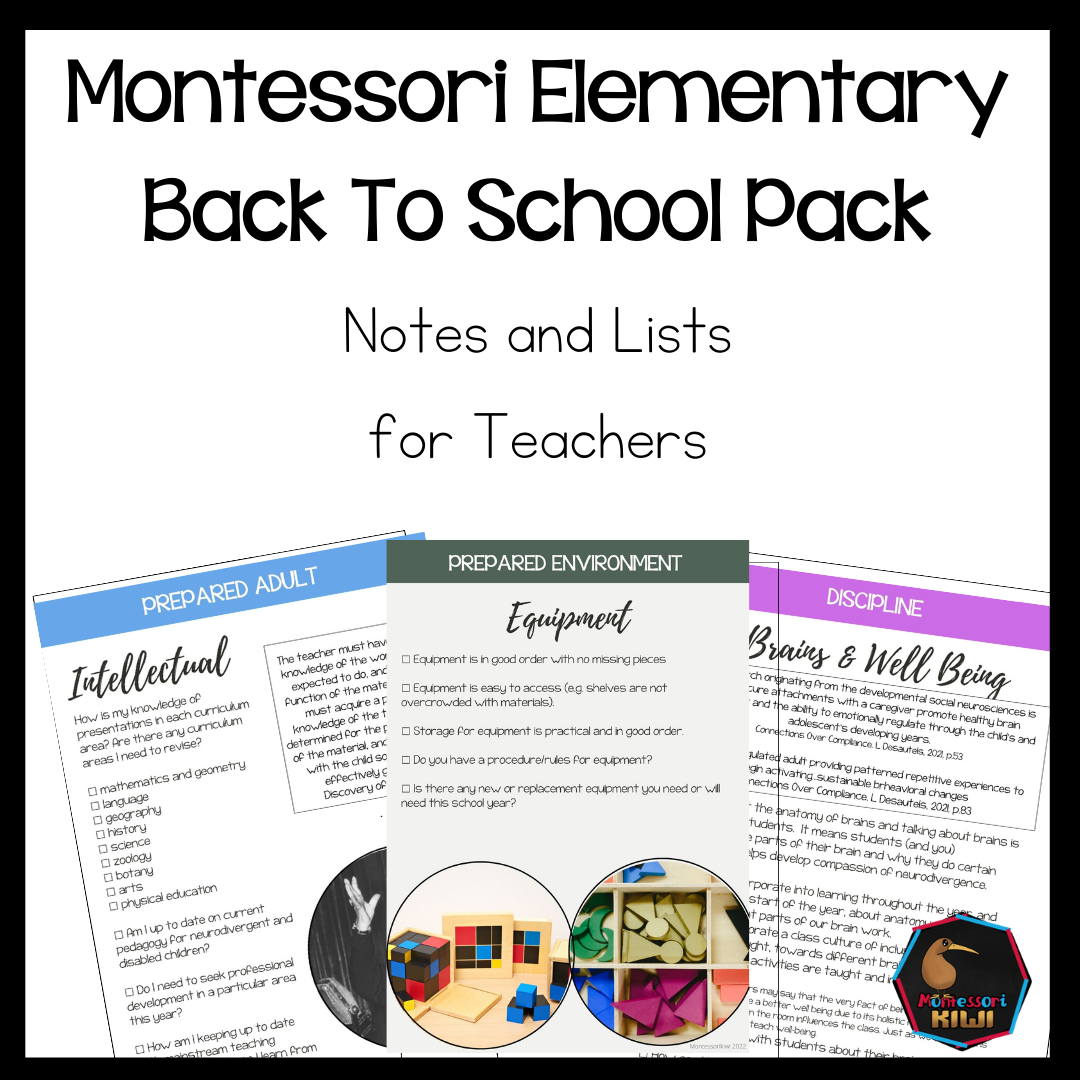
The Montessori Back-to-School Teacher Checklist is a 21-page reflection and planning pack designed to help you prepare the classroom, the adults and the systems around the children before the school year begins.
It is part of the MontessoriKiwi Back-to-School Series: practical resources created to help Montessori elementary teachers begin the year with greater clarity, consistency and confidence.
At a glance
Series: MontessoriKiwi Back-to-School Series
Format: 21-page printable PDF
Designed for: Montessori elementary teachers, guides, assistants, classroom leaders and homeschool educators
Use it for: Beginning-of-year preparation, classroom setup, team planning, staff discussion and professional reflection
Main sections: Prepared environment, prepared adult, assistants, routines and expectations, work plans, relationships, wellbeing, communication, accessibility and inclusion
Approach: Reflective, inclusive, neurodiversity-aware and practical
Best used: Before students return, during teacher-only days or as a team discussion tool
Important: This is a reflective planning checklist, not a legal, licensing or compliance document
Start the year by planning beyond the shelves
It is easy to spend most of your preparation time arranging materials and making the classroom attractive.
But many of the challenges that emerge during the first weeks of school are connected to questions that were never discussed:
- Where will lessons be given?
- How will children get the teacher’s attention during another lesson?
- Can all children move around the classroom safely and independently?
- What happens when a child needs quiet, movement or sensory regulation?
- How will unfinished work be managed?
- What routines will surround work plans, technology and notebooks?
- What does the assistant understand their role to be?
- How will the adults communicate throughout the day?
- Are expectations clear, realistic and developmentally appropriate?
This checklist helps you consider these questions before they become daily frustrations.
Part of the Back-to-School Series: This resource focuses on the thinking that happens behind the classroom setup. It complements your teacher binder, work plans, family forms and first-week activities by helping you establish the environment and systems in which those resources will be used.
Section 1: The prepared environment
The first section helps you examine whether the physical classroom supports independence, accessibility and purposeful work.
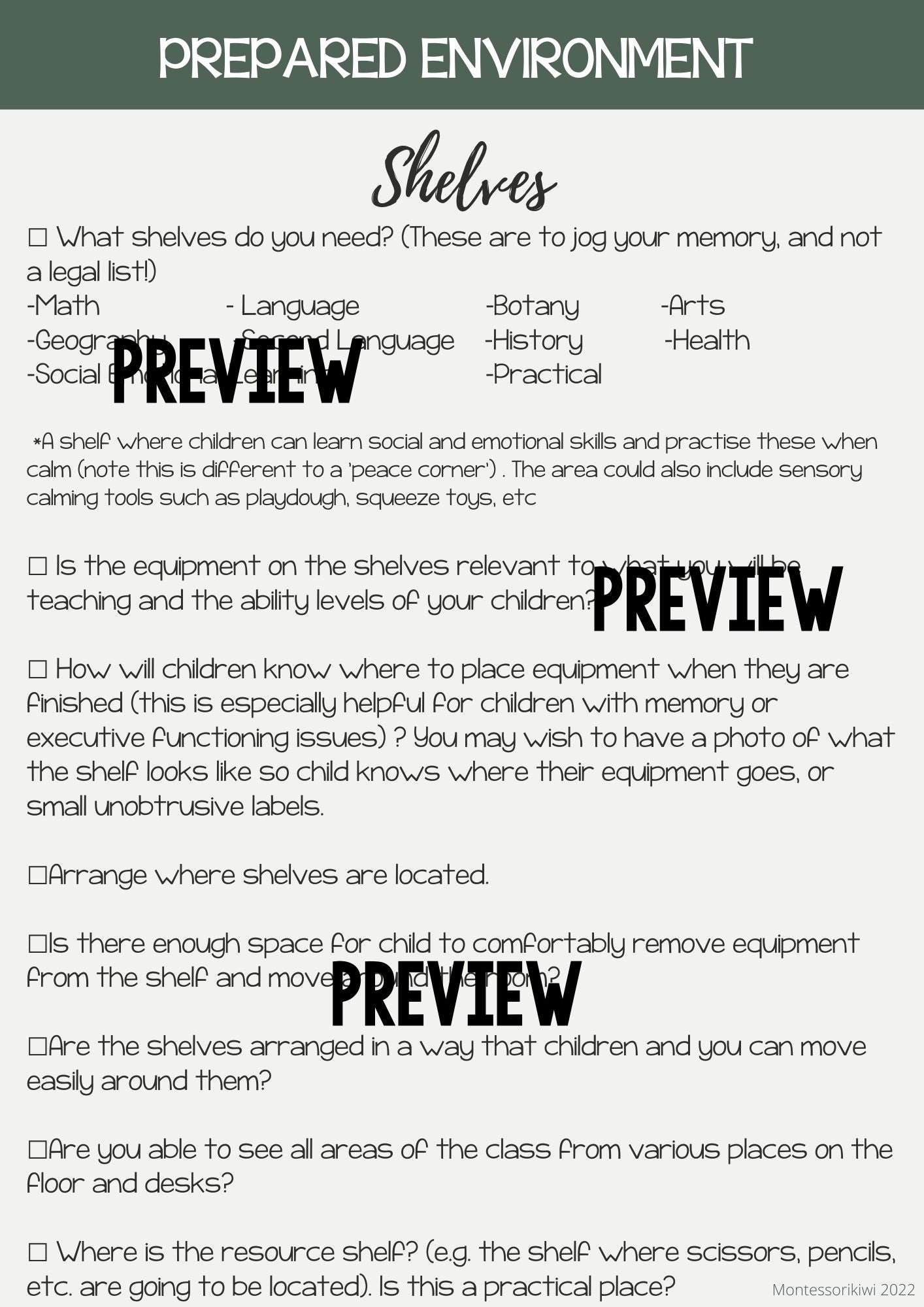
Shelves and curriculum areas
Prompts help you consider:
- which curriculum shelves are needed
- whether materials match current teaching and student ability levels
- how children will know where materials belong
- whether photographs or subtle labels could support memory and executive functioning
- the placement of mathematics, language, geography, history, science, arts and practical-life materials
- whether a social and emotional learning area is needed
- whether children can remove and return work comfortably
- whether the adults can see the different areas of the classroom
The resource encourages teachers to think about a prepared environment that is usable—not simply visually appealing.
Equipment and storage
Review whether:
- materials are complete and in good condition
- shelves are overcrowded
- storage systems are practical
- children understand how to use and return equipment
- replacement materials will be needed during the year
Teaching spaces
Plan where individual, small-group and whole-class lessons will occur.
The checklist also asks you to consider how children who are working independently can request help without repeatedly interrupting a lesson. Suggested systems include leaving a name card beside the teacher or recording a name on a whiteboard.
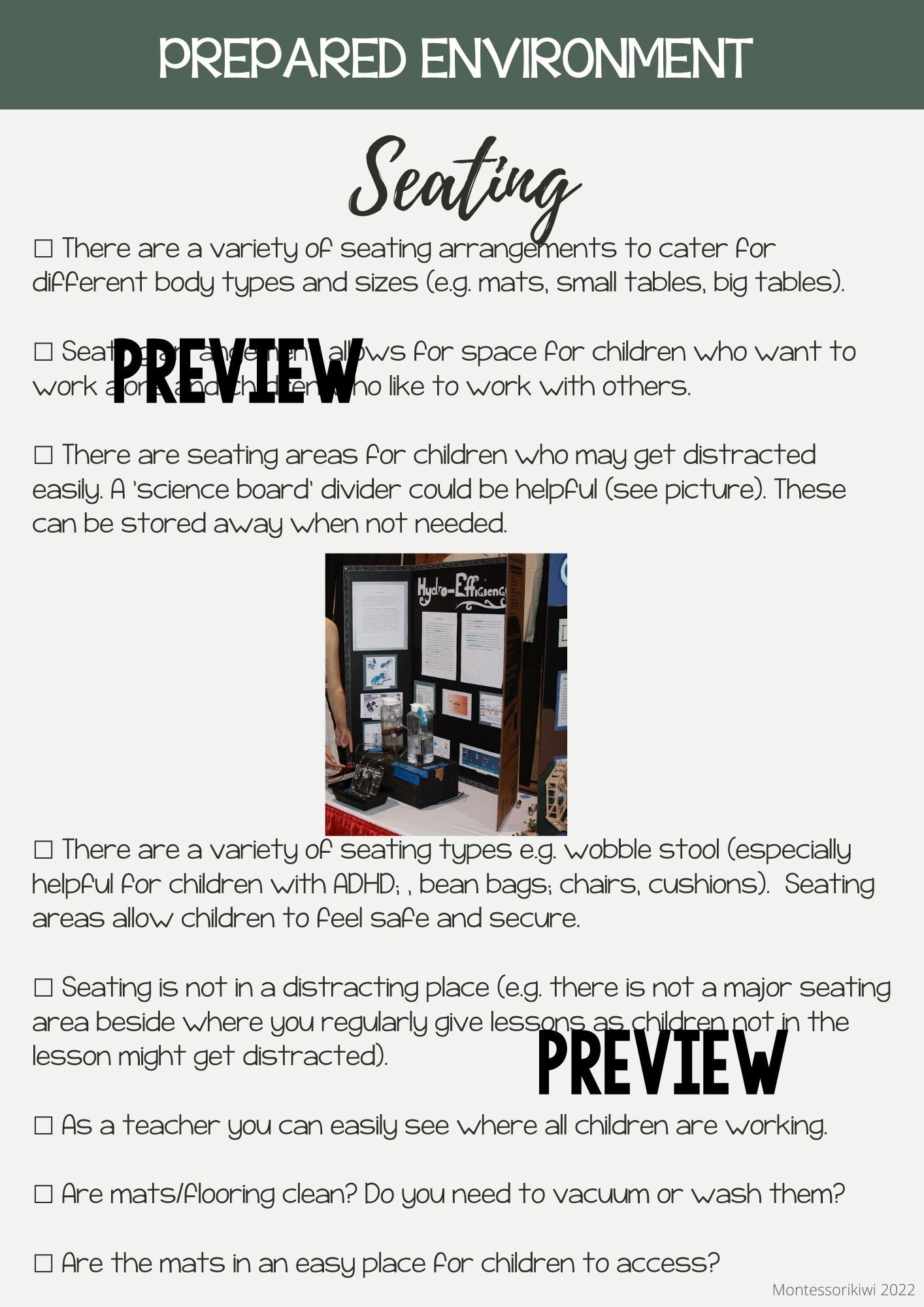
Seating and movement
Consider whether the environment includes:
- individual and collaborative work areas
- tables, floor mats and alternative seating
- spaces for children who are easily distracted
- options for children who need movement
- safe and comfortable seating for different bodies
- clear lines of sight for the adults
- accessible storage for mats and floor-work materials
The resource specifically encourages teachers to consider children who need quiet, sensory support, observation time, movement or additional language support.
Section 2: The prepared adult
Preparing the classroom also means preparing yourself.
This section invites honest reflection on your knowledge, communication, pace, wellbeing, assumptions and teaching style.
Curriculum knowledge
Review your confidence across:
- mathematics and geometry
- language
- geography
- history
- science
- zoology
- botany
- arts
- physical education
You are also prompted to consider professional development, observation systems and current pedagogy relating to neurodivergent and disabled children.
Communication and physical presence
Reflect on questions such as:
- Do I appear rushed or unprepared?
- What do my facial expressions and body language communicate?
- Are my instructions clear?
- Do I speak respectfully while still giving structure?
- How do I create warmth and appropriate humour?
- What physical self-care is built into my day?
Beliefs, regulation and teaching style
The checklist encourages deeper consideration of:
- personal strengths and areas for growth
- unexamined perspectives and belief systems
- ways to regulate and recharge
- authenticity in relationships
- clear boundaries combined with warmth and respect
- whether your adult presence aligns with Montessori principles
Section 3: Preparing to work with an assistant
Unclear adult roles can create confusion for staff and children from the first day.
The assistant section helps teaching teams discuss:
- shared goals
- clearly defined roles
- classroom procedures
- interpersonal relationships
- daily communication
- regular meeting times
- the strengths each adult brings
- professional growth in Montessori practice
- knowledge of disability and neurodivergence
- accountability and team culture
A simple leadership pyramid illustrates that strong goals are supported by clear roles, agreed procedures and healthy relationships.
This section is particularly useful during teacher-only days or beginning-of-year meetings with classroom assistants.
Section 4: Routines and expectations
Children cannot meet expectations that have not been clearly considered, modelled and taught.
The routines section helps you plan what will happen around:
- entering and exiting the classroom
- arrival and welcoming students
- lining up
- moving through shared school spaces
- notebooks and presentation standards
- technology access and storage
- whole-class and circle times
- lesson expectations
- requesting teacher help
- follow-up work
- work mats and tables
- unfinished work
The prompts encourage teachers to decide which activities are compulsory, which are optional and whether expectations genuinely reflect children’s developmental abilities and individual needs.
Section 5: Work plans and learning records
A work plan should support independence—not become another barrier for children who find writing, organisation or memory difficult.
This section helps you consider:
- which work-plan or diary format you will use
- whether one format suits every learner
- how children will set and monitor goals
- whether children may follow a preferred work pattern
- how examples and visual models will be provided
- how English-language learners will be supported
- whether digital options are available for children with writing difficulties
This makes the resource a natural companion to the editable work plans in the MontessoriKiwi Back-to-School Series.
Section 6: Relationships before discipline
The final section moves beyond rules and consequences to consider the relationships, communication and understanding that support a healthy classroom community.
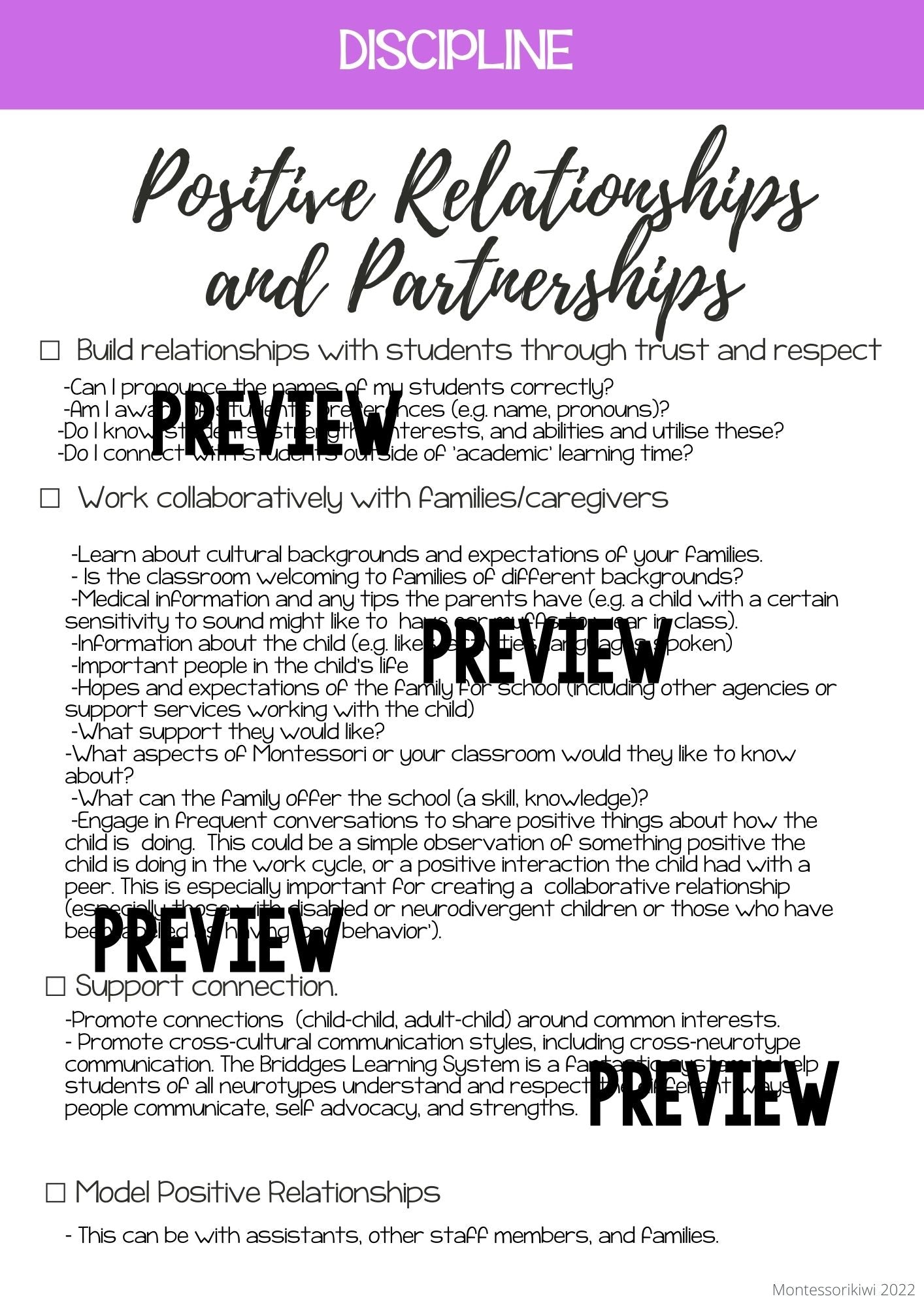
Positive family partnerships
Prompts help you plan how to learn about:
- family cultures and expectations
- languages spoken
- children’s interests, strengths and sensitivities
- important people in each child’s life
- family hopes for the school year
- outside agencies and support services
- the knowledge and skills families can contribute
The resource also encourages frequent positive communication, especially with families whose children have previously been described mainly through behavioural difficulties.
Brains and wellbeing
Reflect on how you will:
- teach children about the brain
- build acceptance of different brain structures
- include wellbeing instruction in the school day
- check in with children about their regulation and emotional state
- teach calming and self-monitoring strategies
Language and behaviour
The pack is grounded in the understanding that behaviour communicates a need.
Teachers are encouraged to consider whether children have the language needed to request:
- help with an activity
- space from another person
- a regulation tool
- a particular object
- conversation or connection
- an end to something they dislike
It also prompts teachers to explicitly teach a wider emotional vocabulary, including words such as frustrated, unsure, distracted, energetic, afraid and focused.
Accessibility and inclusion
Review whether your classroom systems support children with differences in:
- culture
- language
- speech and communication
- memory
- attention
- sensory processing
- body language
- social interaction
- neurotype
The questions encourage teachers to move away from assumptions such as equating eye contact, stillness or one communication style with attention and respect.
Use it independently or with your teaching team
You might use this checklist:
- during the week before school begins
- as part of a teacher-only day
- while physically walking through the classroom
- during planning meetings with an assistant
- to identify tasks that still need to be completed
- as a reflective professional-development activity
- to revisit classroom systems after the first few weeks
- when moving into a new Montessori environment
You do not need to complete every prompt in one sitting. Use the pages that are most relevant to your role, classroom and stage of preparation.
Suitable for new and experienced Montessori educators
New teachers can use the checklist to uncover practical questions they may not yet know to ask.
Experienced educators can use it to challenge routines that have become automatic and consider whether the environment still reflects current students, current understanding and a more inclusive approach to Montessori education.
The purpose is not to create a single “correct” classroom. It is to prompt thoughtful decisions about the particular children and adults who will share your environment this year.
Complete your Montessori back-to-school preparation
Use this teacher checklist alongside other resources in the MontessoriKiwi Back-to-School Series:
-
Montessori Elementary Teacher Binder
Organise classroom records, planning information and essential teacher documentation. -
Editable Montessori Work Plans
Choose from multiple formats to support different ages, learning needs and levels of independence. -
Editable Montessori Family Conference Forms
Prepare for clear, strengths-based communication with families throughout the year. -
Montessori Elementary Back-to-School Bundle
Save time with a wider collection of beginning-of-year classroom, teacher and student resources. - Explore the Complete Montessori Back-to-School Series
Continue planning your Montessori programme:
Created from real Montessori classroom experience
I am a Montessori-trained educator, New Zealand registered teacher, school founder and former homeschool parent.
I have worked in Montessori, mainstream and mixed-age environments and lead a small Montessori school supporting children with a wide range of strengths, needs and learning profiles.
This checklist reflects the understanding that preparing a Montessori classroom is not only about materials. It is also about relationships, accessibility, adult regulation, clear systems and knowing the children who will use the environment.
The resource has developed alongside my own teaching practice and my growing understanding of inclusive, neurodiversity-affirming education.
Digital download information
This is a digital printable resource. No physical product will be shipped.
After purchase, you can download the PDF and print the complete pack or only the sections most relevant to your back-to-school planning.
Purchase includes a licence for use by one teacher in one classroom or by one homeschool family. Please do not share the digital file with other teachers, upload it to shared drives or groups, or distribute it across a school without purchasing the appropriate additional licences.
Prepare more than the classroom
Begin the school year with intentional spaces, clearer routines, stronger adult teamwork and systems that support the children who are actually in front of you.
Download the Montessori Back-to-School Teacher Checklist and begin your classroom preparation with the questions that matter.
