




montessorikiwi
Montessori Spheres of the Earth Printable | Earth Systems & Cosmic Education (cosmic)
Montessori Spheres of the Earth Printable | Earth Systems & Cosmic Education (cosmic)
Couldn't load pickup availability
At a Glance
Best for: Montessori Cosmic Education, Earth science, geography, environmental science, homeschool, and elementary classrooms
Age range: Approximately 7–12 years / Montessori 6–12
Format: 58-page printable PDF
Prep: Print and cut selected cards; laminate optional. Some activities require no prep beyond printing.
Includes: Four-spheres matching activity, real-photo sorting cards, local environment activity, 32 differentiated Earth systems interaction task cards, detailed answer keys, observation walk, human impact and stewardship activities, and teacher guidance
Help children move beyond simply memorising the names of the atmosphere, hydrosphere, biosphere and geosphere/lithosphere and begin to see something much bigger:
Earth is an interconnected system.
This Montessori-inspired Spheres of the Earth activity pack helps children understand how air, water, land, living things and human activity are constantly connected.
Instead of stopping at four vocabulary definitions, children explore real examples, sort photographs, identify interactions between Earth systems, observe their local environment and consider how human choices can affect multiple spheres at once.
This is ideal for Montessori 6–12 classrooms, lower elementary, upper elementary, homeschool, Earth science, geography and Cosmic Education.
At a Glance
Best for: Montessori elementary, ages approximately 7–12, homeschool, Earth science, geography, environmental science and Cosmic Education
Topics covered:
- atmosphere
- hydrosphere
- biosphere
- geosphere/lithosphere
- Earth systems
- interactions between spheres
- cause and effect
- environmental observation
- human impact
- stewardship
- systems thinking
Includes:
- teacher and homeschooler introduction
- practical teaching guidance
- four-spheres matching activity
- control card
- real-photo sorting activity
- local environment drawing task
- 32 differentiated sphere-interaction task cards
- three levels of increasing complexity
- detailed answer keys with explanations
- observation walk activity
- local Earth systems investigation
- human impact and stewardship activities
The Problem With Teaching the Four Spheres in Isolation
It is easy for children to learn:
- atmosphere = air
- hydrosphere = water
- biosphere = living things
- geosphere or lithosphere = land and rock
But memorising four definitions is not the same as understanding how Earth actually works.
Children need opportunities to see that:
- rivers shape land
- plants affect the atmosphere
- wind moves soil
- rain changes rivers and hillsides
- living things depend on water and land
- human activity can affect several Earth systems at once
That deeper understanding is where real scientific thinking begins.
This resource was created to help children move from simple identification to classification, observation, reasoning, discussion and increasingly complex systems thinking.
A Clear Learning Progression
The activities build gradually, so children are not thrown into abstract Earth science concepts too quickly.
Activity 1: Introduce the Four Spheres
Children learn the names and basic definitions of the atmosphere, hydrosphere, biosphere and geosphere/lithosphere.
They use a control card to check their work independently, making this especially suitable for Montessori shelf work and repeat practice.
Activity 2: Real-Photo Sorting
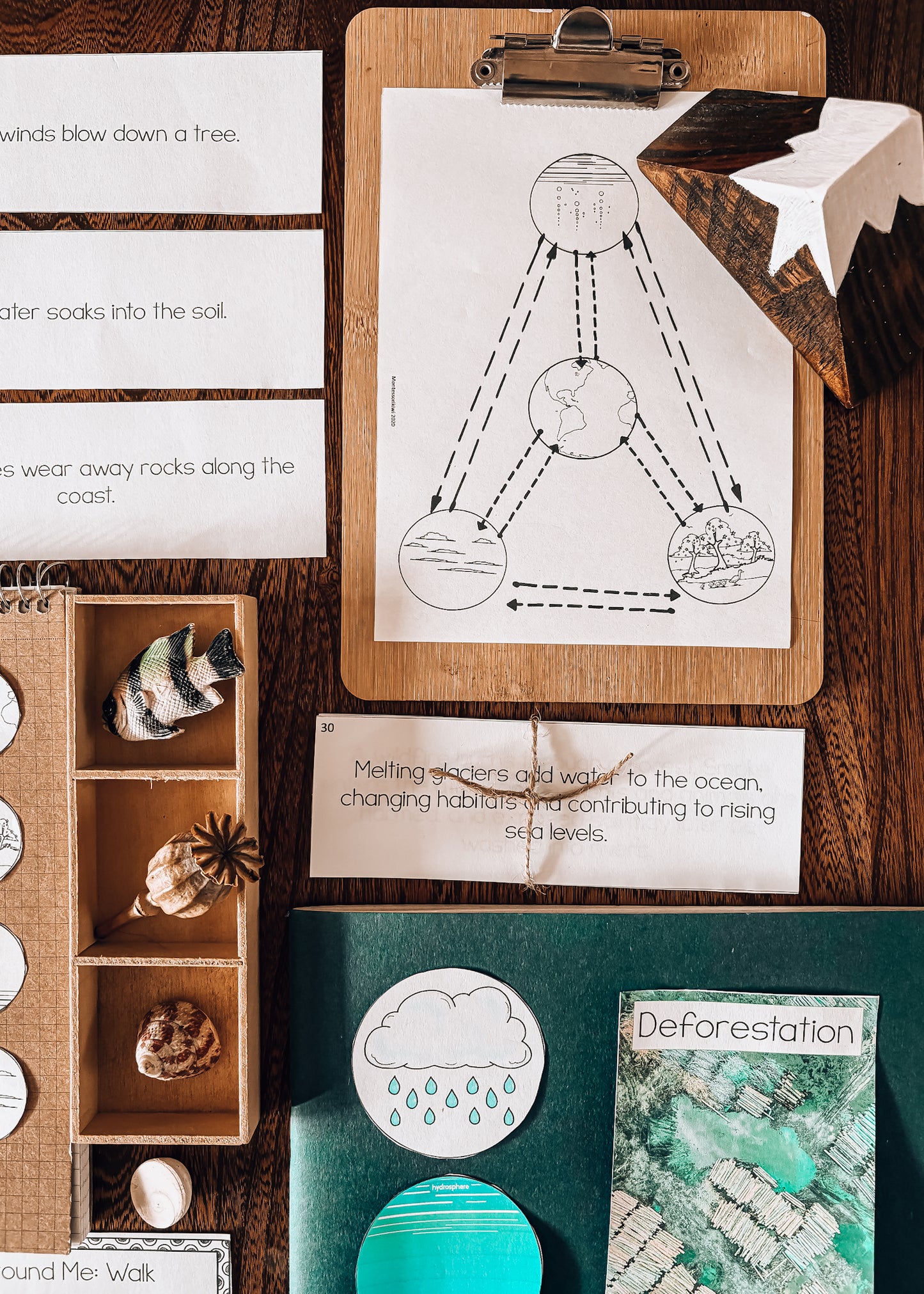
Children sort real photographs into the four Earth spheres.
Examples include:
- forests
- animals
- fungi
- plankton
- rocks
- mountains
- volcanoes
- sand dunes
- clouds
- wind
- smoke
- rain
- rivers
- oceans
- groundwater
- glaciers
This helps children move beyond abstract definitions and recognise Earth systems in the real world.
Activity 3: My Local Earth Spheres
Children create their own diagram showing examples of Earth’s spheres in the place where they live.
They may include local plants, animals, weather, rivers, coastlines, hills, soil or other familiar features.
This makes the learning personal and meaningful.
Activity 4: Which Spheres Are Interacting?
This is where the deeper thinking begins.
Children work through 32 differentiated task cards arranged across three levels.
They begin with simple two-sphere interactions such as:
- plant roots holding soil in place
- ocean waves wearing away rocks
- wind blowing down trees
- rivers creating habitats
They then move into more complex examples involving three or four systems, including:
- drought
- landslides
- volcanic eruptions
- wildfires
- cyclones
- deforestation
- melting glaciers
- wetlands
- agricultural runoff
The aim is not just to find the “correct answer”, but to explain why particular spheres are involved.
Some scenarios may allow more than one defensible answer, and thoughtful reasoning is encouraged.
Activity 5: Observation Walk and Local Investigation
Children take their learning outdoors.
They observe examples of the four spheres around them and look for interactions such as:
- wind moving leaves
- rain soaking into soil
- birds using puddles
- roots holding a bank together
- people changing the local environment
This helps children connect classroom learning with the real world.
Activity 6: Human Impact and Stewardship
Children consider how human actions affect Earth’s systems.
They explore examples such as:
- cutting down forests
- polluting rivers
- planting trees
- building cities
- burning fossil fuels
- protecting wetlands
- composting
- restoring habitats
They can classify impacts as helpful, harmful or mixed and identify which spheres are affected.
This opens the door to rich discussion about environmental responsibility, complexity and stewardship.
Strong Montessori Cosmic Education Connections
This resource fits naturally within Montessori Cosmic Education because it helps children see relationships rather than isolated facts.
Children are encouraged to understand that:
- Earth is made up of interconnected systems
- no sphere exists completely on its own
- living things depend on air, water and land
- natural processes shape habitats and landscapes
- humans are part of the biosphere
- human choices can affect many parts of Earth at once
- everything has a place within a much larger system
This work pairs especially well with:
- the First Great Story
- the Coming of Life
- Earth science
- physical geography
- ecology
- environmental science
- weather
- erosion
- volcanoes
- the water cycle
- habitats
- sustainability
- human impact
Perfect For
Use this resource for:
- Montessori 6–9 classrooms
- Montessori 9–12 classrooms
- mixed-age elementary classrooms
- homeschool
- Earth science units
- geography shelves
- Cosmic Education follow-up
- independent work
- small-group lessons
- environmental science
- project-based learning
Created by an Experienced Montessori Teacher
I am a Montessori-trained and state-trained teacher from New Zealand and the founder of a Montessori school.
I create resources for real classrooms, with a focus on helping children think deeply, work independently, make meaningful connections and see themselves as part of a much bigger world.
This resource was designed to do more than teach four vocabulary words.
It helps children begin to understand that Earth is a connected system, and a change in one part can affect many others
Continue Exploring Earth Systems
The Spheres of the Earth are a natural starting point for wider studies of the atmosphere, rocks, landforms, volcanoes, the formation of Earth and the Montessori First Great Story.
Extend the learning with these related Montessori Earth science and Cosmic Education resources.
Build a Complete Earth Science Study
Children who are beginning to see how air, water, land and living things interact are often ready to investigate the individual systems in greater depth.
These complementary resources help children move from broad systems thinking into more focused studies of the atmosphere, geology, Earth’s structure and the forces that shape our planet.
Montessori Atmosphere Layers Activity
Take a closer look at the atmosphere through reading, visual matching, diagram work and creative retelling.
This is a strong next step for children who become interested in the atmosphere while completing the Spheres of the Earth activities. It also connects naturally with weather, climate, the water cycle and the formation of Earth.
Montessori Rocks and Rock Cycle Unit
Help children investigate the geosphere through rock classification, the rock cycle, weathering, erosion, experiments, charts and independent geology work.
This substantial unit moves children beyond memorising the three rock types and helps them understand the processes that continually change the solid Earth.
Space, Sun and Earth Impressionistic Charts
Introduce big Earth science and physical geography concepts through visual Montessori impressionistic charts and supporting presentations.
Children can explore the Sun, Earth, atmosphere, hydrosphere, continental movement, weathering, erosion, rocks, volcanoes and the forces that make life on Earth possible.
Try a Free Layers of the Earth Activity
Looking for a simple activity for younger learners or a quick introduction to Earth’s internal structure?
This free printable puzzle introduces the crust, mantle, outer core and inner core through hands-on matching and self-correcting control cards.
Looking for a Complete First Great Story Study?
Montessori First Great Story Bundle
The Spheres of the Earth resource works beautifully as follow-up work after the Montessori First Great Story.
The First Great Story Bundle gives you a wider collection of presentation and independent learning materials for exploring the formation of the universe and Earth, matter, stars, land, water, the atmosphere and other big scientific ideas introduced through the story.
Choose this bundle when you want a focused collection centred on the First Great Story and its immediate follow-up pathways.
Want Your Cosmic Education Shelves Prepared Across the Year?
Best-Value Upgrade: Montessori Cosmic Education Bundle
The Montessori Cosmic Education Bundle gives you a much larger library of Great Lesson follow-up work, Earth science, history, geography, Fundamental Needs, timelines, research activities, classification materials and independent shelf work for ages 6–12.
It is ideal when you do not want to keep searching for a separate resource every time a child’s interest moves from Earth systems into rocks, volcanoes, life, humans, history, geography or culture.
Spend less time preparing individual activities and build a connected Cosmic Education programme that children can return to throughout the year.
More Focused Earth Science Extensions
- Volcano Vocabulary and Definition Cards — build scientific language around volcanoes, magma, lava, vents, craters and plate boundaries
- Earthquake Matching and Vocabulary Cards — explore faults, tectonic movement, epicentres, magnitude, tsunamis and related Earth processes
- Montessori Geographic Impressionistic Chart Bundle — extend Earth science into wider physical geography, land and water forms and impressionistic Cosmic Education lessons
Share


-
Items are secured / Terms of Use
Our items are secured. They are not able to be altered. We secure our items because they are our intellectual property and because we use art from artists who require that we secure our files.
You may not:
-resell our items or use them for commercial gain
-claim these items as your own
-modify this resource
-share them with others by any means e.g. electronic or hard copy
-
All Items are instant downloads
You will not get a printed product in the mail.
-
All prices are in USD
Due to the international nature of our customers our prices are all in USD. If you wish to work out the conversion before you buy we recommend www.xe.com