


montessorikiwi
Montessori Pythagorean Theorem Activities (Ages 10–12) – Hands-On Geometry Practice Made Simple
Montessori Pythagorean Theorem Activities (Ages 10–12) – Hands-On Geometry Practice Made Simple
Couldn't load pickup availability
Your student can substitute numbers into a² + b² = c²—but do they understand what the equation represents or know when to use it?
The Pythagorean theorem can quickly become another abstract formula to memorise. Children may remember to square and add, yet still confuse the hypotenuse with a leg, struggle to interpret diagrams or overlook the right triangle hidden inside a real-life problem.
This Montessori Pythagorean Theorem Activity Pack gives upper-elementary learners a more concrete pathway into the theorem. Children explore a visual proof, construct the relationship between the three squares, review its mathematical history and apply the theorem to illustrated geometry problems.
At a Glance
- Learning focus: Pythagorean theorem, right triangles and missing side lengths
- Includes: Visual proof work, construction activity, history page and task cards
- Task cards: 14 illustrated real-world problems
- Skills: Finding a hypotenuse, finding a leg and applying a² + b² = c²
- Best for: Montessori upper elementary, homeschool and geometry centres
- Suggested ages: Approximately 10–13 years
- Length: 22 printable pages
- Format: Instant digital PDF download
Help Children See Why the Formula Works
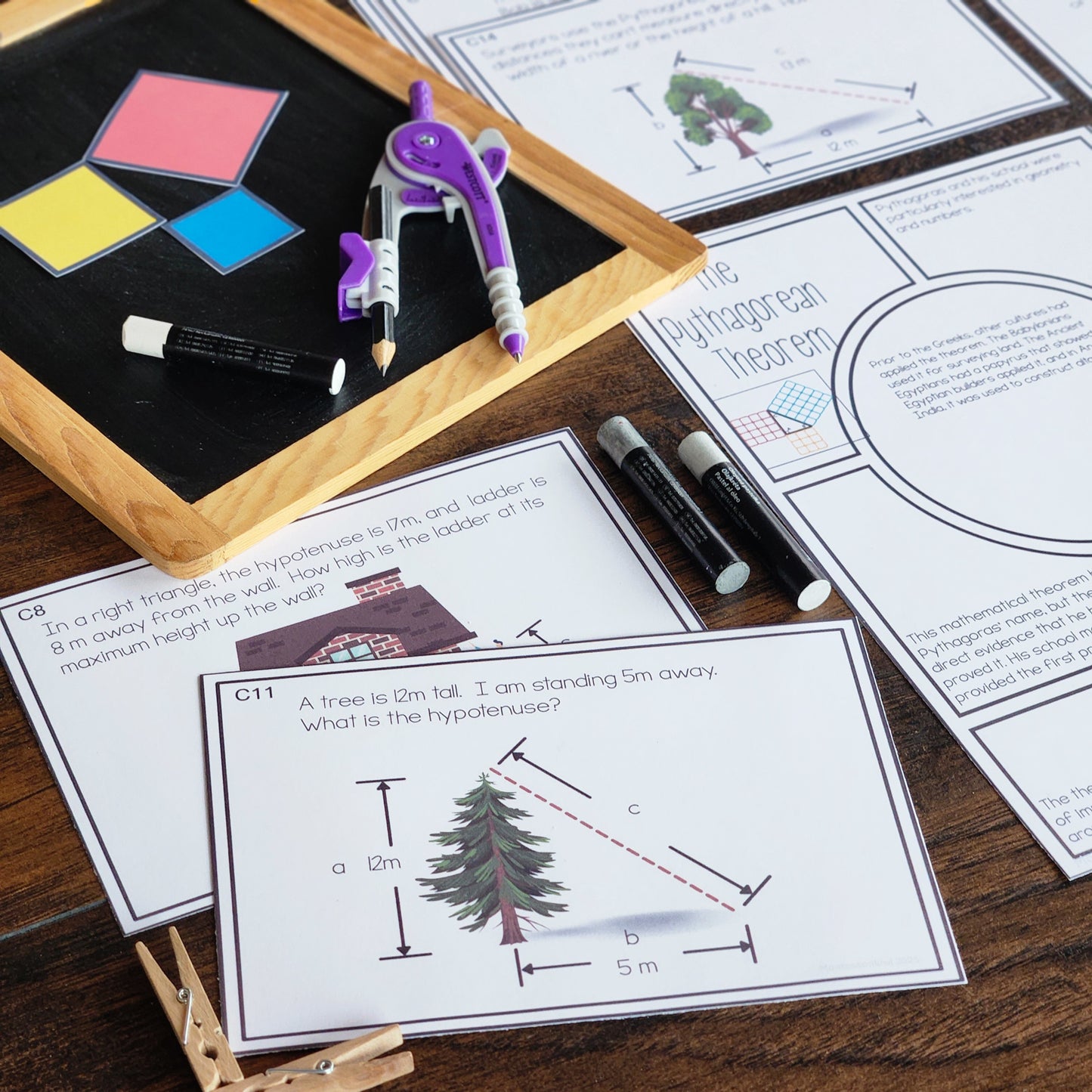
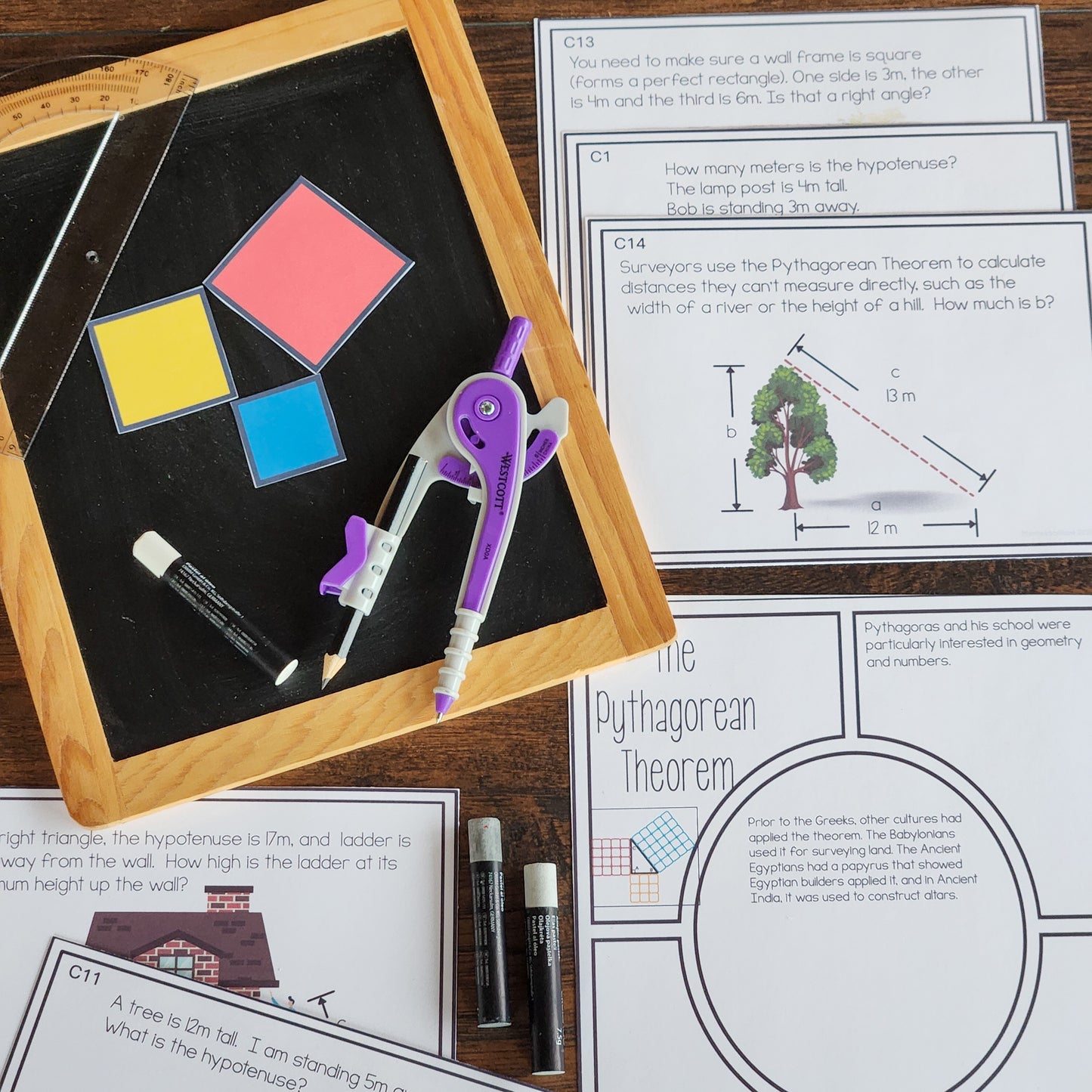
The opening activities connect each side of a right triangle with a square. Children colour and compare the areas, then cut and arrange the three squares to build their own representation of the theorem.
This makes the central relationship visible:
a² + b² = c²
The areas of the squares on the two shorter sides combine to equal the area of the square on the hypotenuse.
Instead of encountering the equation as an unexplained rule, learners can connect the symbols with the triangle and the areas they represent.
Bridge the Gap Between Montessori Materials and Formal Geometry
Older elementary students are often ready for advanced mathematics but still benefit from visual structure and purposeful hands-on work. This pack preserves a concrete entry point while helping learners move confidently into equations, square roots and practical problem solving.
What Is Included?
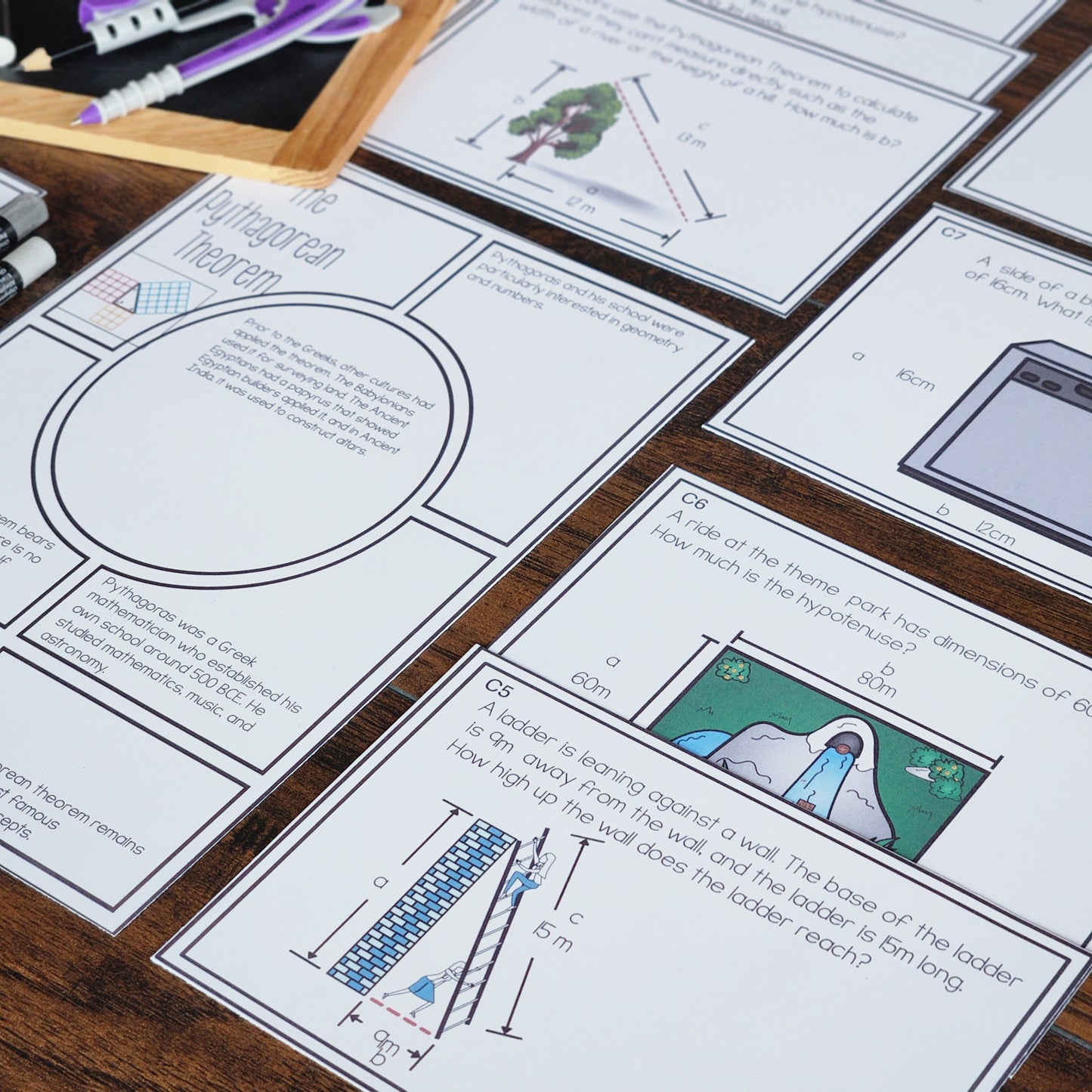
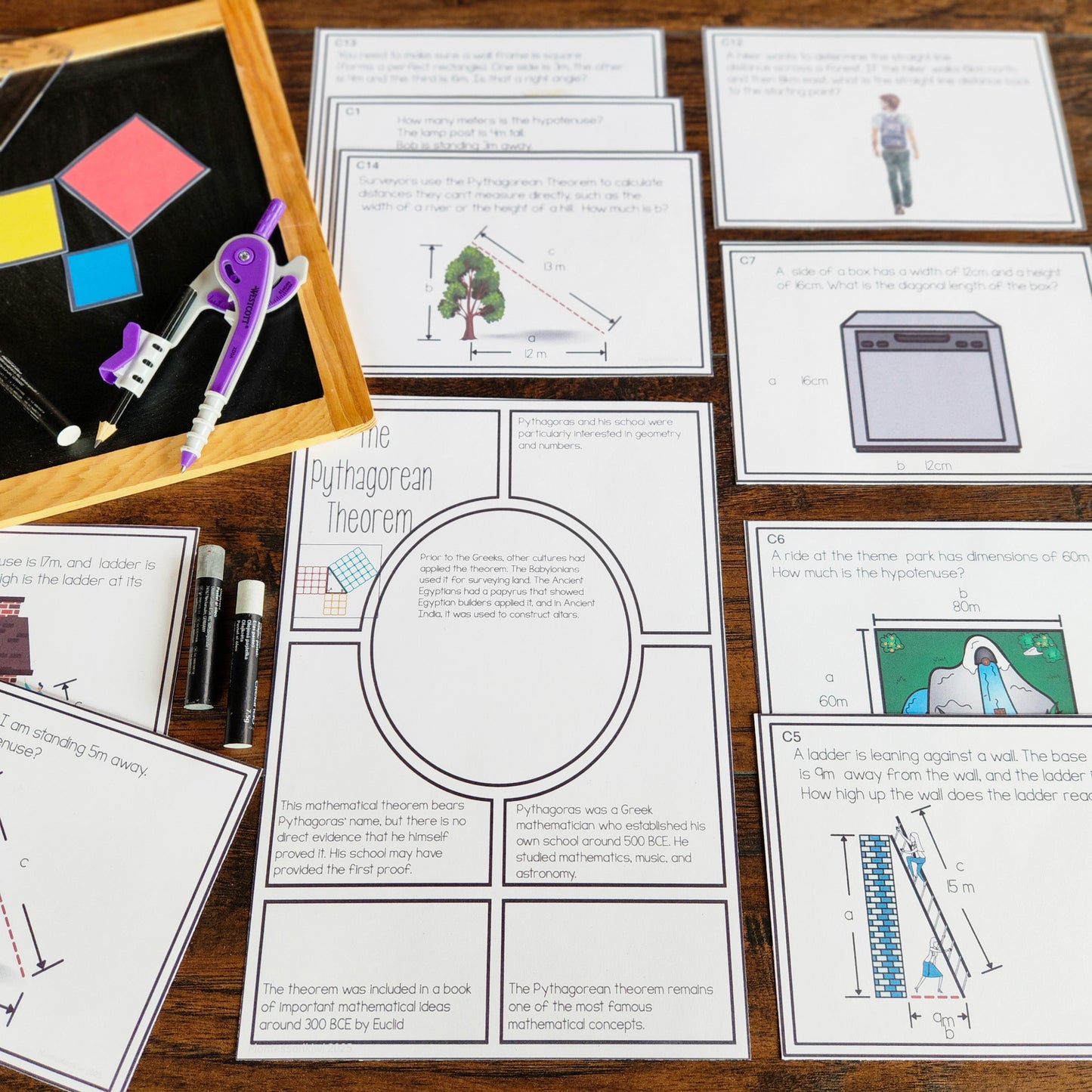
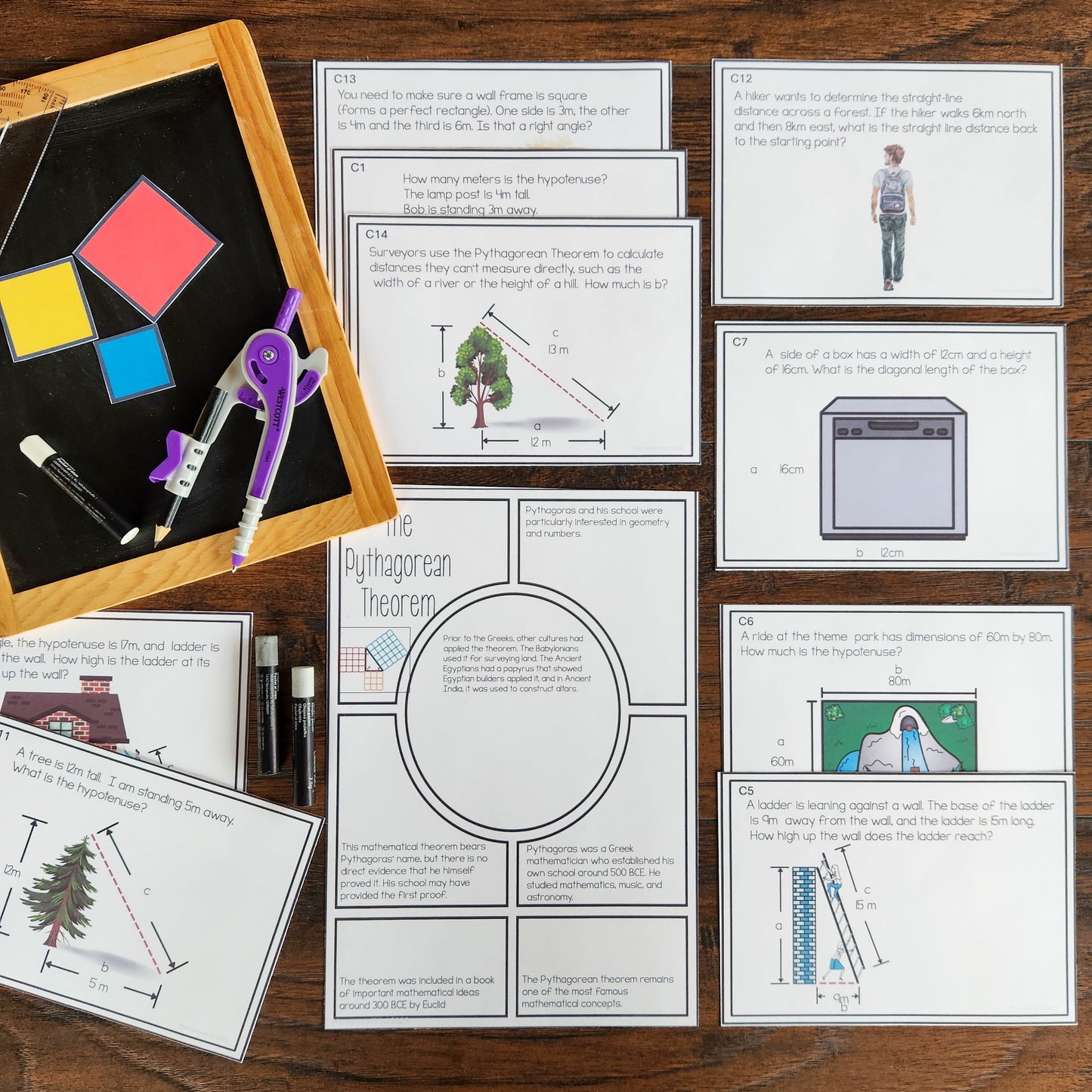
- A visual theorem diagram showing the legs, hypotenuse and three related squares
- A colouring activity using distinct colours for the three square areas
- A cut-and-build Pythagorean theorem model
- A history and comic-style planning page introducing Pythagoras and earlier uses of the relationship
- A worked example for finding the hypotenuse
- A worked example for finding a missing leg
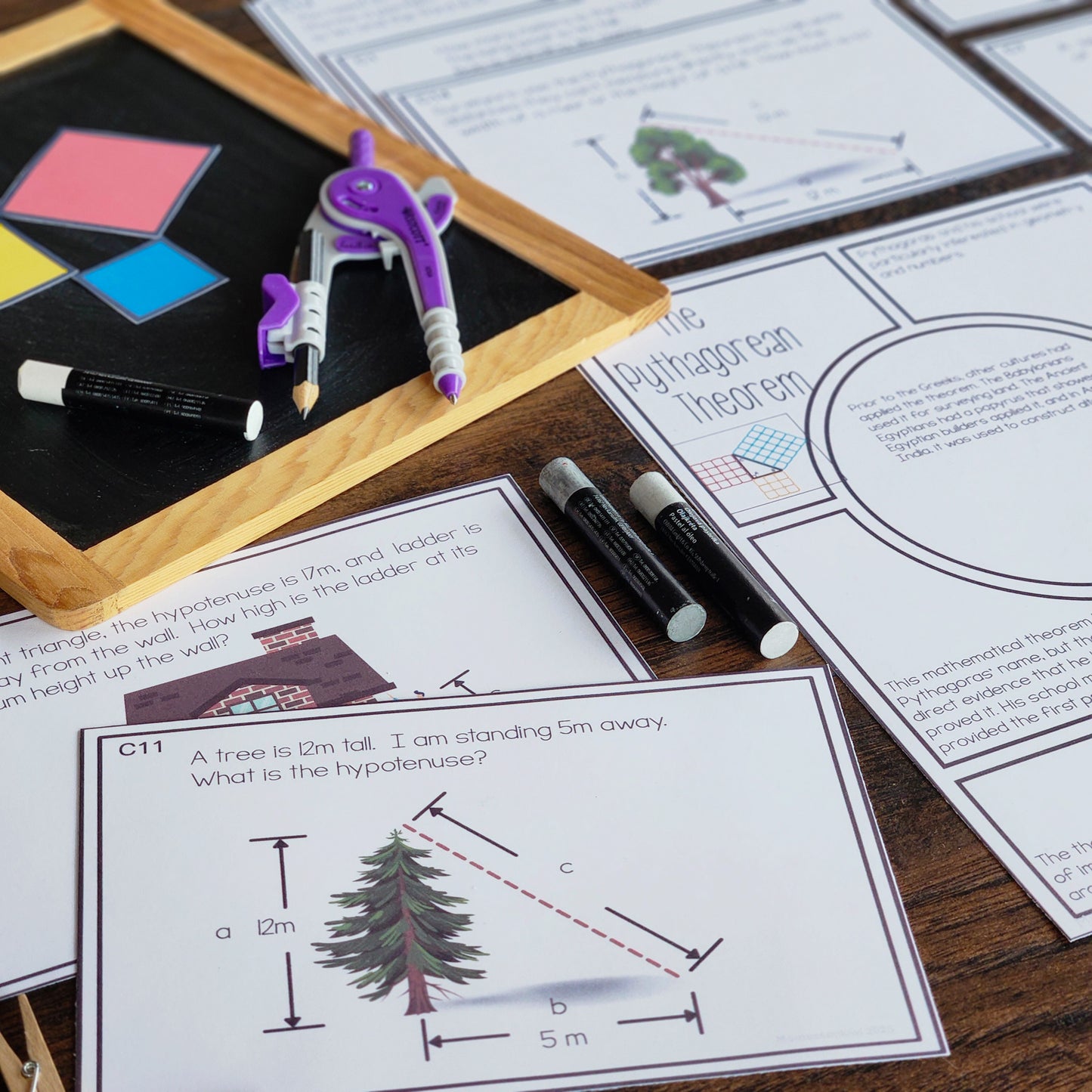
- 14 illustrated task cards
- Corresponding answer pages
- Questions using centimetres, metres and kilometres
Learn to Identify the Three Sides
Before solving an equation, children need to recognise:
- the two legs that meet to form the right angle;
- the hypotenuse, which sits opposite the right angle;
- which side is unknown; and
- whether the calculation requires addition or subtraction of squared values.
The labelled visual model supports this vocabulary before students begin the independent cards.
Worked Examples for Both Problem Types
Finding the Hypotenuse
The first guide models a triangle with legs of 3 and 4 units. Students follow the full process:
- write the theorem;
- substitute the known values;
- square both legs;
- add the squared values; and
- find the square root.
Finding a Missing Leg
The second guide demonstrates how to work backwards when the hypotenuse and one leg are known.
Children learn that they must subtract the known squared leg from the squared hypotenuse before finding the square root.
Fourteen Real-World Geometry Problems
The illustrated task cards ask learners to apply the theorem in varied contexts, including:
- the distance between a person and the top of a lamp post;
- the height of a bookcase reached by a ladder;
- the dimensions and diagonals of envelopes;
- a ladder leaning against a wall;
- the diagonal length across a theme-park ride;
- the diagonal of a rectangular appliance;
- the height reached by a ladder beside a house;
- a loading ramp and platform;
- the distance to the top of a statue;
- the hypotenuse formed by a tree and observer;
- a hiker’s straight-line distance across a forest;
- checking whether three measurements form a right triangle; and
- a surveying problem using an indirectly measured distance.
These contexts help children recognise that the theorem is used whenever a right triangle connects height, width and diagonal distance.
Particularly Helpful for Neurodivergent Learners
Each task card presents one contained problem with a labelled diagram, reducing the need to construct the entire visual model mentally. Learners can refer back to the worked examples, use the same step-by-step process each time and check answers independently. The visual proof also supports children who understand spatial relationships more readily than verbal explanations alone.
A Practical Teaching Sequence
- Introduce the triangle vocabulary. Identify the right angle, legs and hypotenuse.
- Complete the visual proof. Colour and compare the three square areas.
- Build the theorem model. Cut and position the squares around a right triangle.
- Explore the history. Use the comic-planning page to review the development of the theorem.
- Model finding the hypotenuse. Work through the first guided example.
- Model finding a leg. Compare how the equation changes.
- Offer selected task cards. Begin with familiar 3–4–5 or related triples.
- Check and discuss. Ask children to explain why they added or subtracted the squared values.
Recommended Prior Knowledge
Learners should already understand:
- right-angled triangles;
- square numbers;
- square roots of common perfect squares;
- multiplication and subtraction;
- basic algebraic substitution; and
- how to interpret measurements in diagrams.
The included worked examples provide support, but this is intended as follow-up after a teacher presentation rather than a completely independent first introduction.
Ways to Use This Resource
- Montessori upper-elementary geometry shelves
- Pythagorean theorem lessons
- Maths centres
- Independent work cycles
- Partner problem solving
- Homeschool geometry
- Upper-elementary extension
- Real-world measurement studies
- Revision before algebra or trigonometry
- Formative assessment
Please Note
This is a printable digital resource. Physical geometry materials, rulers, scissors and calculators are not included.
The task-card values were selected so the questions can be solved using whole-number square roots without a calculator.
Created by an Experienced Montessori Educator
I’m Lisa—an NZ registered teacher, Montessori-trained educator, school principal and former homeschooler. I create practical resources for mixed-age classrooms and diverse learners, including children who are ready for advanced mathematical ideas but still need a clear visual bridge into abstraction.
Continue Building Upper-Elementary Geometry Skills
-
Browse Montessori Resources for Ages 9–12
Explore advanced geometry, algebra, fractions, decimals, science and independent upper-elementary work. -
Pythagorean Theorem Follow-Up Activities
Return to this individual resource page or pair it with wider upper-elementary maths work. -
Patterns and Rules Task Cards
Strengthen mathematical rule finding and early algebraic reasoning before more formal equation work.
Need a Complete Upper-Elementary Maths Collection?
The Montessori Upper Elementary Maths Bundle brings together advanced work across fractions, decimals, percentages, ratios, algebraic thinking, geometry, measurement, probability and problem solving.
Choose the larger bundle when you need a broad bank of ready-to-print maths resources for approximately ages 9–12 rather than one focused geometry activity.
Teaching Across Ages 6–12?
The Montessori Elementary Maths Bundle offers a wider collection of printable materials for place value, operations, fractions, geometry, measurement and mathematical reasoning across the elementary years.
Explore More Montessori Maths
Browse the Montessori Elementary Maths Collection for hands-on follow-up work, task cards, geometry, operations, fractions and problem solving.
Help Children Understand the Triangle Behind the Formula
Move from a visual proof into worked examples and real-world geometry problems through a clear Montessori-compatible sequence.
Download the Montessori Pythagorean Theorem Activities and help learners use a² + b² = c² with understanding and confidence.
Share
-
Items are secured / Terms of Use
Our items are secured. They are not able to be altered. We secure our items because they are our intellectual property and because we use art from artists who require that we secure our files.
You may not:
-resell our items or use them for commercial gain
-claim these items as your own
-modify this resource
-share them with others by any means e.g. electronic or hard copy
-
All Items are instant downloads
You will not get a printed product in the mail.
-
All prices are in USD
Due to the international nature of our customers our prices are all in USD. If you wish to work out the conversion before you buy we recommend www.xe.com