montessorikiwi
Montessori Patterns & Rules Task Cards | Self-Correcting Math Activities
Montessori Patterns & Rules Task Cards | Self-Correcting Math Activities
Couldn't load pickup availability
Your students can complete “2, 4, 6, 8”—but what happens when the pattern decreases, alternates, begins at 896 or has numbers missing from the middle?
Recognising patterns is not simply about guessing the next item. Children must notice what changes, identify the rule and check whether that rule continues throughout the sequence.
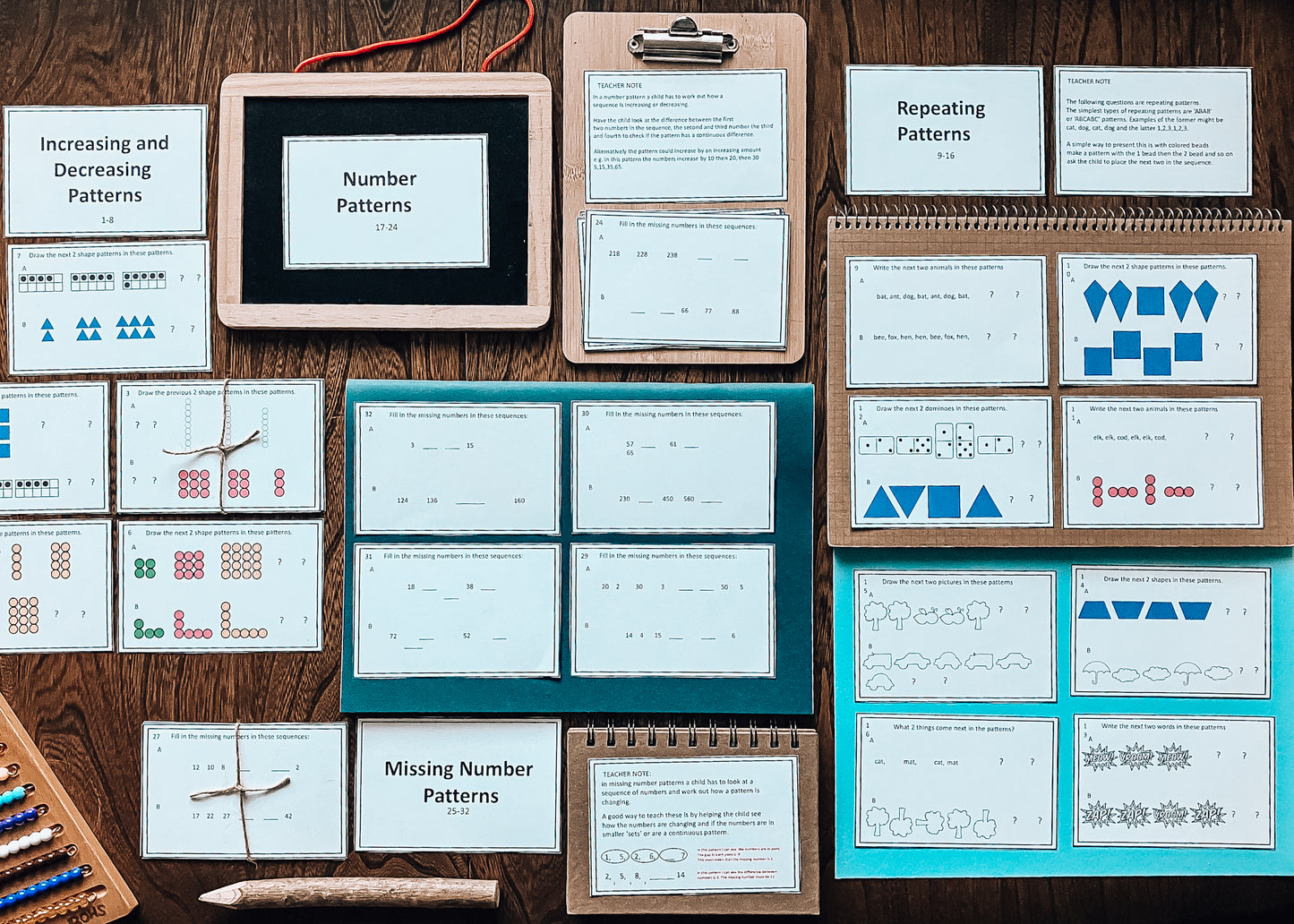
These Montessori Number Patterns and Sequences Task Cards give children a progressive pathway from concrete visual patterns to increasingly abstract number rules.
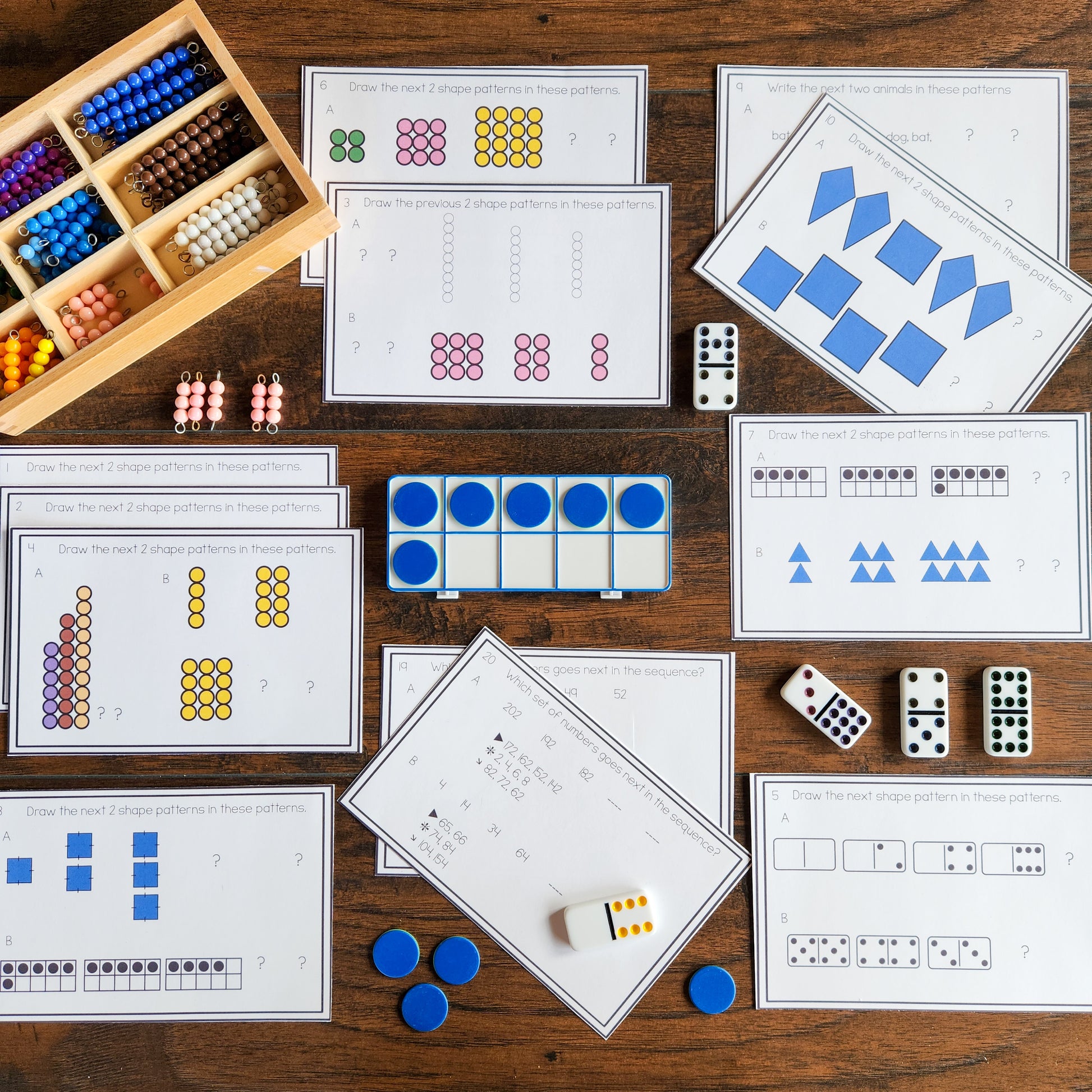
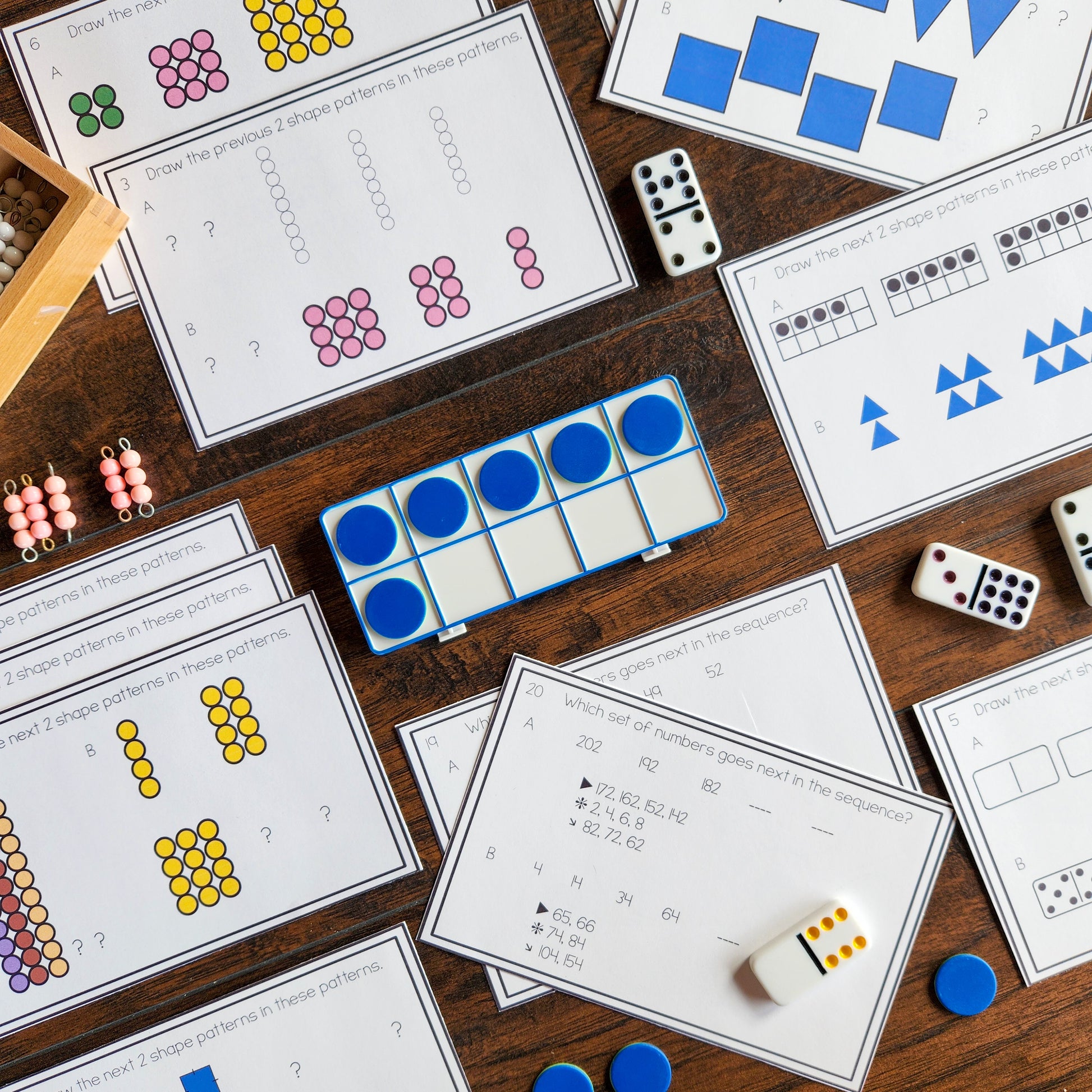
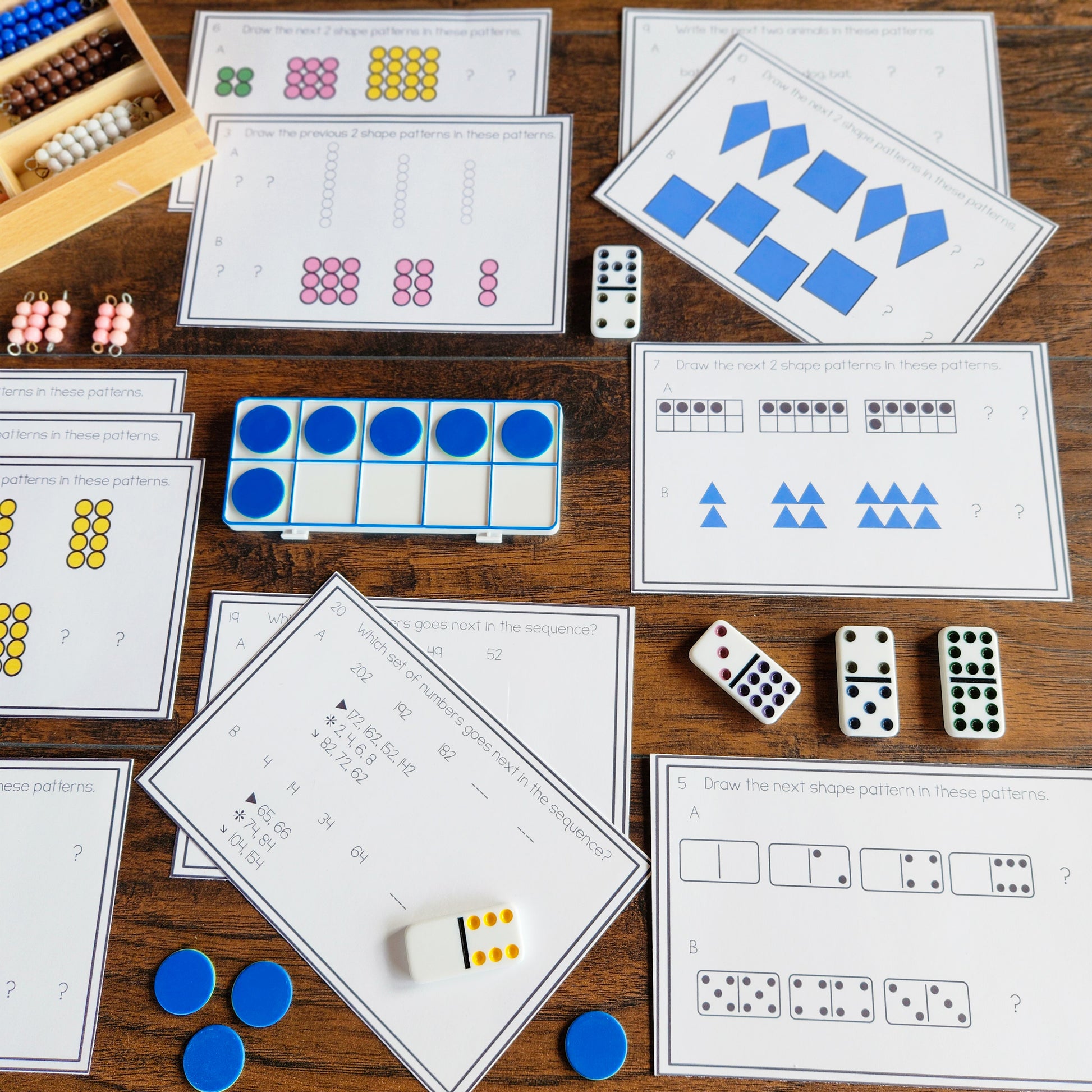
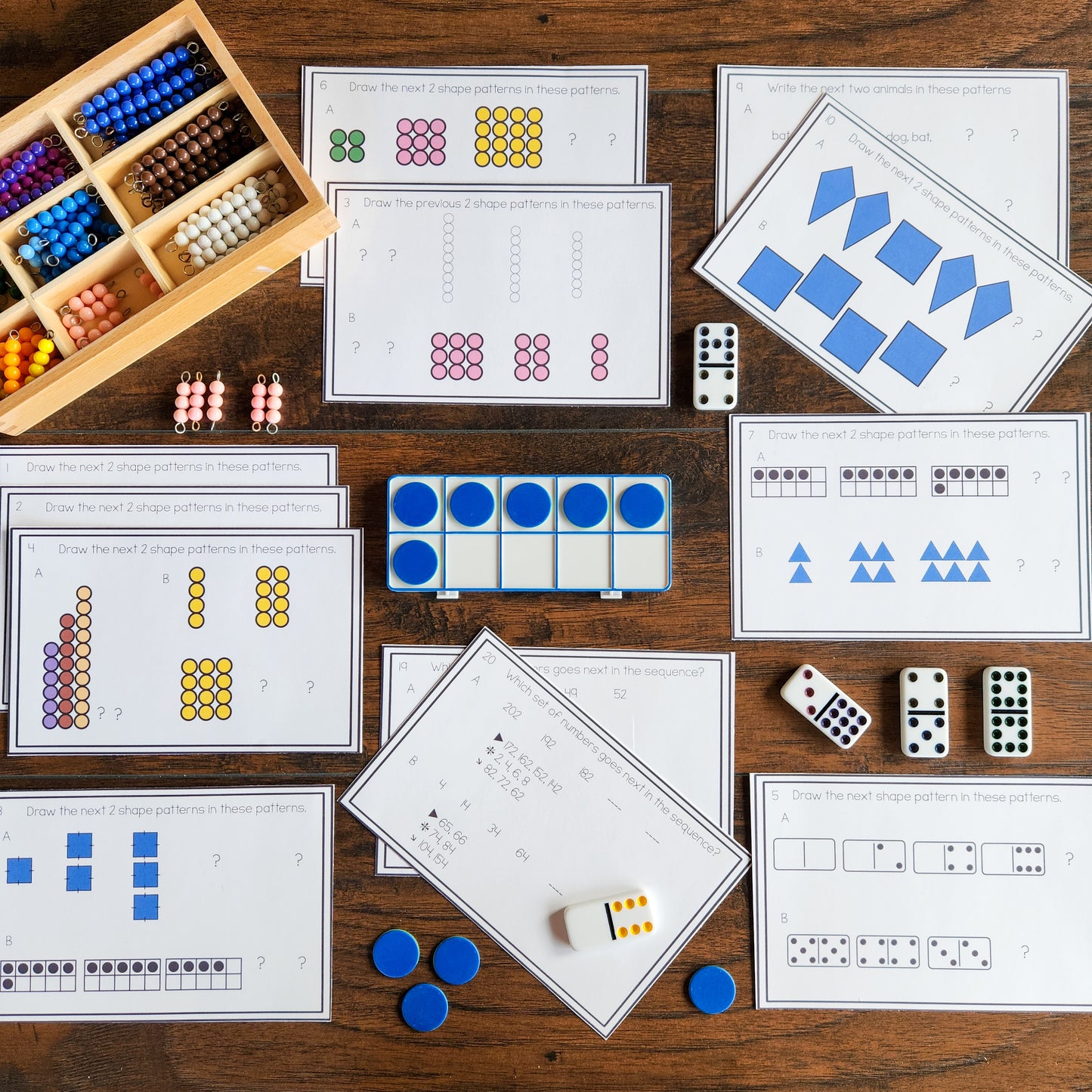
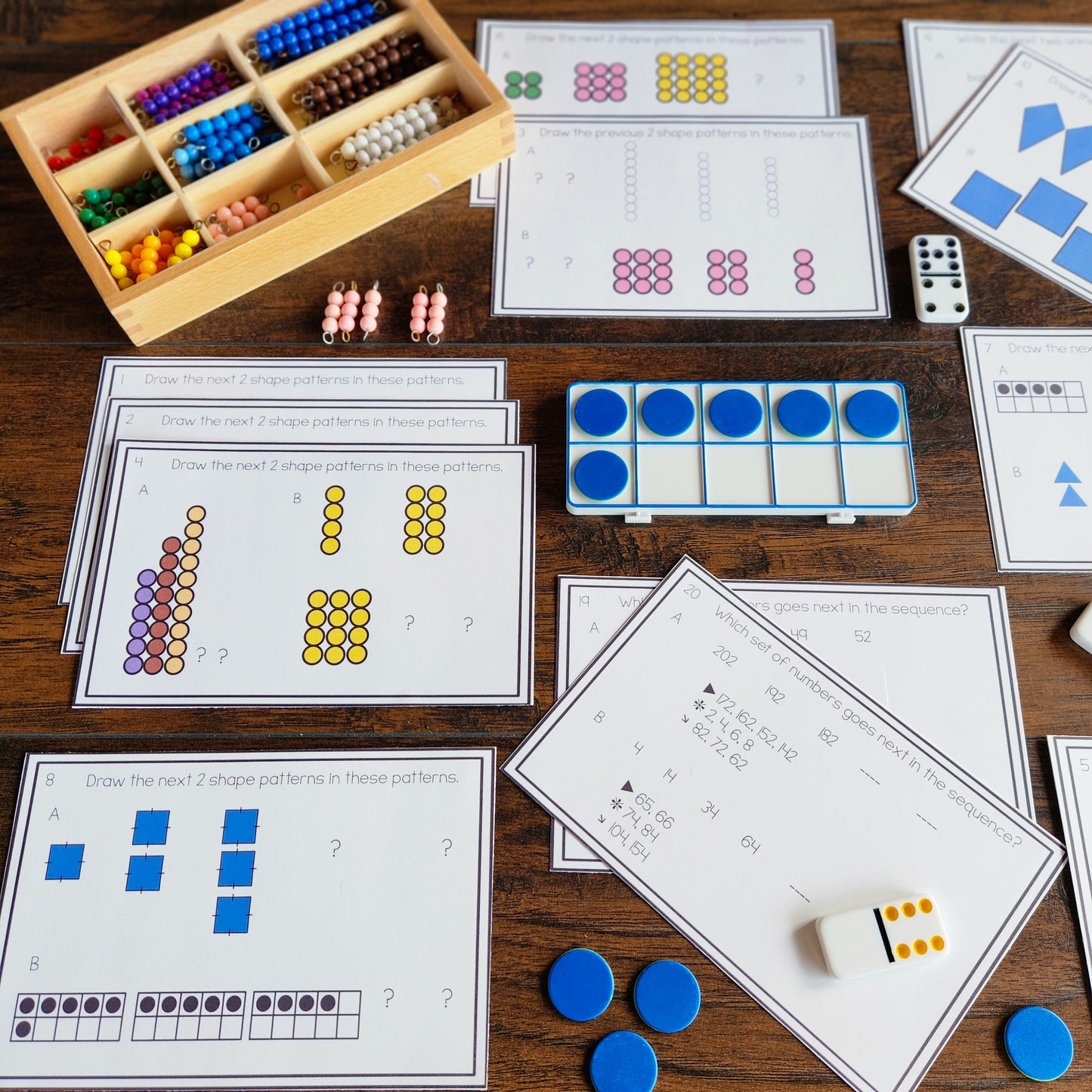
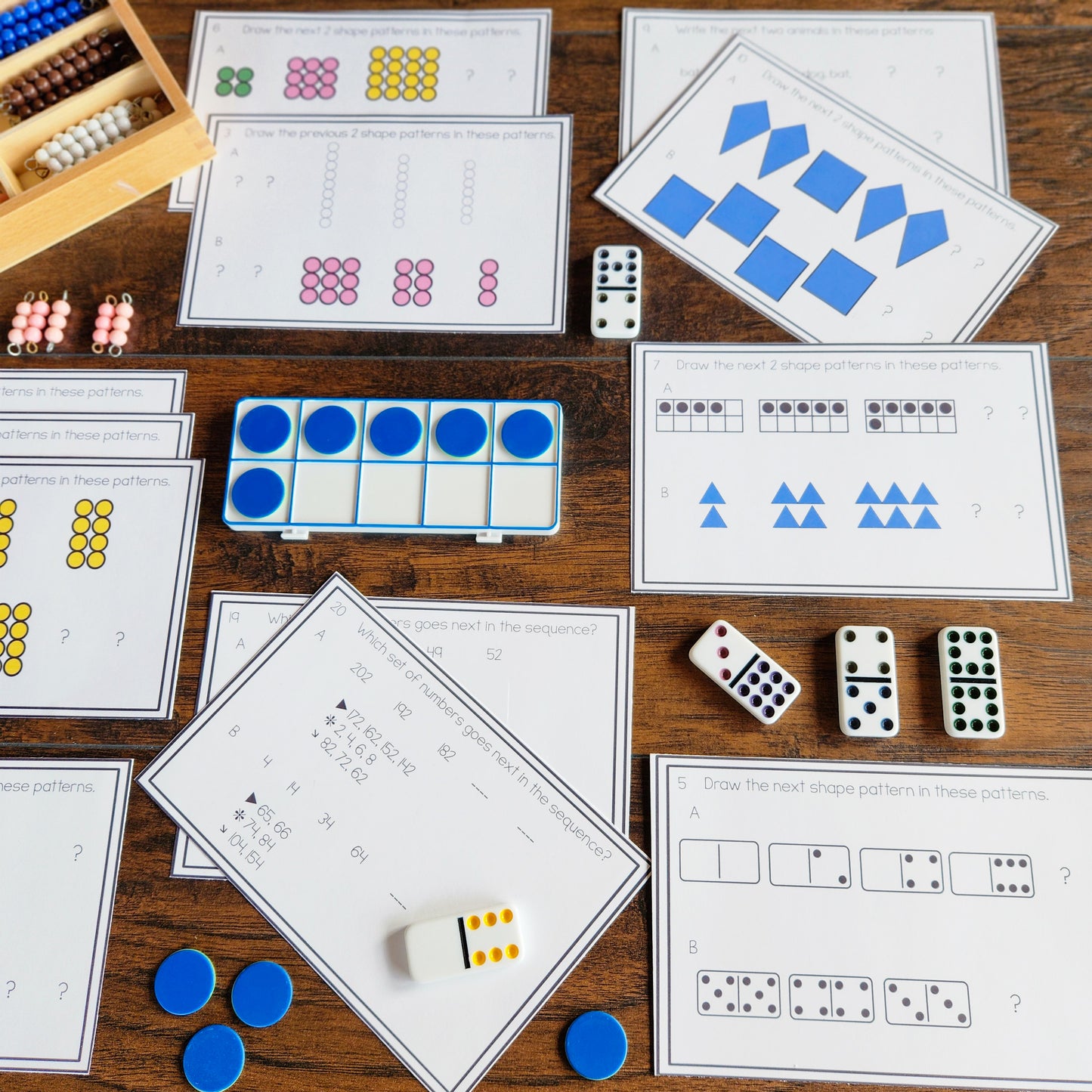
Students work with growing and shrinking shapes, repeating sequences, dominoes, pictures, words, increasing and decreasing number patterns, multiple-choice reasoning and challenging missing-number sequences.
At a Glance
- Learning focus: Pattern recognition, sequences and mathematical rules
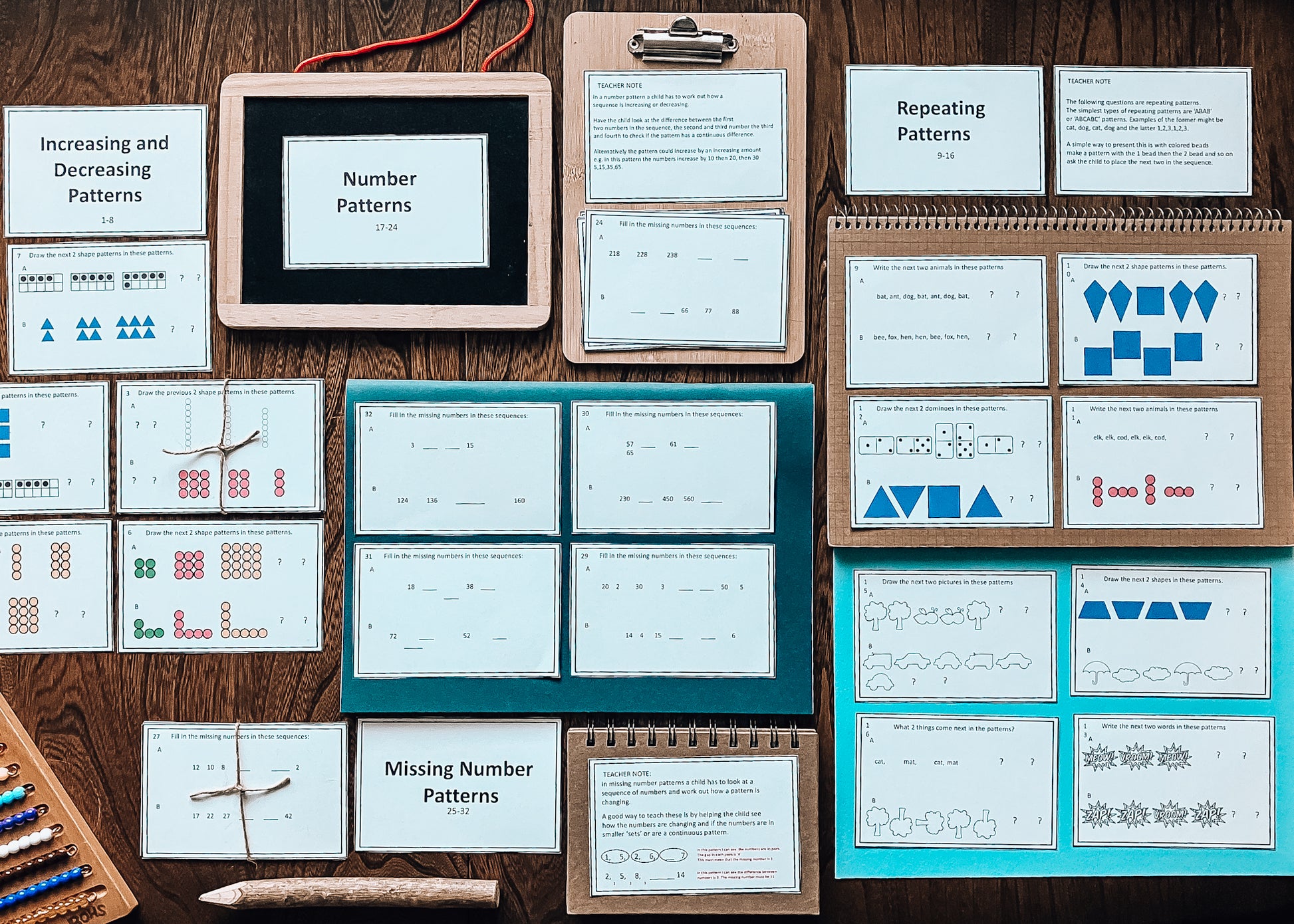
- Includes: 32 progressive task cards
- Four sections: Increasing and decreasing, repeating, number and missing-number patterns
- Best for: Montessori elementary, primary classrooms and homeschool
- Suggested ages: Approximately 6–10 years
- Teacher support: Introductory teaching notes for every section
- Control of error: Corresponding answer pages
- Length: 38 printable pages
- Format: Instant digital PDF download
Move Children Beyond “What Comes Next?”
Easy pattern activities can sometimes encourage children to guess from the final two items rather than examine the complete sequence.
This resource encourages more deliberate mathematical thinking. Children must ask:
- What is changing?
- Is the sequence increasing or decreasing?
- How much is being added or removed?
- Which complete unit repeats?
- Does the same rule work at every stage?
- Are there two patterns operating at once?
- Which missing value preserves the rule?
The tasks gradually become more demanding, allowing children to build confidence before working with larger numbers and less obvious rules.
Give Children Independent Work That Still Requires Real Thinking
These cards are structured enough for children to begin confidently, but varied enough that they cannot rely on one memorised strategy. The answer pages allow learners to check their work, revisit mistakes and develop independence without waiting for an adult after every card.
Four Progressive Pattern Sets
Set 1: Increasing and Decreasing Patterns
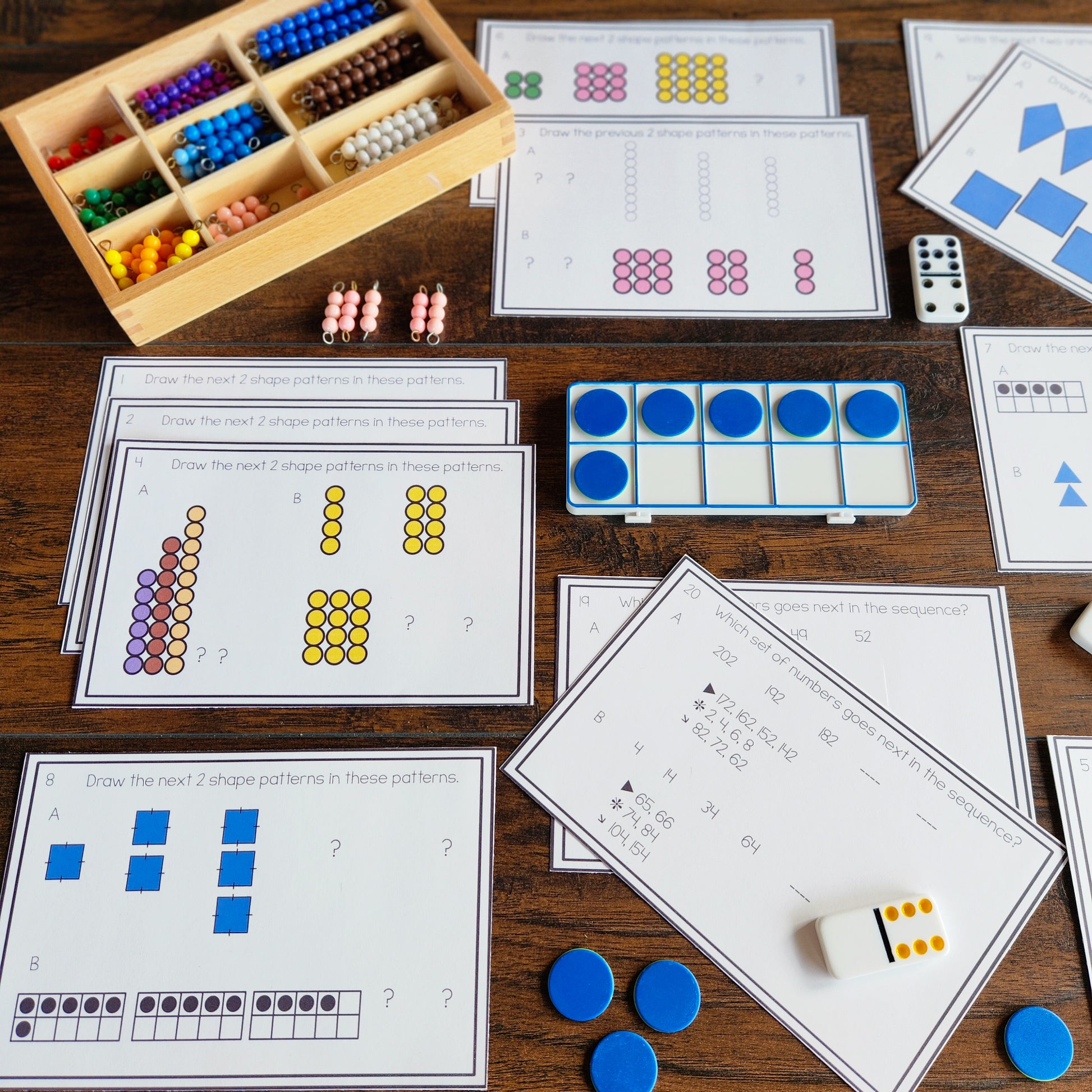
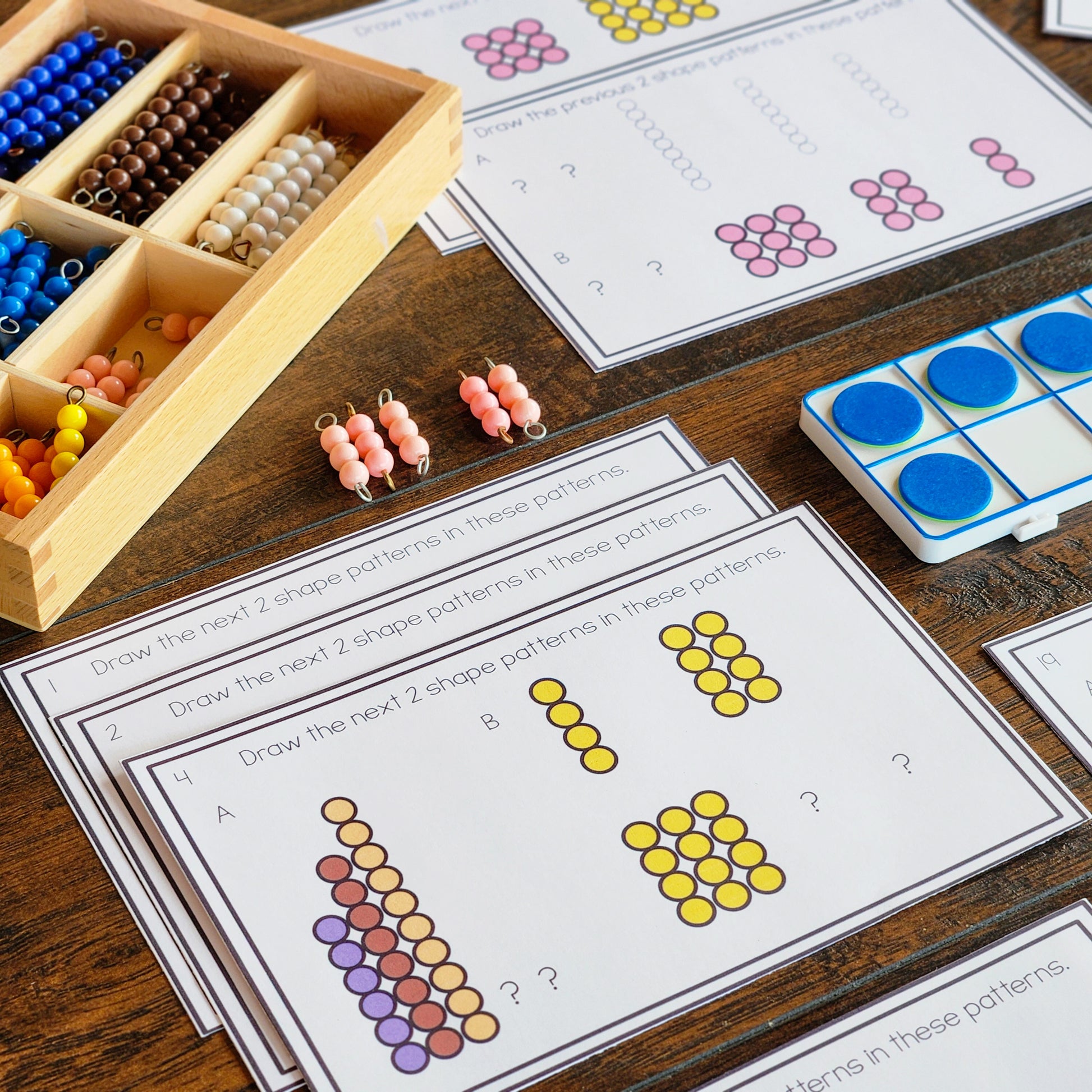
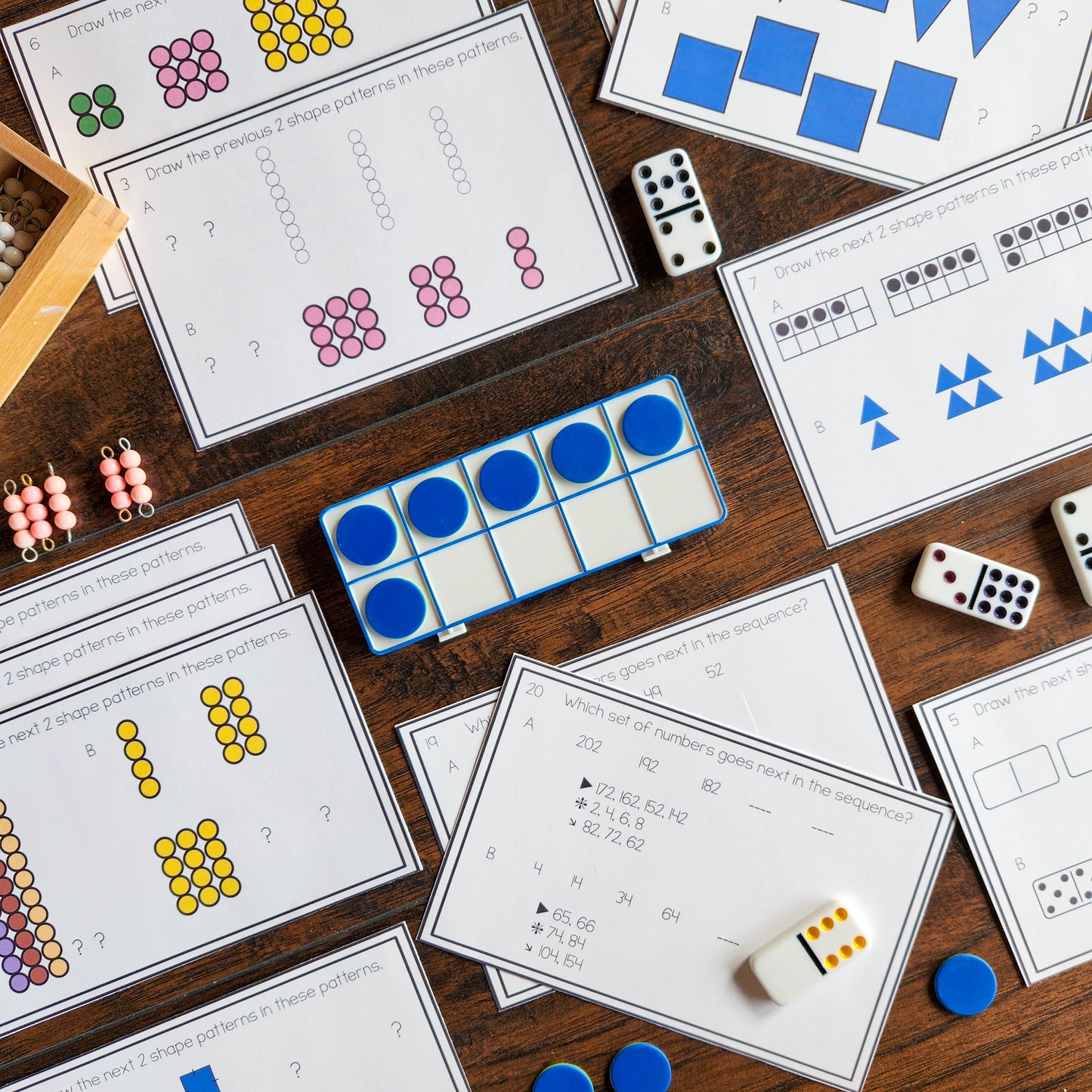
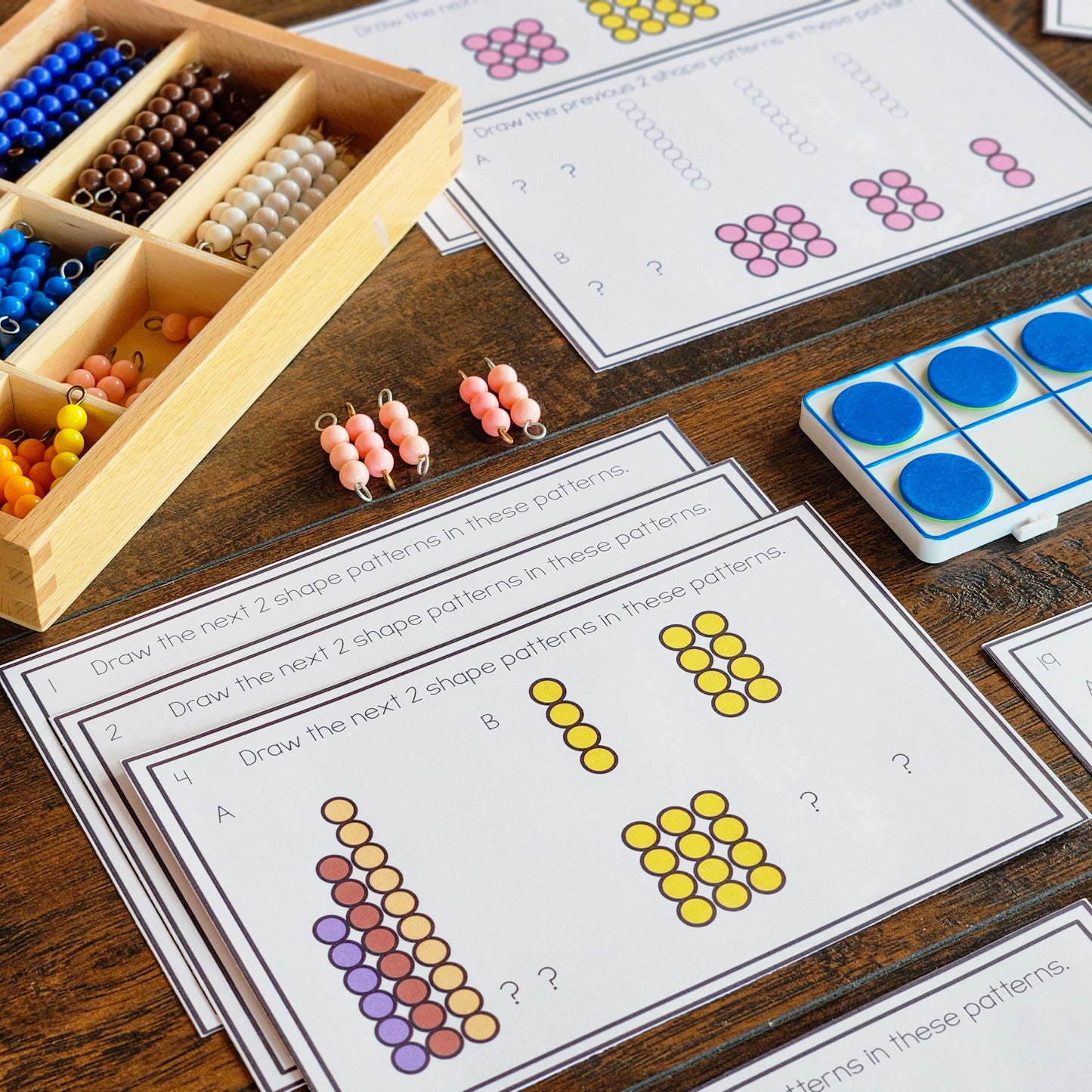
The first eight cards use shapes and visible quantities to introduce patterns that grow or shrink.
Children:
- draw the next stages of a visual pattern;
- work backwards to find previous stages;
- identify how much has been added or removed;
- extend patterns made with circles and rectangles;
- interpret domino sequences;
- work with ten-frame-style arrangements; and
- notice changes in size, quantity and orientation.
These visual tasks provide an accessible starting point before children move into abstract numerical rules.
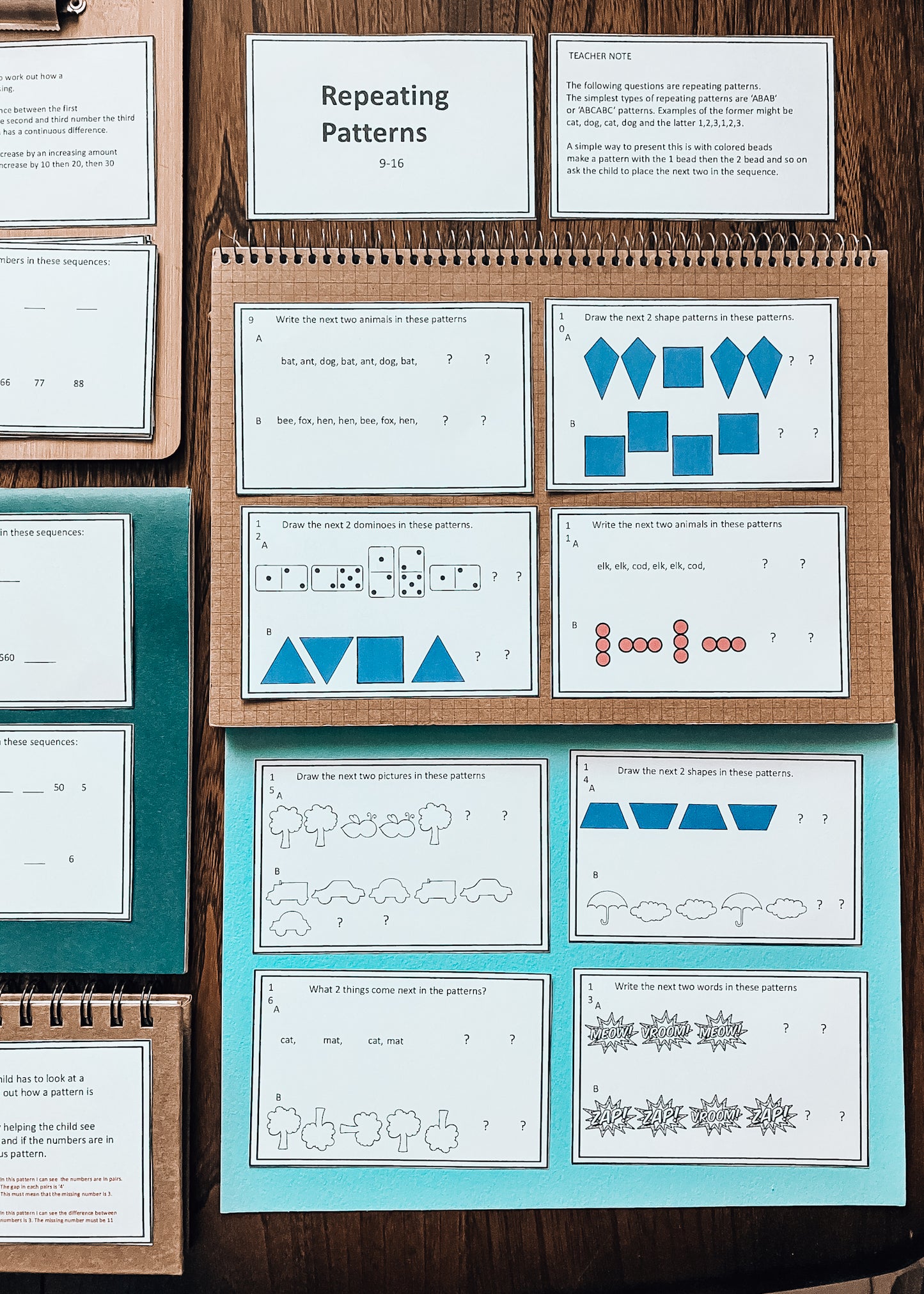
Set 2: Repeating Patterns
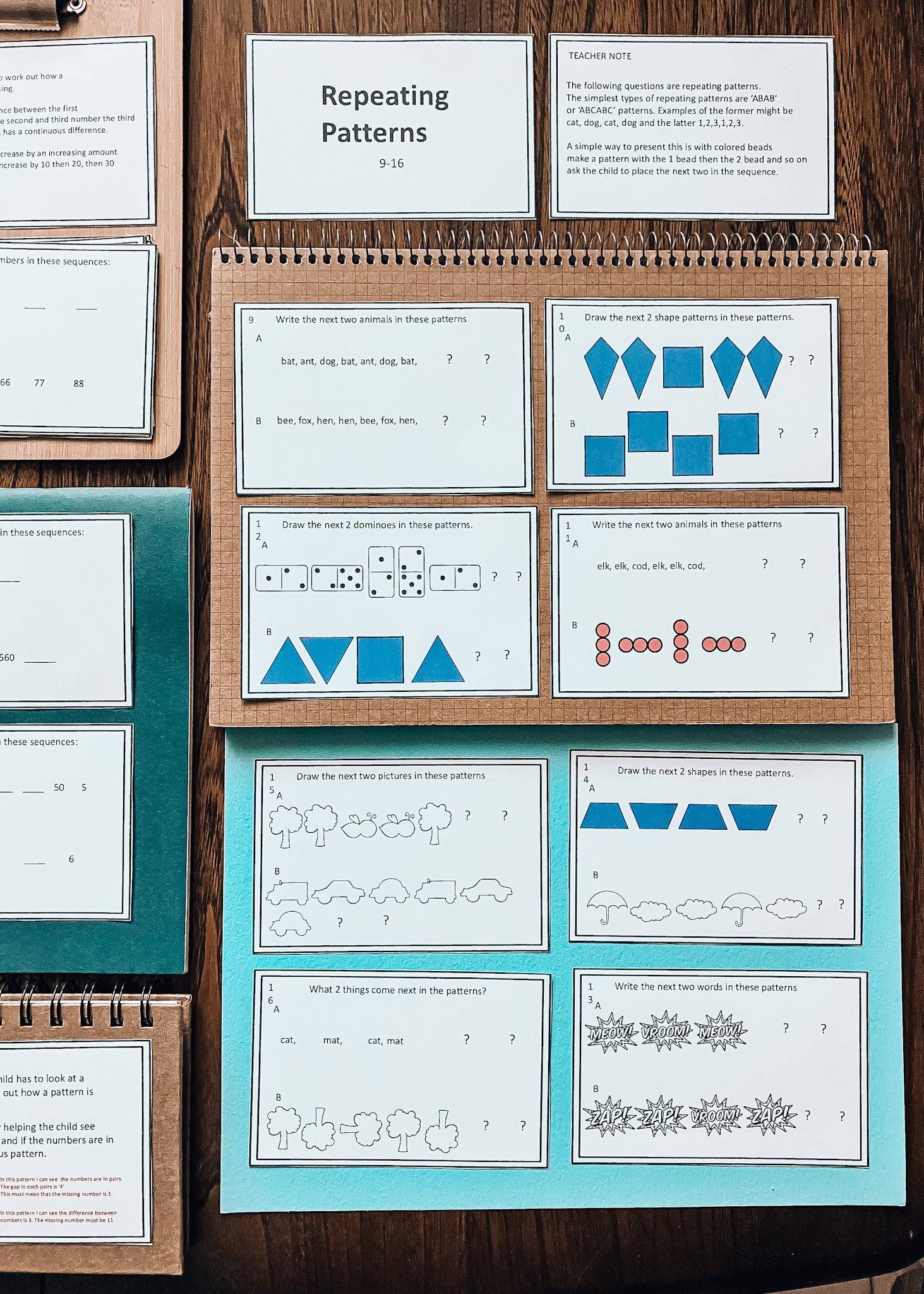
Cards 9–16 explore repeating units through:
- animal names;
- geometric shapes;
- coloured quantities;
- dominoes;
- sound-effect words;
- pictures and objects;
- orientation changes; and
- ABAB and ABCABC structures.
Children must identify the whole repeating unit rather than copying only the most recent object.
Set 3: Number Patterns
Cards 17–24 transfer pattern reasoning into number sequences.
Students work with:
- increasing sequences;
- decreasing sequences;
- constant differences;
- skip-counting rules;
- patterns with larger numbers;
- doubling sequences;
- multiple-choice continuations; and
- patterns where the amount of change also changes.
The teacher notes encourage children to compare more than one pair of numbers before deciding on a rule.
Set 4: Missing-Number Patterns
Cards 25–32 ask children to apply a rule when part of the sequence is hidden.
These tasks include:
- numbers missing from the middle;
- numbers missing from the beginning;
- more than one missing value;
- counting forwards and backwards;
- alternating patterns;
- paired sequences;
- numbers into the hundreds; and
- sequences with multiple layers of structure.
This section provides an effective bridge into early algebraic thinking because children must determine an unknown value from the surrounding relationships.
What Is Included?
This 38-page printable PDF includes:
- 32 numbered task cards
- Four section-title cards
- Four teacher-note cards
- Increasing visual patterns
- Decreasing visual patterns
- Repeating shape and picture patterns
- Word and animal-name sequences
- Domino pattern activities
- Increasing and decreasing number sequences
- Multiple-choice pattern questions
- Missing-number challenges
- Alternating and grouped sequences
- Corresponding answer pages
A Concrete-to-Abstract Pathway
The progression reflects a Montessori approach to mathematical learning:
- Experience patterns with objects. Build sequences using beads, counters, shapes or classroom materials.
- Recognise visible changes. Identify what is growing, shrinking or repeating.
- Represent the pattern pictorially. Work with shapes, diagrams, dominoes and pictures.
- Transfer the rule to numbers. Analyse numerical differences and relationships.
- Find unknown values. Apply the rule when information is missing.
- Explain and generalise. Describe the rule in words and use it beyond the examples shown.
This supports children who need a visual foundation before they are ready to reason with abstract number sequences.
Introduce Each Pattern Type Before Independent Work
Use the teacher-note cards to prepare a short hands-on presentation before offering each set.
Useful materials include:
- Montessori coloured bead bars;
- counters;
- linking cubes;
- dominoes;
- geometric shapes;
- number cards; and
- familiar classroom objects.
Ask children to describe the change and test their proposed rule against every stage of the pattern.
Self-Correcting for Independent Learning
The pages are designed to be printed back-to-back so the corresponding answer sits behind each task card.
This control of error allows children to:
- check their own predictions;
- notice when a rule does not work;
- correct a mistake independently;
- repeat a challenging card; and
- work with less adult interruption.
You can also print the answers separately when you prefer students to record several responses before checking their work.
Develop Foundations for Algebra
Pattern work supports more than sequencing.
As children complete these tasks, they practise:
- observing mathematical relationships;
- identifying operations;
- working with unknown values;
- generalising a rule;
- testing whether a rule is consistent;
- predicting future terms;
- working backwards from known information;
- explaining mathematical reasoning; and
- developing early algebraic thinking.
Ways to Use the Task Cards
- Montessori maths shelf work
- Independent work cycles
- Maths centres and rotations
- Partner problem solving
- Small-group instruction
- Early-finisher work
- Homeschool maths
- Morning work
- Number-sense intervention
- Formative assessment
- Pattern revision
- Preparation for algebra
Easy to Differentiate
For Beginning Learners
- Start with the visual increasing patterns.
- Build each sequence with concrete objects first.
- Use one task card at a time.
- Ask the child to describe what changes aloud.
- Focus on simple AB repeating patterns.
For Developing Learners
- Introduce decreasing and repeating patterns.
- Move into constant-difference number sequences.
- Ask children to record the rule.
- Use multiple-choice cards to discuss distractors.
- Find missing terms within a sequence.
For More Confident Learners
- Use sequences beginning with three-digit numbers.
- Explore alternating and grouped rules.
- Ask students to create similar patterns.
- Require an explanation for every answer.
- Challenge children to find more than one possible continuation where appropriate.
Who Is This Resource For?
This resource is suitable for:
- Montessori lower-elementary classrooms;
- approximately ages 6–10;
- Years 2–5;
- mainstream primary classrooms;
- homeschool and home-education settings;
- mixed-age maths groups;
- children developing number sense;
- students preparing for early algebra; and
- learners who benefit from visual and self-correcting work.
Please Note
This is a printable task-card resource. Physical beads, counters, dominoes and other manipulatives are not included.
The cards are intended as follow-up after children have received a hands-on introduction to each type of pattern.
Created by an Experienced Montessori Educator
I’m Lisa—an NZ registered teacher, Montessori-trained educator, school principal and former homeschooler.
I create practical resources for mixed-age learning environments, including children who need a clear visual starting point and those ready to move into deeper mathematical reasoning.
These task cards were designed to help children recognise relationships, explain rules and work independently—not simply fill in another worksheet.
Continue Building Number Sense and Pattern Recognition
-
Montessori Hundred Board Puzzle Task Cards
Strengthen number order, spatial reasoning and recognition of patterns within the hundred chart. -
Montessori Hundred Board Task Cards Bundle
Extend learning through number order, place value, skip counting, mental maths and hundred-board patterns. -
Hundred Board Task Cards Set 2
Explore skip counting, sequences and early multiplication patterns through independent hundred-board work. -
Montessori Multiples and Common Multiples
Apply pattern recognition to multiples, common multiples and multiplication sequences. -
Three-Digit Gateway to Algebra Task Cards
Move from numerical patterns towards missing values and early algebraic reasoning.
Explore More Independent Maths Work
-
Browse Montessori Task Cards
Find low-preparation independent work across mathematics, language, science and cosmic education. -
Explore the Montessori Maths Collection
Browse number sense, operations, fractions, geometry, place value and problem-solving resources.
Need a Wider Hundred Board and Number-Pattern Collection?
The Montessori Hundred Board Bundle combines task cards, puzzle pieces and picture extensions that strengthen counting, number order, skip counting, pattern recognition and mathematical reasoning.
Choose the larger bundle when you need a broader bank of hands-on number-pattern work rather than one focused task-card pack.
Digital Resource Information
This is a downloadable PDF. No physical cards or manipulatives will be posted.
Your purchase is licensed for use by one teacher or one homeschool family. Please purchase additional licences rather than sharing the file or printed cards with other teachers, classrooms or organisations.
Help Children Find the Rule—Not Just the Next Number
Move from concrete visual patterns to repeating sequences, number relationships and missing-value challenges through progressive, self-correcting work.
Download the Number Patterns and Rules Task Cards and give children meaningful practice with prediction, reasoning and early algebraic thinking.
Share
-
Items are secured / Terms of Use
Our items are secured. They are not able to be altered. We secure our items because they are our intellectual property and because we use art from artists who require that we secure our files.
You may not:
-resell our items or use them for commercial gain
-claim these items as your own
-modify this resource
-share them with others by any means e.g. electronic or hard copy
-
All Items are instant downloads
You will not get a printed product in the mail.
-
All prices are in USD
Due to the international nature of our customers our prices are all in USD. If you wish to work out the conversion before you buy we recommend www.xe.com