montessorikiwi
Montessori Newton’s Third Law & Simple Machines Activities | Upper Elementary Science
Montessori Newton’s Third Law & Simple Machines Activities | Upper Elementary Science
Couldn't load pickup availability

Simple machines can quickly become a lesson in memorising six definitions—but children understand force and motion much more deeply when they can see them, test them and build with them.
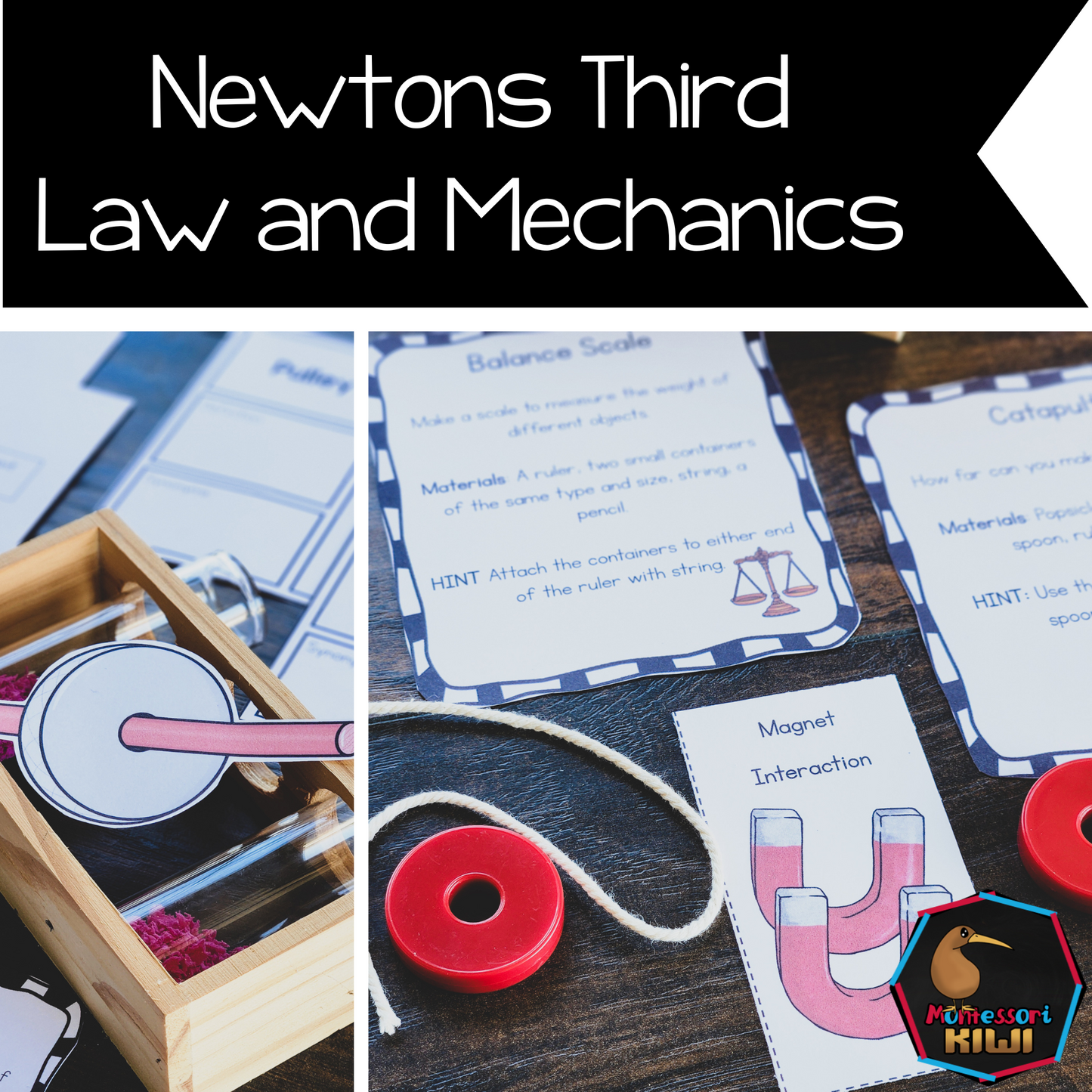
The Montessori Newton’s Third Law and Simple Machines Activities resource brings physics to life through clear explanations, practical experiments, sorting work, vocabulary study, reading comprehension and hands-on engineering challenges.
Children first explore Newton’s Third Law: for every action, there is an equal and opposite reaction. They then investigate how this principle can be observed in levers, pulleys, screws, inclined planes, wedges, and wheels and axles.
Rather than completing a single worksheet and moving on, learners are invited to connect scientific language with real objects, investigate how machines reduce effort, and apply their understanding through independent construction projects.
At a glance
Age range: Approximately 9–12 years
Format: 61-page printable PDF
Topics: Newton’s Third Law, forces, action and reaction, simple machines, friction and mechanical systems
Simple machines covered: Lever, pulley, screw, inclined plane, wedge, and wheel and axle
Includes: Lesson guidance, experiments, explanation pages, construction challenges, vocabulary organisers, cloze activities, classification work, reading comprehension and assessment
Best for: Montessori upper elementary, homeschool, science shelves, Cosmic Education, STEM and mixed-age classrooms
Preparation: Print the pages you need and gather simple household or classroom materials for the practical activities
Answers: Included for the cloze and classification activities
Move beyond naming the six simple machines
Children may be able to identify a pulley or inclined plane without understanding what it actually does. They may also learn Newton’s Third Law as a sentence but struggle to recognise action and reaction forces in everyday life.
This resource connects the two ideas.
Children explore questions such as:
- Why does a balloon move forwards when air rushes backwards?
- How does a lever help us move a heavy load?
- Why can a pulley make lifting easier?
- How does an inclined plane change the force needed to move an object?
- What makes a wedge useful for splitting or separating materials?
- How does a wheel and axle reduce friction?
- Where can action and reaction forces be observed in simple machines?
- How can several simple machines work together in one structure?
The result is a more connected study of physics in which children read, discuss, observe, classify, experiment, build and explain.
Begin with Newton’s Third Law
The resource begins with a teacher lesson plan introducing the idea that forces occur in pairs. Suggested demonstrations use familiar materials such as chairs or skateboards, balls, balloons and objects of different weights.
A clear display page explains:
For every action, there is an equal and opposite reaction.
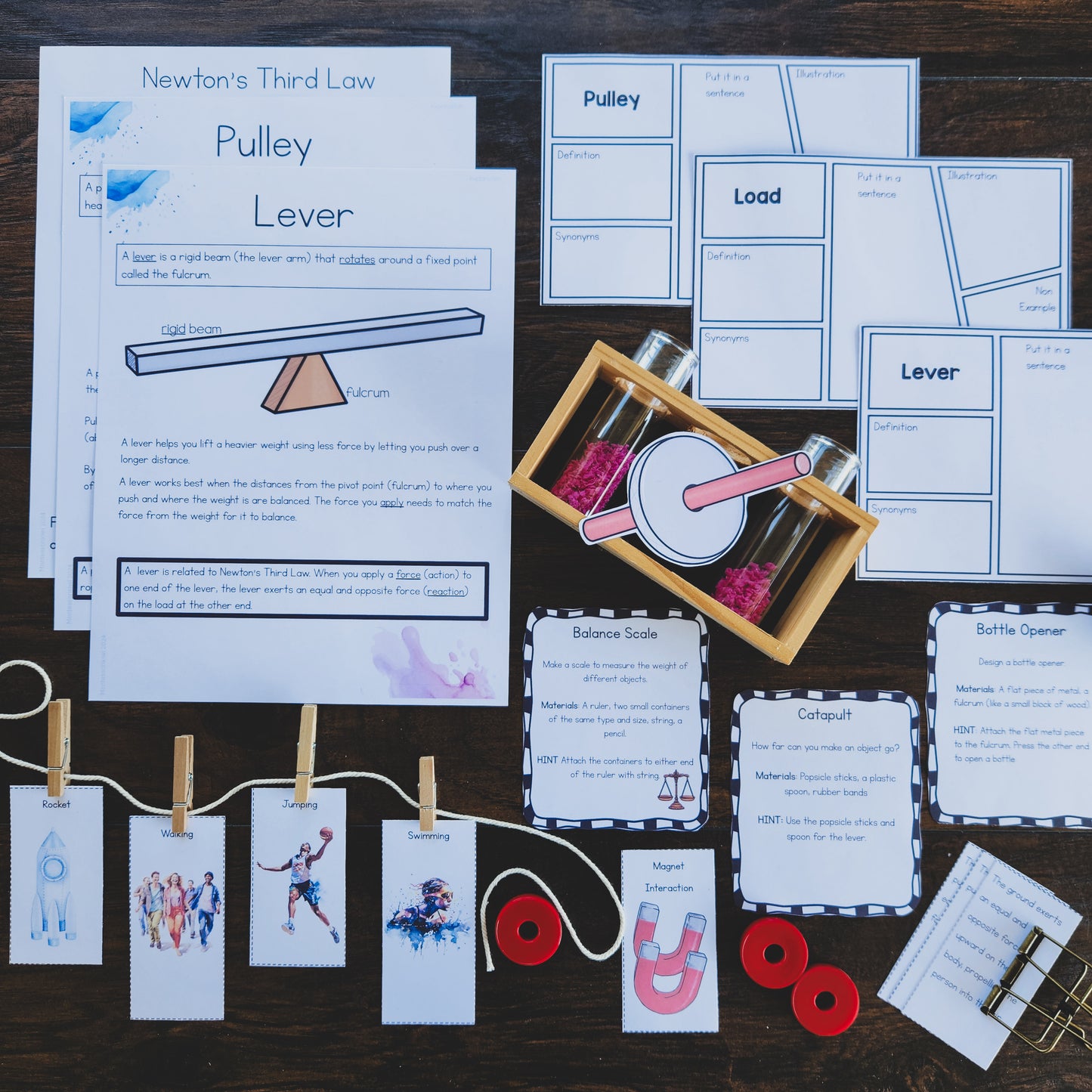
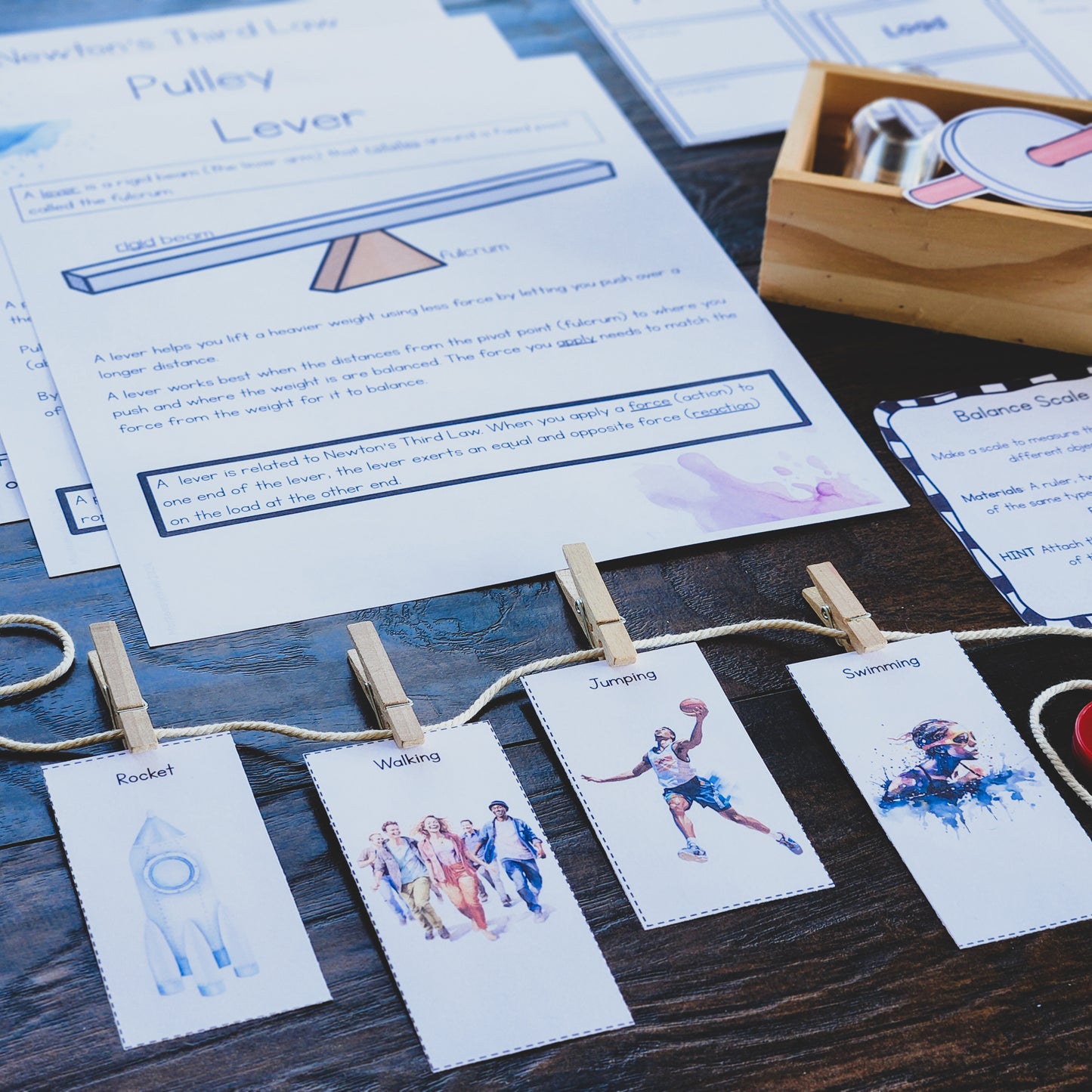
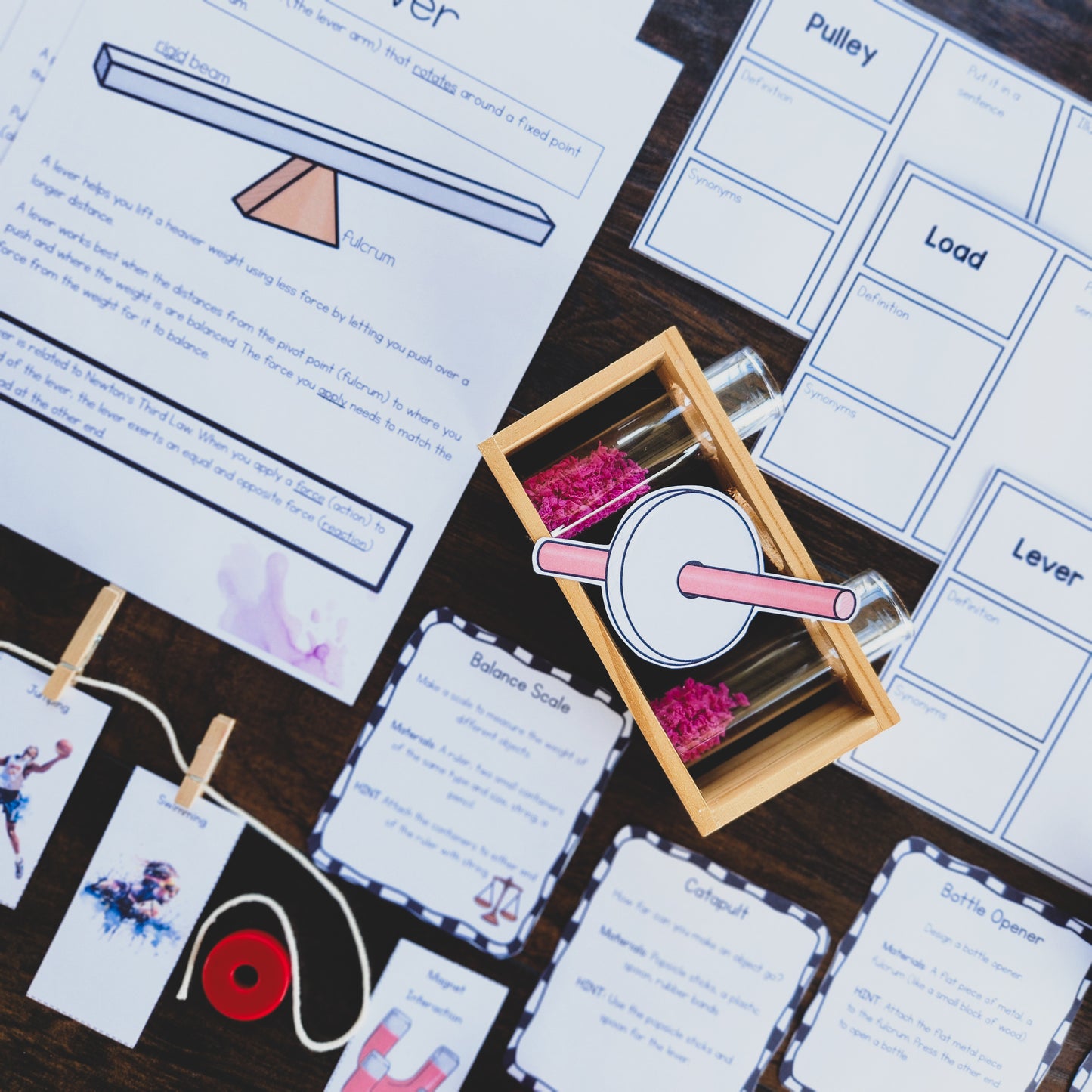
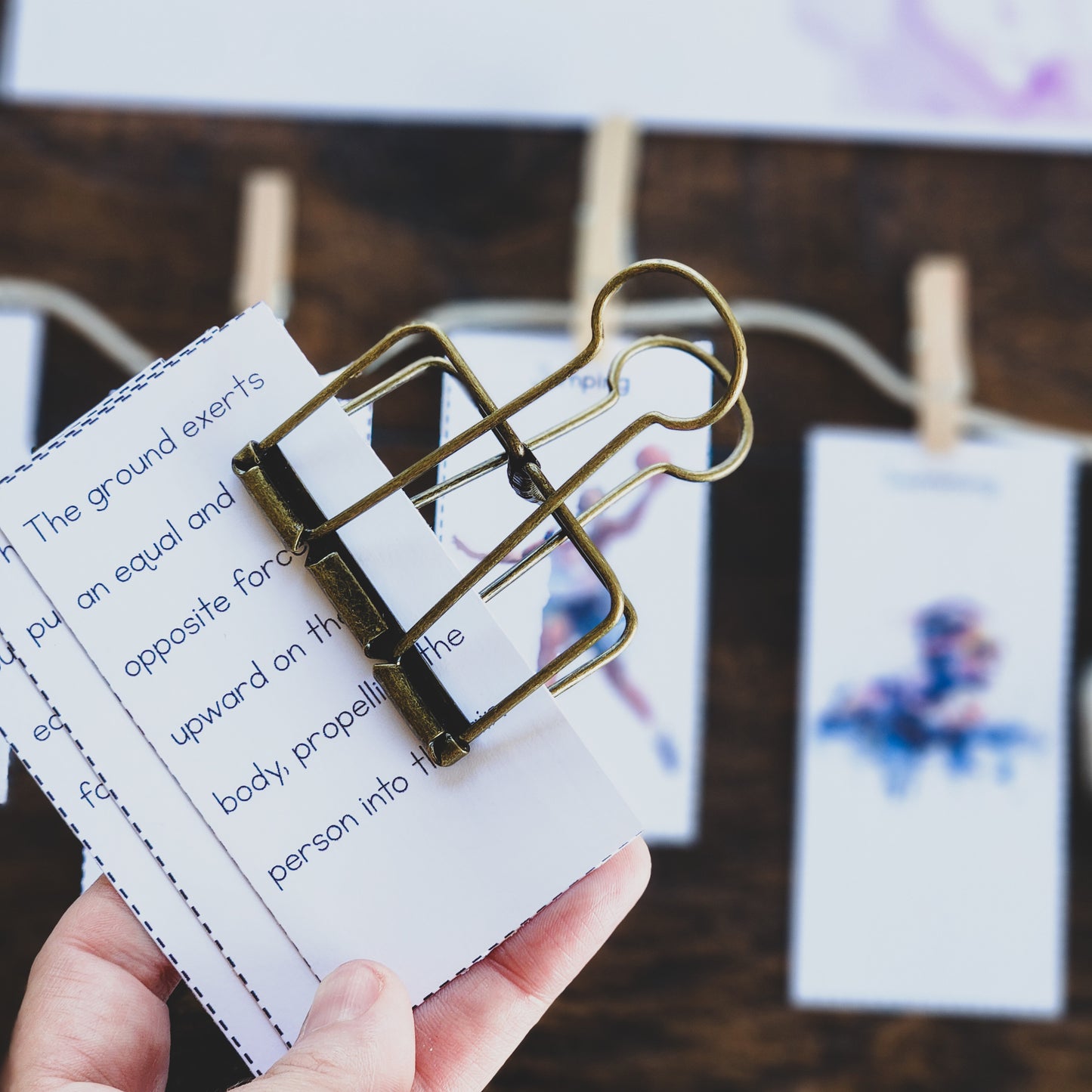
Children then complete a sorting and sequencing activity using examples including:
- a rocket launching
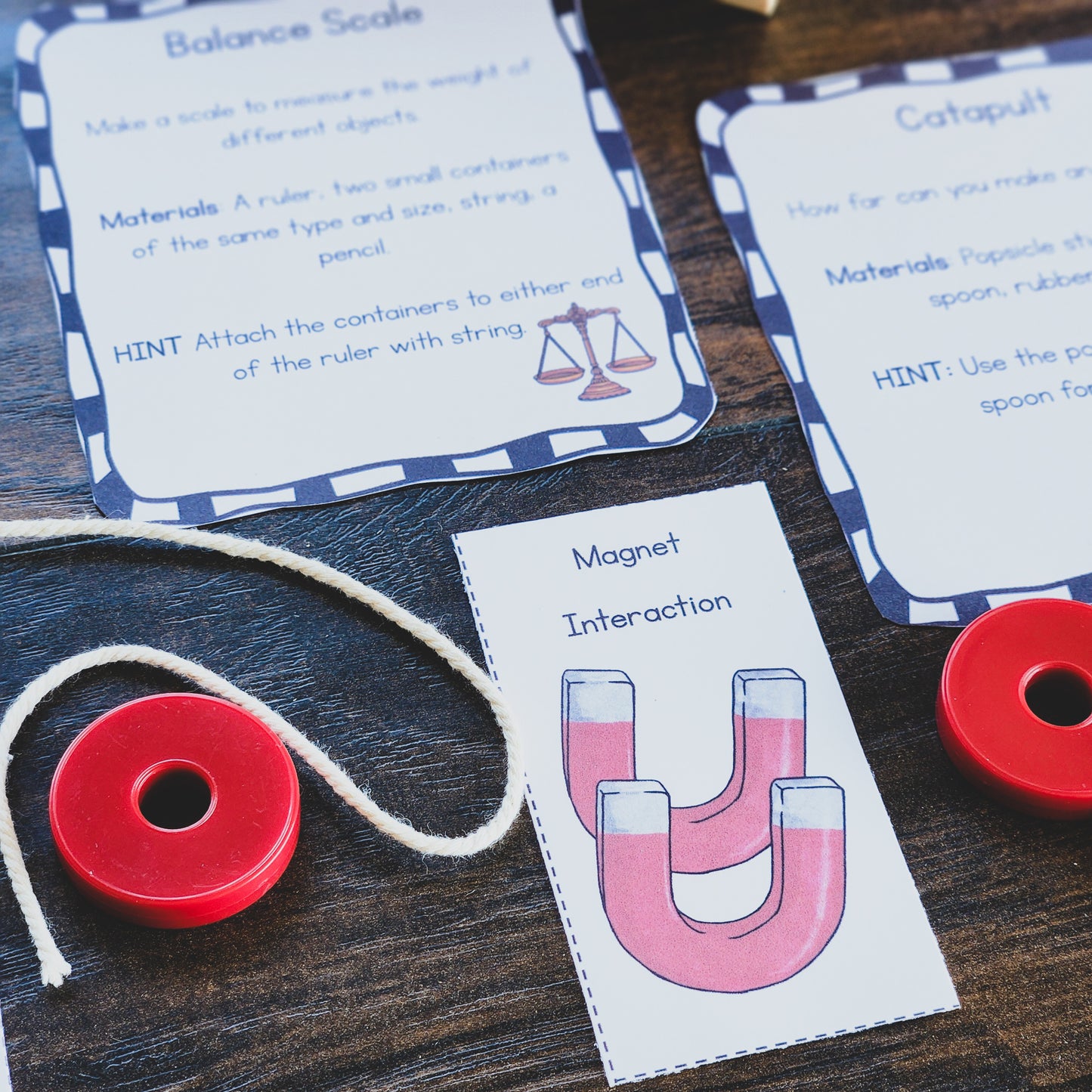
- two magnets interacting
- a person jumping
- walking
- swimming
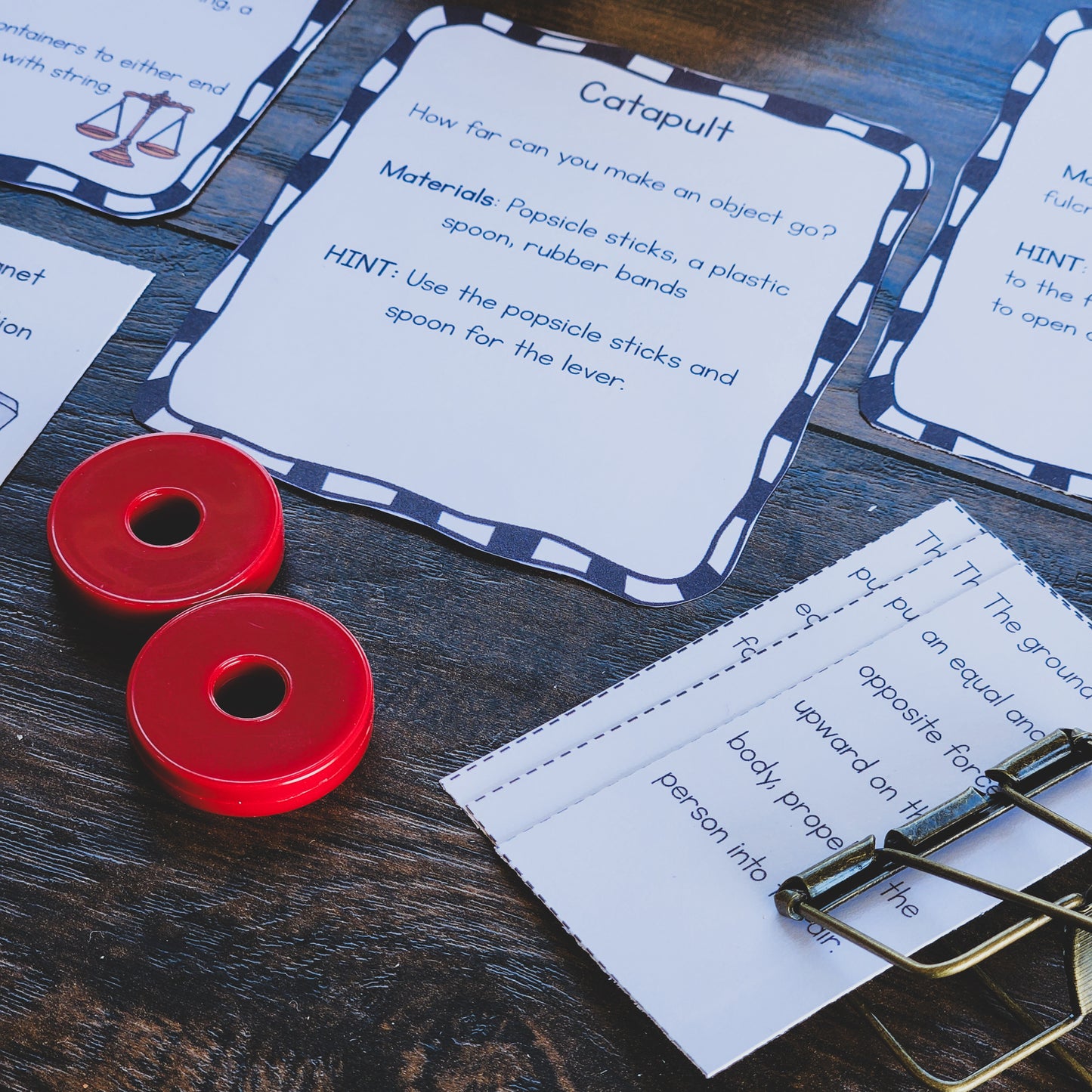
For each example, children connect the event with its action force, reaction force and resulting motion.
Three practical Newton’s Third Law experiments
Children can observe action and reaction directly through three guided investigations:
- Soda bottle rocket: Explore how building gas pressure creates motion in the opposite direction.
- Balloon propulsion: Create a balloon-and-string system and observe how escaping air propels the balloon forwards.
- Egg drop: Investigate reaction forces and how different materials can cushion and reduce the force experienced by an object.
Each experiment includes:
- a materials list
- simple instructions
- an explanation of what children should observe
- a direct connection to Newton’s Third Law
Why this matters: Children are not only told what action and reaction mean. They have the opportunity to observe the principle in motion and then apply it to the study of simple machines.
Six simple machines explored in depth
Each simple-machine section begins with a child-friendly explanation page that introduces its structure, purpose and relationship to force.
Lever
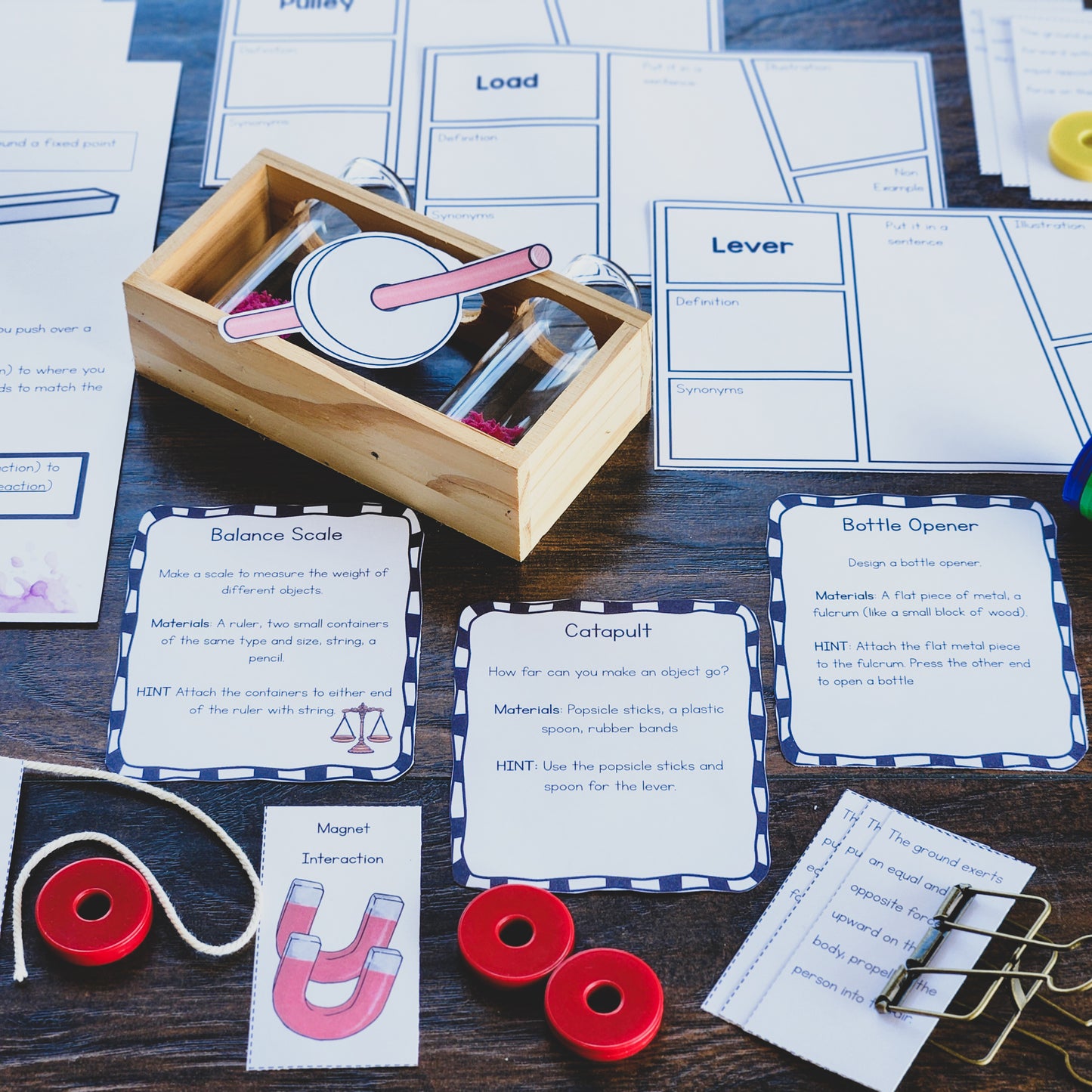
Children learn about the lever arm and fulcrum, and how changing the distance from the pivot point can affect the force required.
Construction choices include:
- bottle opener
- homemade seesaw
- balance scale
- catapult
Pulley
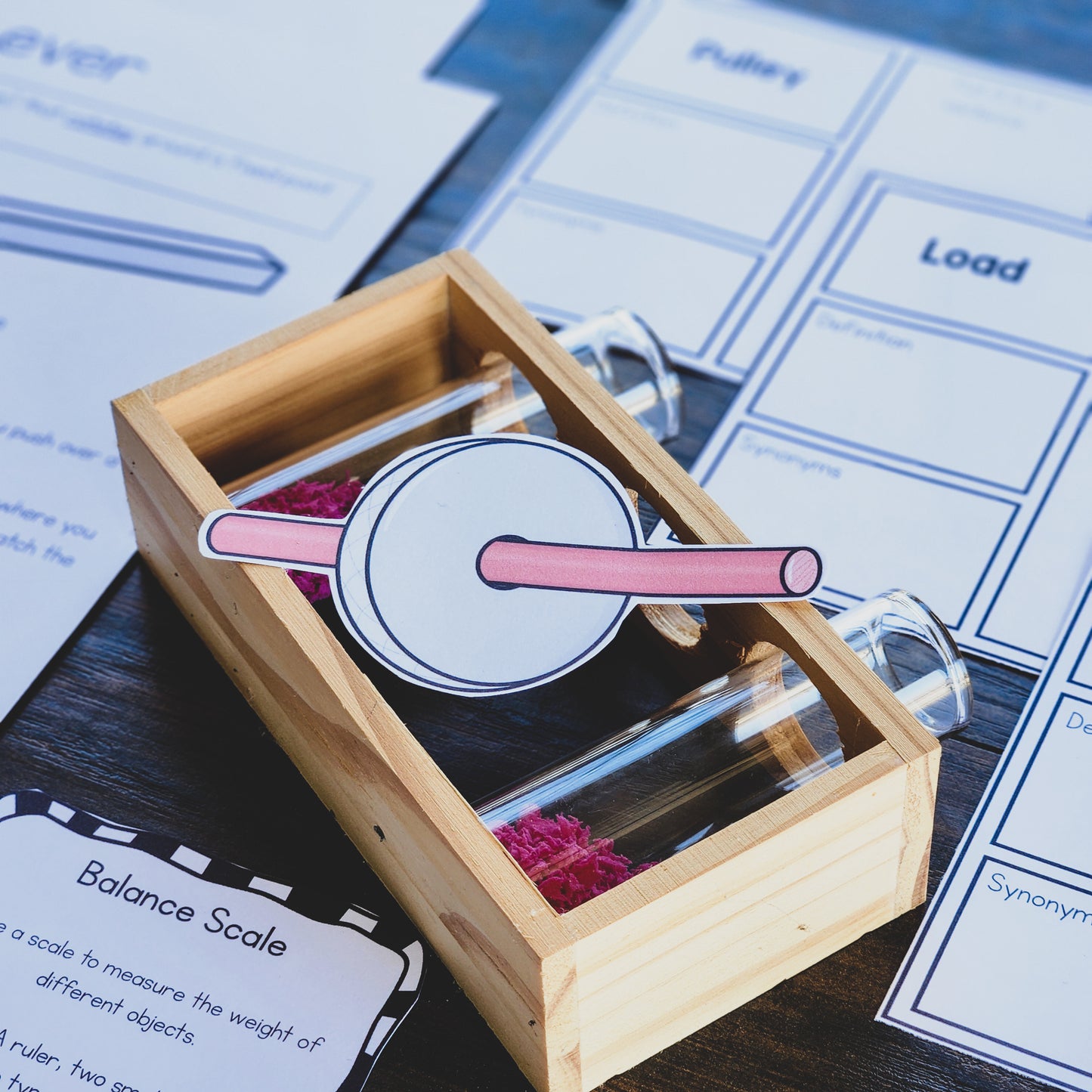
Children explore load, effort and pulley systems, including how pulleys can change the direction of force or distribute a load.
Construction choices include:
- flagpole model
- simple elevator
- clothesline
- miniature well
Screw
Children examine how a screw functions as an inclined plane wrapped around a central core and converts rotational motion into linear motion.
Construction and investigation choices include:
- bottle-cap opener
- mini press
- lid tightener
- manual drill
Inclined plane
Children investigate how a sloping surface allows an object to be moved over a greater distance using less force.
Construction choices include:
- book incline
- simple slide
- ramp investigation
Wedge
Children learn how a wedge acts as a portable inclined plane and can split, separate, lift or hold materials in place.
Practical choices include:
- soap carving
- splitting modelling clay
- rubber-band and wedge investigation
Wheel and axle
Children explore how a larger wheel connected to a smaller axle helps move objects and reduce friction.
Construction choices include:
- toy car
- rolling pin
- spinning top
Hands-on work without losing scientific depth
Building activities are engaging, but construction alone does not guarantee understanding. This pack supports children in connecting their models with the underlying science.
Each section combines several forms of learning:
- clear scientific explanation
- labelled diagrams
- real-life applications
- Newton’s Third Law connections
- design and construction challenges
- subject-specific vocabulary
- written consolidation
This makes the material appropriate for children who enjoy practical work while also providing the structure needed for meaningful follow-up and assessment.
Integrated science and language work
Scientific vocabulary can become a barrier, particularly when children understand the practical idea but cannot explain it using precise language.
The resource includes vocabulary organisers for important words connected with each machine. Children can record:
- a definition
- synonyms
- the word in a sentence
- an illustration
- a non-example
Vocabulary includes words such as:
- force
- reaction
- rigid
- rotates
- load
- effort
- system
- rotational
- threads
- friction
- surface
- exert
Cloze activities allow children to practise using the vocabulary in context. Answer pages are included, making these activities suitable for independent work and self-checking.
Classification and real-world application
After learning about the six machines, children can look for examples in their own home, classroom or school using the simple-machines scavenger hunt.
A separate sorting activity asks children to classify familiar objects, including:
- crowbar
- seesaw
- ramp
- bicycle
- steering wheel
- flagpole
- window blinds
- crane
- knife
- doorstop
- jar lid
- light bulb
This helps children recognise that simple machines are not confined to textbook diagrams. They are embedded throughout everyday tools, buildings and technologies.
Reading comprehension with connected machines
Once children understand the individual machines, they explore how several can work together in more complex structures.
Reading and response activities examine:
- A water wheel: Converting flowing water into mechanical energy using wheels and axles, inclined planes, levers, screws and wedges.
- A windmill: Using wheels and axles, levers and inclined planes to capture and transfer wind energy.
- A plant-made hut: Considering how levers, pulleys, wedges and inclined planes can be used in traditional construction.
The questions invite children to explain, compare, research and apply what they have learned rather than simply locating one-word answers.
Final engineering assessment: Make Your Own Sailboat
The culminating task asks children to design and build a cardboard sailboat incorporating simple machines.
Children plan, construct, test and evaluate a model that may include:
- a pulley to raise and lower the sail
- a lever as part of the rudder mechanism
- inclined planes to support stability or loading
After testing the boat, children can write a report or give a presentation explaining:
- how each simple machine works
- the challenges experienced during construction
- how problems were overcome
- how well the sailboat performed
- what improvements could be made
Two versions of the assessment are included. One provides more explicit instructions and guidance, while the second gives learners greater independence in planning and construction.
Flexible for a Montessori environment
You do not need to complete every page or present all six simple machines at once.
You might:
- begin with the Newton’s Third Law demonstration and experiments
- introduce one simple machine at a time
- place explanation pages and project choices on the science shelf
- allow children to select one construction challenge from each section
- use vocabulary pages with children who need additional language support
- offer the scavenger hunt as movement-based follow-up work
- use the reading pages with an older or more-confident group
- complete the sailboat project as an individual or collaborative assessment
This allows the adult to balance structure and choice while adapting the resource to different interests, reading levels and degrees of independence.
Ideal for
- Montessori upper elementary classrooms
- children approximately 9–12 years old
- mixed-age elementary environments
- homeschool science
- physics and force units
- simple-machines studies
- STEM and engineering challenges
- Cosmic Education follow-up
- independent science shelves
- children who learn best through practical investigation
- learners who benefit from explicit vocabulary support
Continue the science learning
Explore related Montessori science resources:
- Montessori Laws of the Universe Experiments
- Montessori Rocks and Rock Cycle Lessons
- Montessori Plate Tectonics Activities
- Explore All Montessori Science Resources
Helpful articles:
Created by an experienced Montessori educator
I am a Montessori-trained educator, New Zealand registered teacher, school founder and former homeschool parent.
My resources are shaped by experience teaching children in Montessori, mainstream and mixed-age environments. They are designed to be practical, flexible and accessible for diverse learners, including neurodivergent children and those who benefit from explicit language support.
I created this resource to help children experience physics as something they can observe and investigate—not simply a collection of definitions they are expected to remember.
Digital download information
This is a digital printable resource. No physical product will be shipped.
After purchase, you can download the PDF and print the explanation pages, activities and project cards you wish to use.
Purchase includes a licence for use by one teacher in one classroom or by one homeschool family. Please do not share the digital file with other teachers, upload it to shared drives or groups, or distribute copies outside your own classroom or household.
Turn force and simple machines into science children can see, build and explain
Give upper-elementary learners a connected study of Newton’s Third Law, practical machines, scientific vocabulary and real-world engineering.
Download the resource and add meaningful, hands-on physics work to your Montessori science shelves.