


montessorikiwi
Word Family Sorting Cards | Montessori Science of Reading Phonics Activity
Word Family Sorting Cards | Montessori Science of Reading Phonics Activity
Couldn't load pickup availability
Can your child read one simple word—but fail to notice that changing just the beginning sound can create a whole new family of words?
Once children can decode simple words, word families can help them notice recurring spelling patterns and see how one known word can unlock several others.
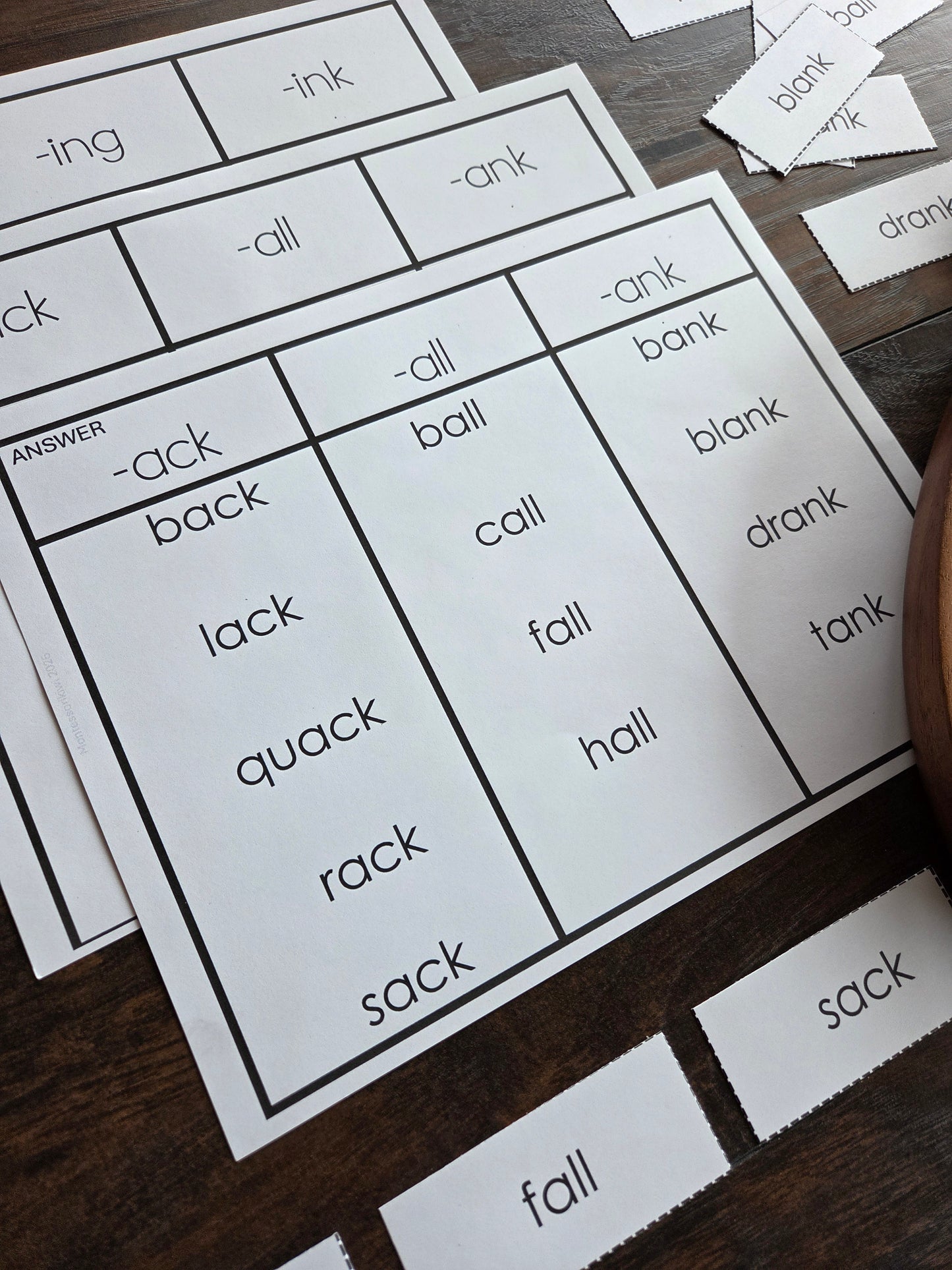
These hands-on Word Family Sorting Cards help children compare words, identify shared endings and sort them into 18 different word families.
Children read each word, look closely at the ending pattern and place it under the correct family heading. In doing so, they begin to see how changing the initial sound creates a new word while the rest of the pattern stays the same.
Designed for Montessori classrooms, Science of Reading-aligned phonics instruction, structured literacy, intervention and homeschool learning, this resource supports decoding, spelling-pattern recognition and independent word study in a clear, hands-on format.
🌿 At a Glance
✔ 18 different word families
✔ 3–5 words in each family
✔ Children read and sort words under the correct family heading
✔ Helps children notice shared spelling patterns
✔ Shows how changing the beginning sound creates new words
✔ Includes self-correcting answer cards
✔ Montessori colour-coded version included
✔ Black-and-white version included
✔ Ideal for independent Montessori shelf work, literacy centres and intervention
📚 What's Included?
This printable word-family resource includes:
- 18 word-family headings
- 3–5 word cards for each family
- Self-correcting answer cards
- Montessori colour-coded version
- Black-and-white version
Children read each word and place it under the correct word-family heading.
The activity can then be left on the shelf for independent practice and self-correction.
Why Can Word Families Be Helpful?
A child may learn to read one word such as:
cat
and not immediately realise that the same ending pattern appears in:
- bat
- hat
- mat
- sat
Word-family work helps children notice that the ending stays the same while the initial sound changes.
This can help them move from treating every word as completely new towards recognising recurring orthographic patterns.
From One Known Word to a Family of Words
The key learning progression is:
read one word → notice the shared ending → compare it with other words → change the initial sound → recognise the family pattern.
This supports children in seeing relationships between words rather than learning each one in isolation.
What Is a Word Family?
A word family is a group of words that share the same ending pattern.
For example:
- cat
- bat
- hat
- mat
all belong to the -at family.
The beginning sound changes, but the ending remains the same.
This makes it easier for children to compare words and notice common spelling structures.
Why Sort the Words?
Sorting makes similarities and differences visible.
Rather than reading a random list of words, children have to ask:
- What is the ending pattern?
- Which family does this word belong to?
- What stays the same?
- What changes?
This encourages active comparison and supports stronger pattern recognition.
Why This Helps With Spelling
If a child can spell one word in a family, they may be able to use that known pattern to help spell others.
For example, knowing how to spell:
cat
can help with:
- bat
- hat
- mat
The child still needs to hear and change the initial sound, but the shared ending provides a useful spelling pattern.
From Decoding to Orthographic Pattern Recognition
At first, a child may decode every word sound by sound.
With repeated exposure, they may begin to recognise familiar chunks and patterns more quickly.
This resource supports the progression:
decode the word → notice the shared ending → compare it with known words → sort it into a family → recognise the pattern more efficiently.
This helps children build familiarity with recurring written structures.
Why Include 18 Word Families?
A wide range of word families gives children repeated opportunities to compare different ending patterns.
Because each family includes between 3 and 5 words, children can focus on one manageable group at a time.
You can:
- Introduce one family first
- Compare two families
- Offer several headings at once
- Gradually increase the challenge
This makes the activity easy to differentiate.
Why Self-Correction Matters
The included answer cards allow children to check their own work.
This supports:
- Independence
- Persistence
- Self-monitoring
- Immediate feedback
- Reduced dependence on adult correction
This fits naturally with Montessori practice, where children are encouraged to work independently and use a clear control of error.
Colour and Black-and-White Options
The resource includes both:
- Montessori colour-coded cards
- Black-and-white cards
This gives you flexibility depending on your classroom approach, printing needs and learner preferences.
How to Use the Activity
- Choose one or more word-family headings.
- Read the headings aloud with the child.
- Shuffle the word cards.
- Invite the child to read one word.
- Ask them to notice the ending pattern.
- Place the word under the correct family heading.
- Continue with the remaining words.
- Use the answer card to check the completed sort.
What Skills Does This Resource Support?
Children will practise:
- Reading simple phonetic words
- Word-family recognition
- Initial sound manipulation
- Decoding
- Spelling-pattern recognition
- Orthographic awareness
- Word comparison
- Classification and sorting
- Independent self-correction
More Than a Simple Sort
The goal is not merely to place words under a heading.
The deeper learning progression is:
read the word → notice the ending pattern → compare it with other words → identify what changes and what stays the same → sort by word family → self-check.
This helps children see how words are related and gives them a stronger foundation for decoding and spelling.
A Useful Step After Early CVC Reading
This resource works particularly well once children are already able to read simple phonetic words.
A possible progression is:
blend CVC words → compare similar endings → sort into word families → notice recurring spelling patterns → use known families to support reading and spelling.
This makes the activity a natural next step after basic CVC decoding.
Easy to Differentiate
You do not need to offer all 18 families at once.
For a child who is just beginning, you might:
- Offer only one family
- Compare two clearly different families
- Use fewer word cards
- Work together before introducing independent shelf work
As confidence grows, increase the number of headings and words.
🌿 Perfect For
- Montessori language shelves
- Science of Reading-aligned phonics instruction
- Structured literacy lessons
- CVC word practice
- Word-family study
- Literacy centres
- Small-group instruction
- Reading and spelling intervention
- Independent shelf work
- Homeschool phonics lessons
Help Children See the Pattern Between Words
Children do not need to treat every new word as completely unrelated to every word they already know.
Word families help make recurring spelling patterns visible.
The learning progression is:
read the word → identify the shared ending → compare it with related words → sort it into the correct family → use the pattern to support future reading and spelling.
That makes this resource a practical bridge between simple sound-by-sound decoding and stronger word-pattern recognition.
🔗 Related Resources
Continue building children's confidence with CVC words, decoding and spelling patterns through these related Montessori literacy resources:
🌿 CVC Continuous Blending Picture Match
Support children as they move from identifying individual sounds to blending them smoothly into complete CVC words.
Explore the CVC Continuous Blending Cards →
🌿 CVC Word Sorting by Category
Help children decode simple CVC words, understand their meaning and sort them into semantic categories.
Explore the CVC Word Sorting Activity →
🌿 CCVC Word to Picture Matching Cards
Take the next step beyond simple CVC words by helping children retain two initial consonants while decoding.
Explore the CCVC Word Matching Cards →
🌿 CVC Sentence Frames
Help children move from isolated CVC word reading towards supported sentence reading and beginning writing.
Explore the CVC Sentence Frames →
🌿 Modern Montessori Reading Collection
Explore hands-on resources for phonemic awareness, phonics, CVC and CCVC words, spelling patterns, sentence reading and comprehension.
Explore the Modern Montessori Reading Collection →
🌿 Modern Montessori Science of Reading Bundle
Explore a broader Montessori-aligned literacy sequence covering phonological awareness, decoding, spelling patterns, syllables, morphology, sentence reading and comprehension.
Created by Lisa, a Montessori-trained teacher, NZ registered teacher, school principal and former homeschooler. My resources are designed with real learners in mind—including neurodivergent children—and focus on practical, affordable, low-prep materials that support independence.
Share


-
Items are secured / Terms of Use
Our items are secured. They are not able to be altered. We secure our items because they are our intellectual property and because we use art from artists who require that we secure our files.
You may not:
-resell our items or use them for commercial gain
-claim these items as your own
-modify this resource
-share them with others by any means e.g. electronic or hard copy
-
All Items are instant downloads
You will not get a printed product in the mail.
-
All prices are in USD
Due to the international nature of our customers our prices are all in USD. If you wish to work out the conversion before you buy we recommend www.xe.com