montessorikiwi
Montessori Geometry Transformations Activities | Enlargement, Reflection & Rotation
Montessori Geometry Transformations Activities | Enlargement, Reflection & Rotation
Couldn't load pickup availability

Children may know the words reflection, rotation and enlargement—but can they accurately transform a detailed image on a coordinate-style grid?
Geometry transformations can feel abstract when they are introduced only through arrows, rules and simple polygons. Learners need to notice position, orientation, distance and proportion at the same time, which can quickly become overwhelming.
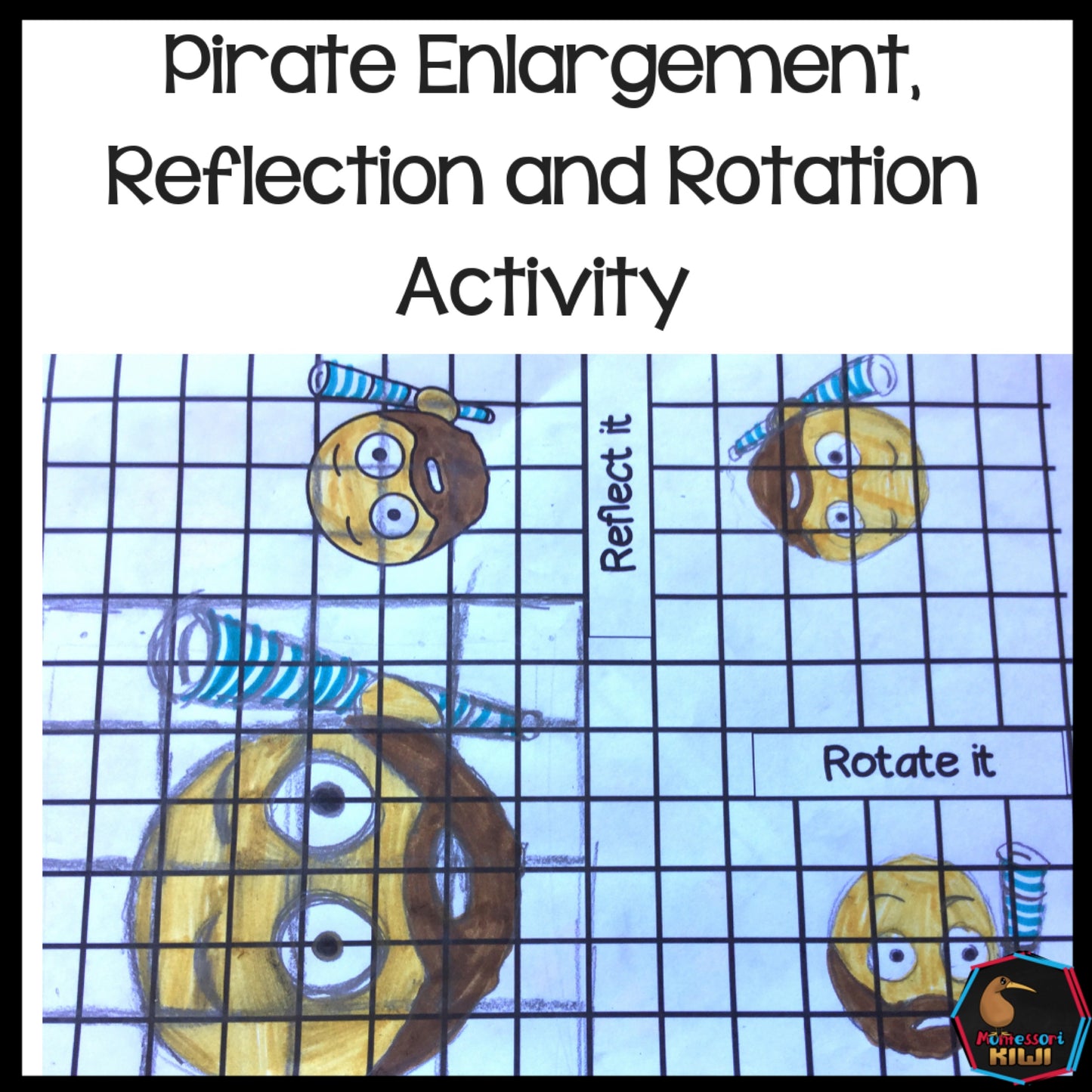
These Montessori Geometry Transformations Activities give children a visual, creative way to practise three essential transformations. On each grid, students enlarge, reflect and rotate an engaging image while using the squares to guide accuracy.
At a Glance
- Learning focus: Geometric transformations and spatial reasoning
- Transformations: Enlargement, reflection and rotation
- Scale factor: Enlarge by a factor of 2
- Includes: One completed example and 20 student activity pages
- Best for: Montessori elementary, homeschool and geometry centres
- Suggested ages: Approximately 8–12 years
- Skills: Grid drawing, proportion, symmetry, orientation and visual-spatial reasoning
- Format: Instant digital PDF download
Make Three Different Transformations Visible
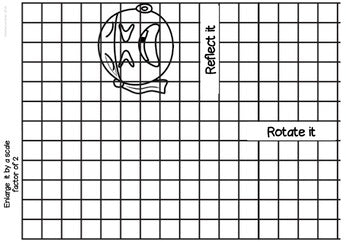
Each page divides the grid into three purposeful work areas.
Enlarge by a Scale Factor of 2
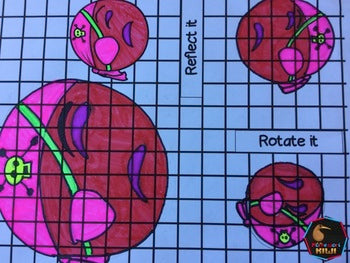
Children reproduce the original image at twice its size. They must compare corresponding points and ensure that every length is enlarged proportionally rather than simply drawing a larger freehand version.
Reflect Across a Line
The words “Reflect it” form the reflection line. Learners recreate the image on the opposite side, keeping each point the same perpendicular distance from the line.
Rotate the Image
Students turn the original image and redraw it in the rotation section. The completed example models a 90-degree rotation, but children can also investigate other rotation angles after receiving clear instructions.
Particularly Helpful for Neurodivergent Learners
The grid breaks a complex picture into smaller, manageable sections. Children can focus on one square or landmark at a time instead of holding the whole image in working memory. The repeated page layout also makes the expectations predictable, while the playful images provide a motivating alternative to pages of abstract shapes.
What Is Included?
- One full-colour completed example
- 20 blackline transformation activity sheets
- A different illustrated character or object on each activity page
- A large square grid for proportional enlargement
- A clearly marked vertical reflection line
- A separate grid area for rotation
- Teacher guidance explaining the three tasks
The completed example helps teachers demonstrate what the finished transformations can look like without giving away the answers for the remaining images.
More Than a Drawing Activity
To complete the pages successfully, learners practise:
- counting grid squares;
- locating corresponding points;
- maintaining proportion;
- recognising horizontal and vertical position;
- measuring distance from a reflection line;
- tracking orientation during rotation;
- visualising a transformed image; and
- checking whether the result is mathematically consistent.
The engaging illustrations make the task feel creative, but the underlying work develops genuine geometric reasoning.
A Practical Teaching Sequence
- Model one transformation at a time. Begin with a simple shape before using the detailed images.
- Mark important points. Identify corners, edges and distinctive features on the original picture.
- Count across the grid. Locate each matching point in the new section.
- Complete the enlargement. Double horizontal and vertical distances consistently.
- Reflect the picture. Check that matching points remain equally distant from the mirror line.
- Rotate the image. Agree on a direction and angle before drawing.
- Compare and explain. Ask the learner what changed and what remained the same.
Easy to Differentiate
For developing learners: Complete one transformation only, lightly number selected grid lines or allow tracing paper to support the reflection.
For independent learners: Complete all three transformations and label the scale factor, reflection line and rotation angle.
For extension: Ask students to describe the transformation precisely, identify coordinates for key points or repeat the rotation using a different angle or direction.
Ways to Use This Resource
- Montessori elementary geometry shelves
- Transformation lessons
- Maths centres and rotations
- Independent work cycles
- Visual-spatial reasoning practice
- Homeschool geometry
- Early-finisher challenges
- Fine-motor and grid-drawing practice
- Small-group maths support
- Geometry assessment or revision
Please Note
This resource focuses on enlargement by a scale factor of 2, reflection across a vertical line and rotation on a grid.
It does not include coordinate notation, translations, reductions or a separate answer key. Pencils, rulers, tracing paper and other physical materials are not included.
Created by an Experienced Montessori Educator
I’m Lisa—an NZ registered teacher, Montessori-trained educator, school principal and former homeschooler. I create practical resources for mixed-age classrooms and diverse learners, including children who need visual structure and engaging ways to move from concrete spatial experience into abstract geometry.
Extend the Transformation Study
-
Transformation Sorting Activity
Compare reflection, rotation, translation, enlargement and reduction by classifying examples of each transformation. -
Montessori Angle Sorting Activity
Strengthen the angle knowledge children need when describing and measuring rotations. -
Area and Perimeter Task Cards
Extend grid-based geometry into measurement, spatial reasoning and practical problem solving.
Need a Wider Upper-Elementary Maths Collection?
The Montessori Upper Elementary Maths Bundle includes advanced work across geometry, fractions, decimals, percentages, ratios, measurement, probability and mathematical reasoning.
Choose the bundle when you need a broad library for approximately ages 9–12 rather than one focused transformations resource.
Explore More Montessori Geometry
Browse the Montessori Geometry Collection for angles, shapes, transformations, area, perimeter, measurement and hands-on elementary maths work.
Help Children See How a Shape Changes
Turn enlargement, reflection and rotation into visible, creative grid work that develops accuracy and spatial reasoning.
Download the Montessori Geometry Transformations Activities and give learners 20 engaging opportunities to transform, compare and reason.