
montessorikiwi
Missing Addend Addition Worksheets | Early Algebra Thinking
Missing Addend Addition Worksheets | Early Algebra Thinking
Couldn't load pickup availability
Your child can solve 5 + 3 = ___—but what happens when the same relationship is written as 8 = 5 + ___ or ___ = 5 + 3?
Children can become fluent with one familiar equation format without fully understanding how the numbers are related. When the equals sign moves or the missing value appears first, they may treat the question as completely new.
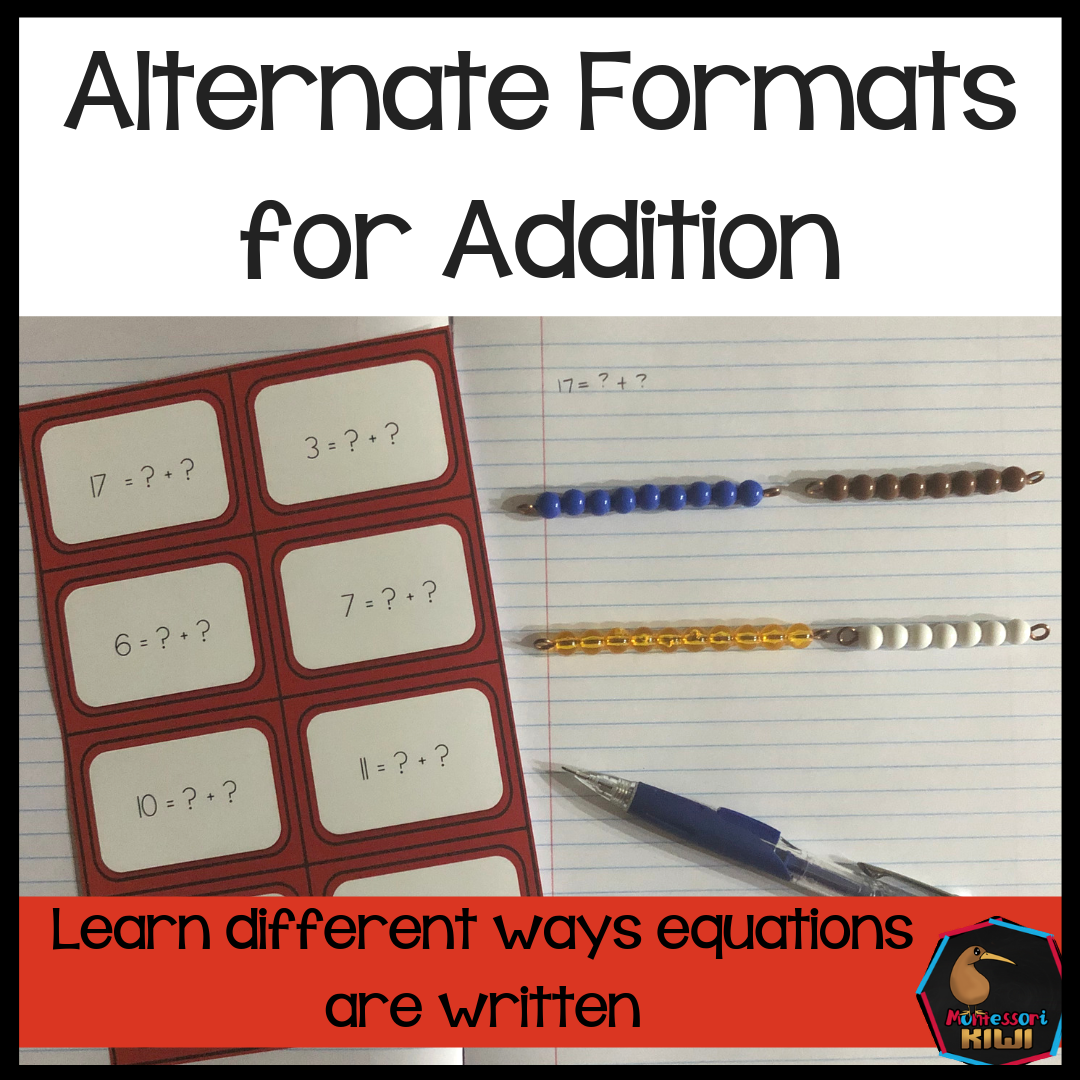
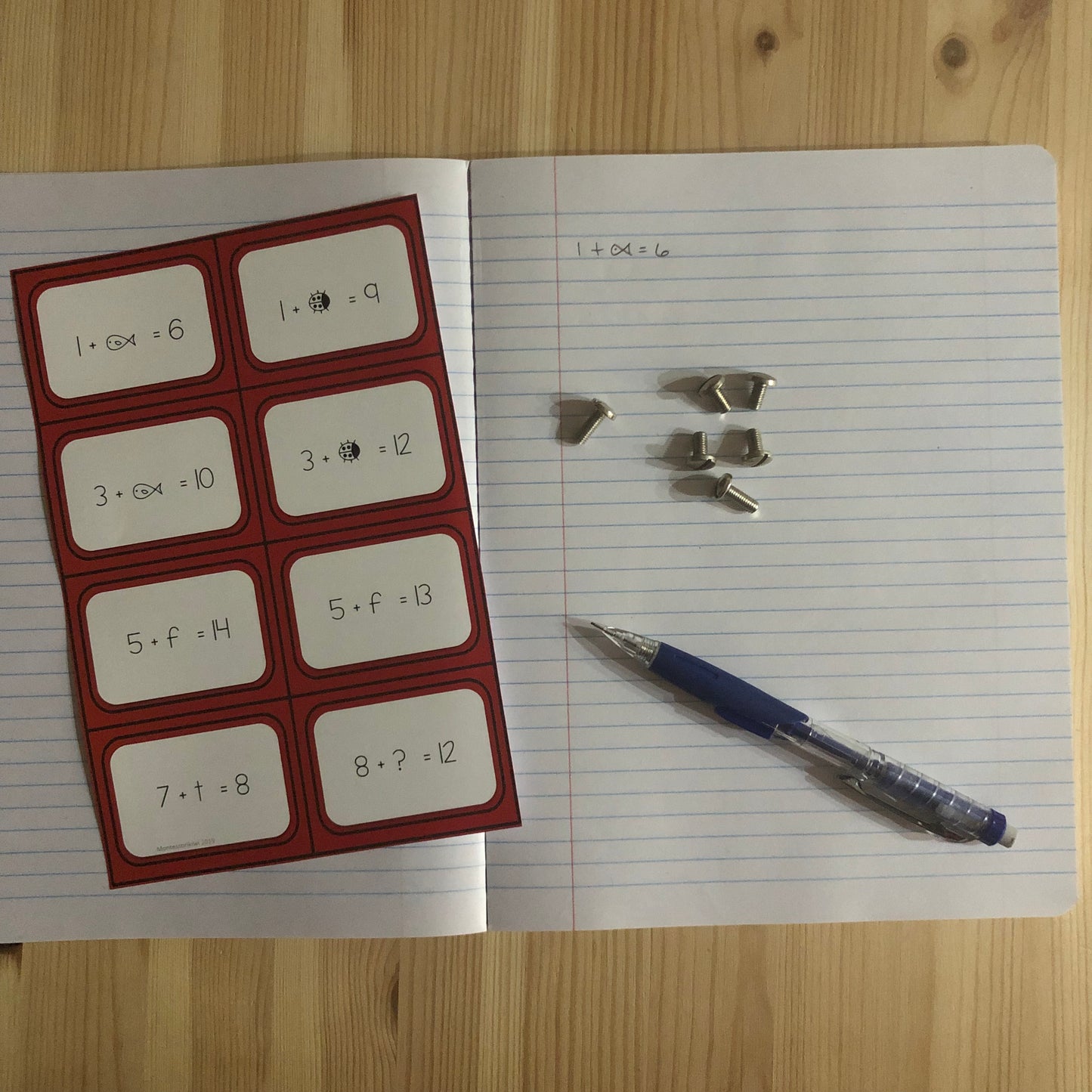
These Alternative Addition Equation Activities give learners structured practice reading and solving addition facts in six different forms. The resource helps children understand that the equals sign means “has the same value as”—not simply “the answer comes next.”
At a Glance
- Learning focus: Addition equations, missing addends and equality
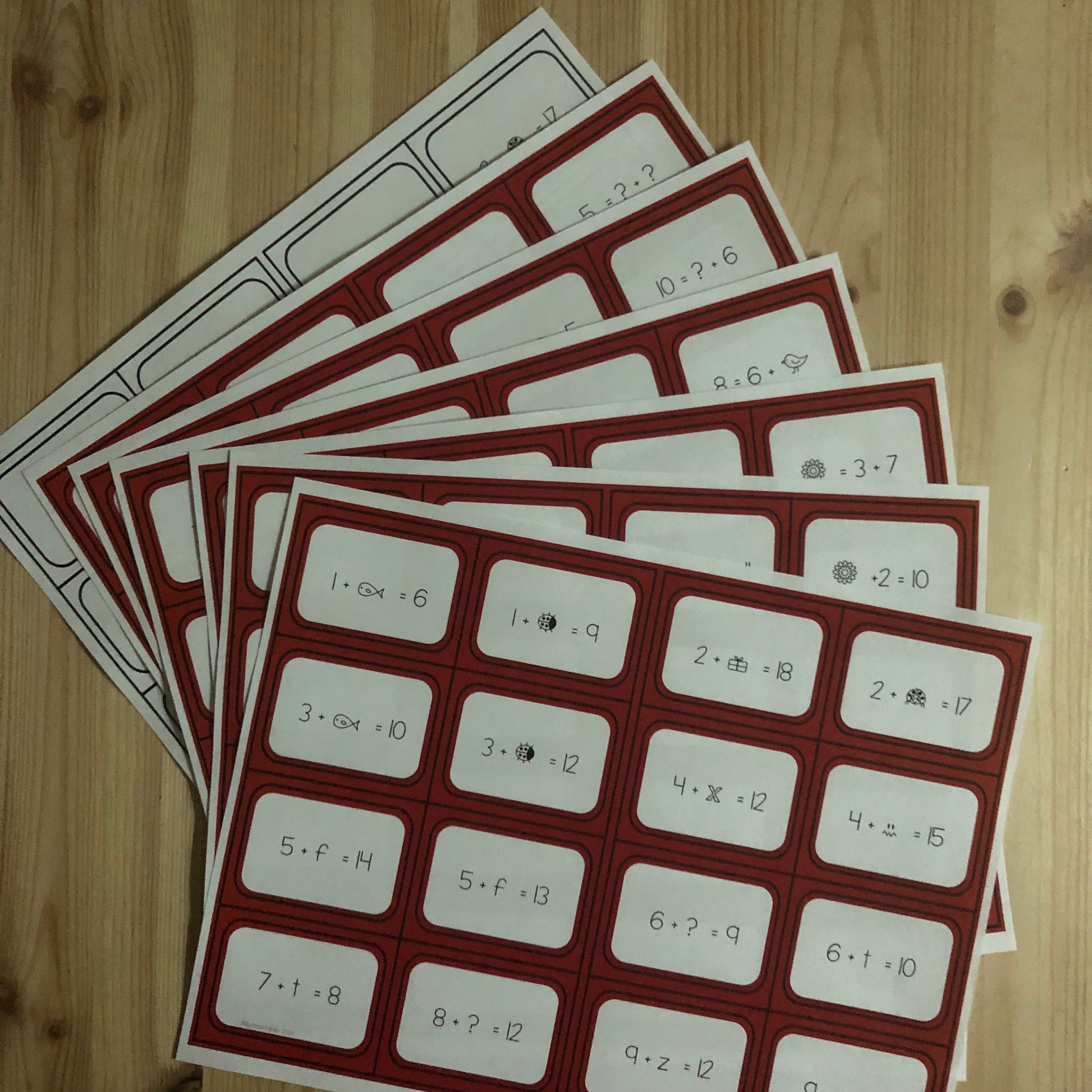
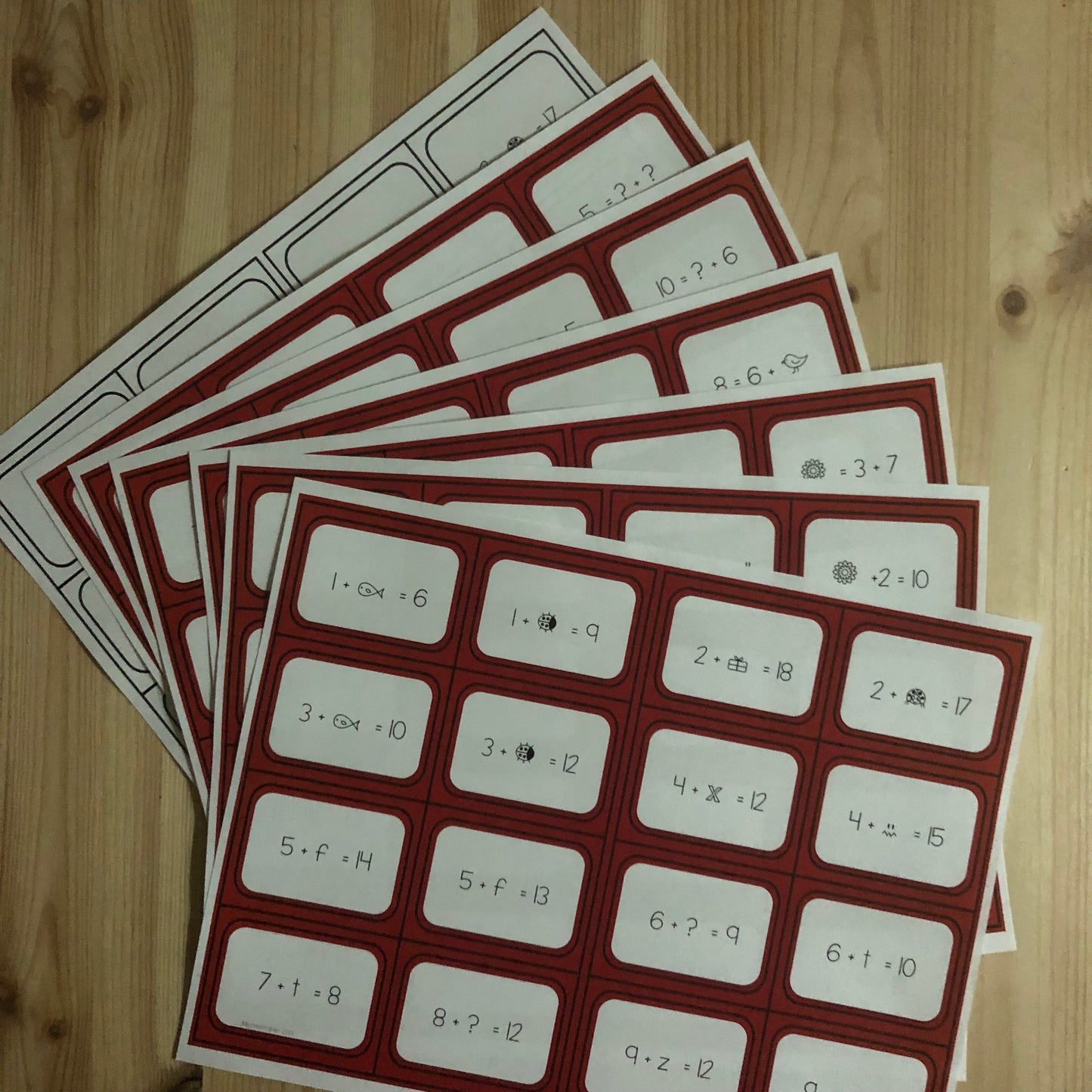
- Includes: Six progressive activity sets
- Practice: 16 addition equations in each set
- Total: 96 basic-fact questions
- Best for: Montessori elementary, homeschool and maths intervention
- Suggested ages: Approximately 6–9 years
- Use for: Maths shelves, centres, work plans and formative assessment
- Format: Instant digital PDF download
Reveal Whether Children Understand the Relationship
A child who has memorised a procedure may expect every addition equation to follow this pattern:
4 + 3 = 7
But addition relationships can also be written as:
- 4 + ___ = 7
- ___ + 3 = 7
- 7 = 4 + 3
- 7 = 4 + ___
- 7 = ___ + 3
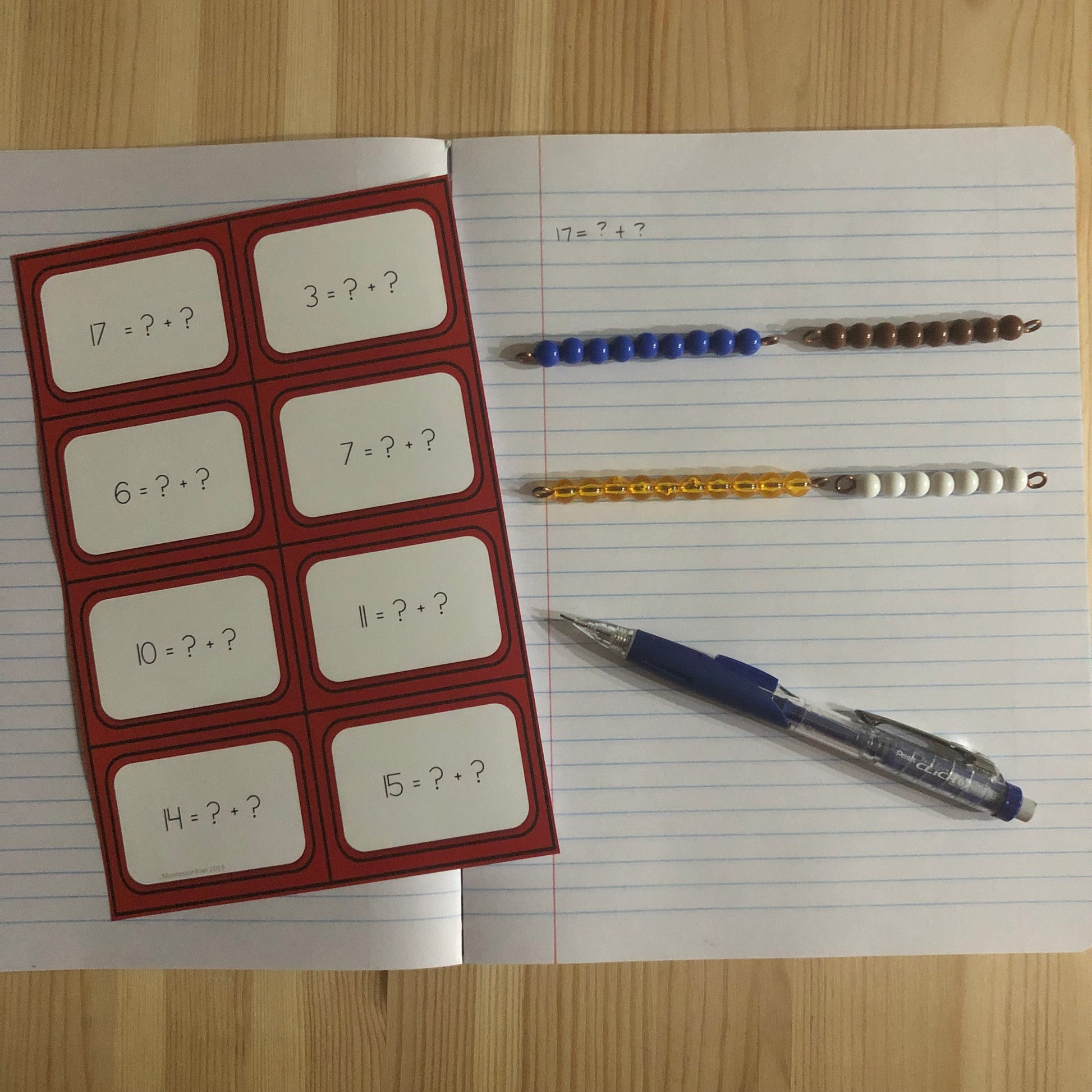
- ___ + ___ = 7
These variations show whether the learner understands the parts and whole—or is relying only on the position of the symbols.
Particularly Helpful for Neurodivergent Learners
Each page keeps the visual structure consistent while changing only one aspect of the equation. This allows children to focus on the mathematical relationship without managing unnecessary decoration or lengthy instructions. Teachers can offer one set at a time and use counters, bead bars or number-bond materials to reduce working-memory demands.
Six Progressive Equation Sets
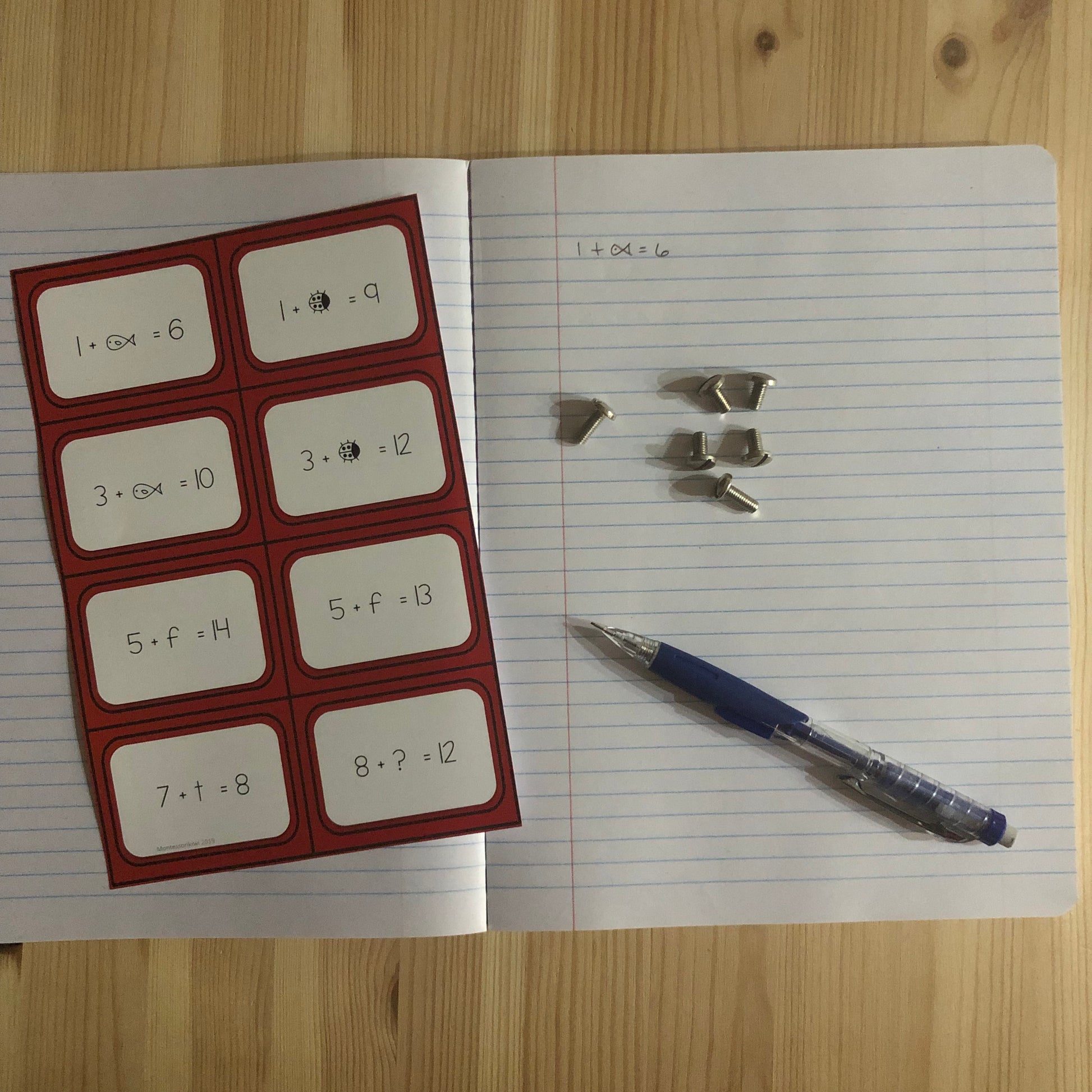
Set 1: Find the Second Addend
Children solve equations where the first addend and total are provided.
Example structure: 4 + ___ = 9
Set 2: Find the First Addend
The missing value appears before the plus sign.
Example structure: ___ + 5 = 9
Set 3: The Total Comes First
The unknown total appears to the left of the equals sign.
Example structure: ___ = 8 + 4
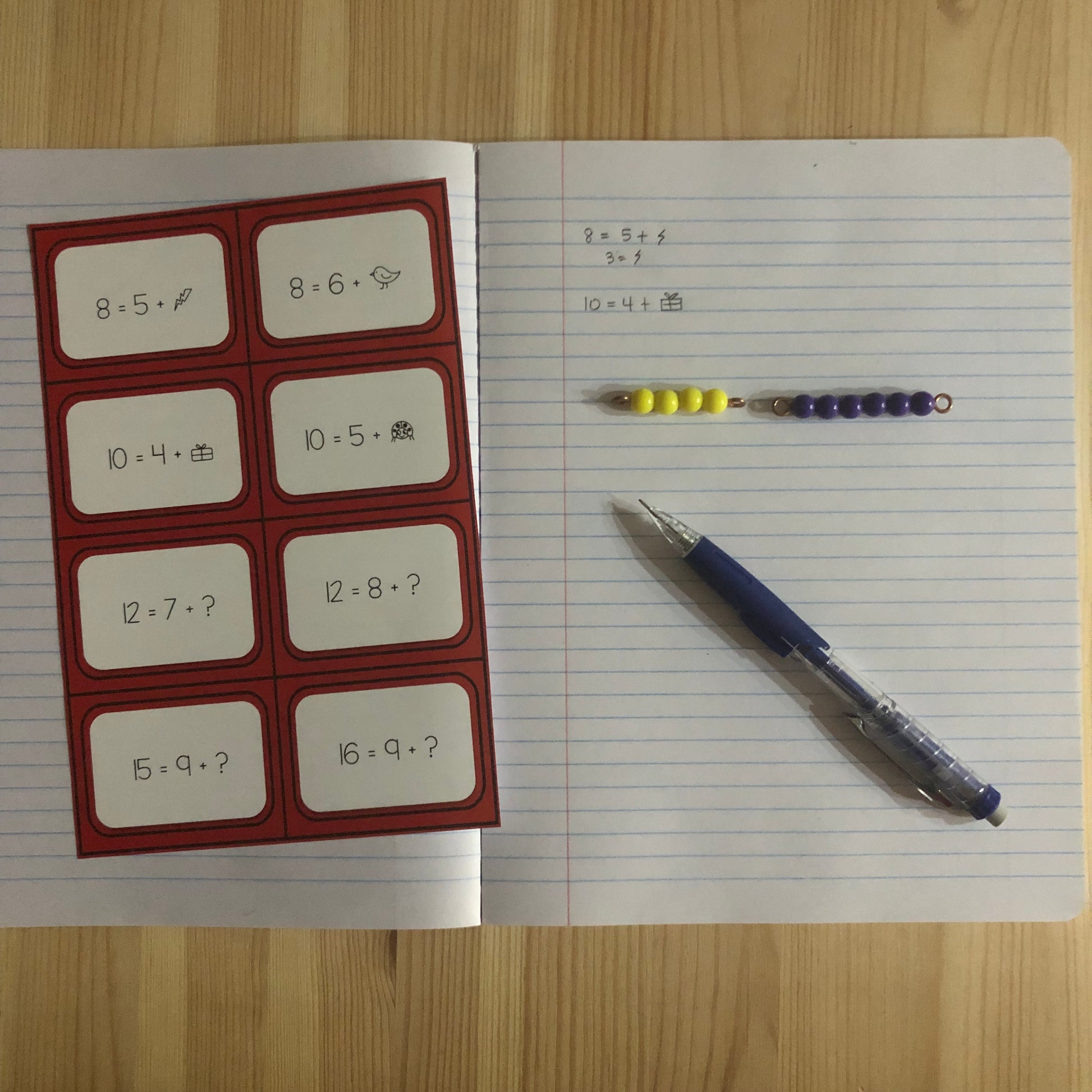
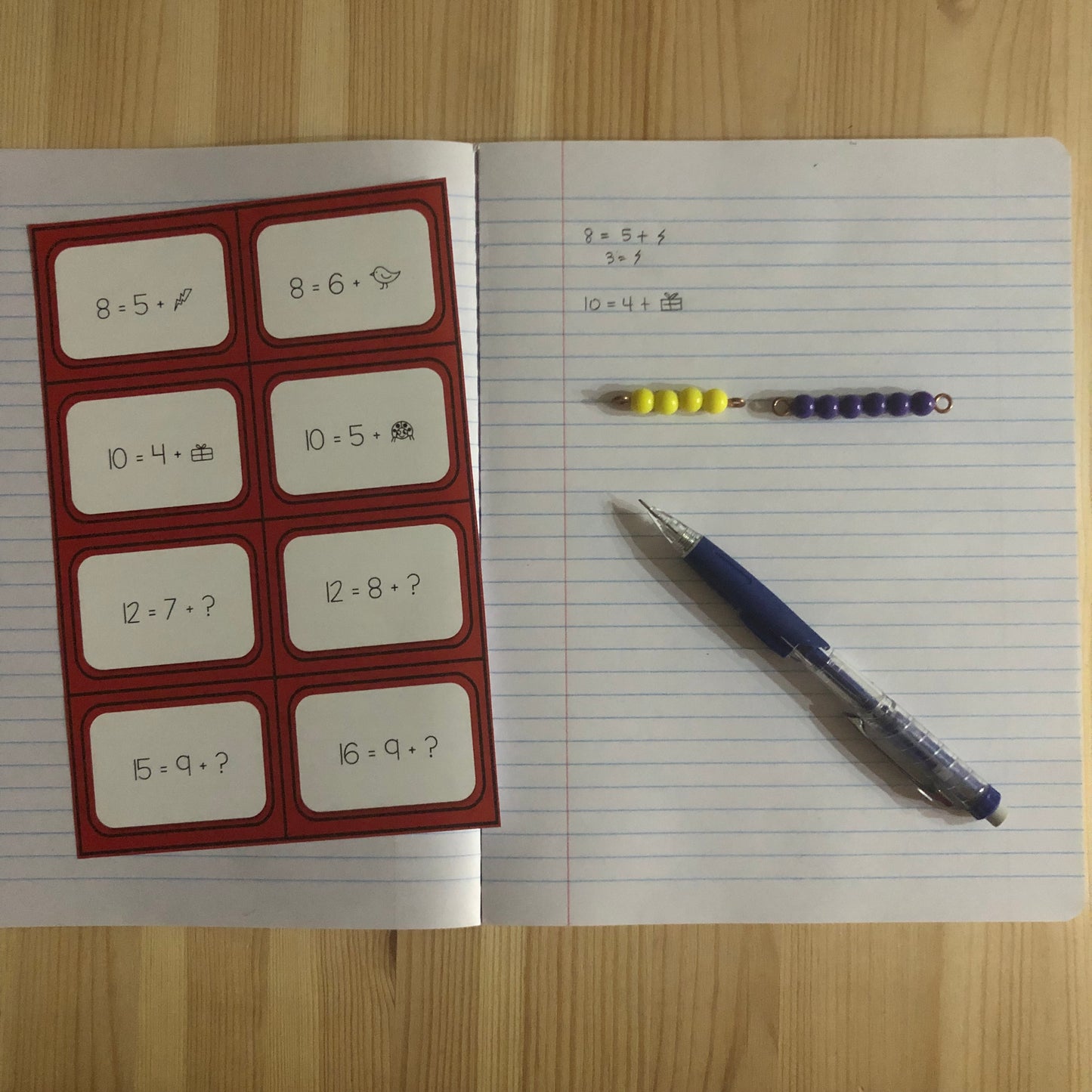
Set 4: Total First, Second Addend Missing
Children must read the equation from both directions and determine the missing part.
Example structure: 6 = 2 + ___
Set 5: Total First, First Addend Missing
The unknown appears immediately after the equals sign.
Example structure: 6 = ___ + 2
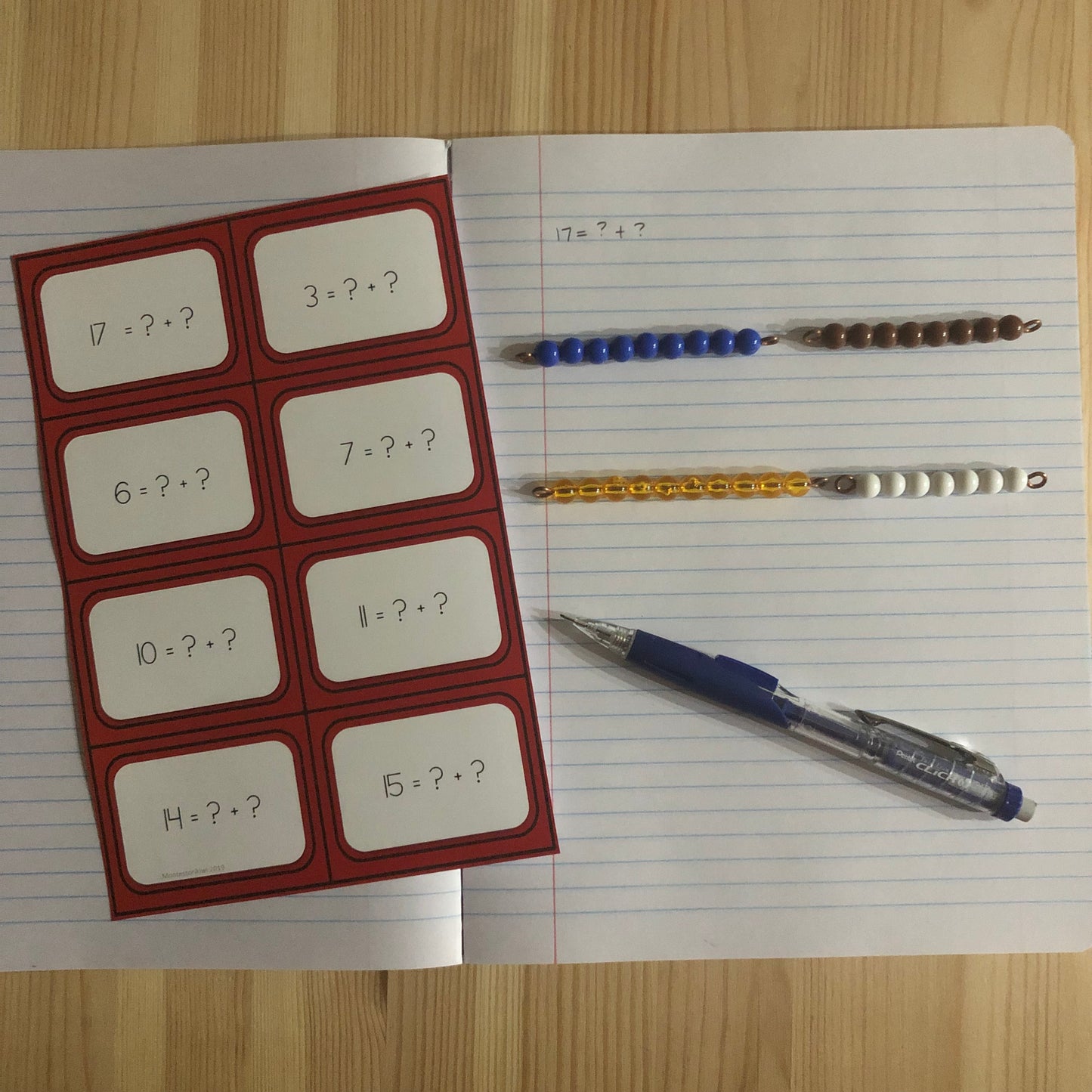
Set 6: Find Both Addends
Children generate two numbers that combine to make the stated total.
Example structure: ___ + ___ = 10
This final set is open-ended, encouraging flexible number combinations rather than one fixed answer.
What This Resource Helps Develop
- Understanding of the equals sign
- Missing-addend reasoning
- Part-part-whole knowledge
- Number bonds and fact families
- Addition fact fluency
- Flexible equation reading
- Inverse-operation thinking
- Early algebraic reasoning
- Confidence with unfamiliar question formats
Use Concrete Materials When Needed
These equations work well alongside:
- Montessori coloured bead bars;
- number-bond materials;
- counters;
- the addition strip board;
- addition charts;
- ten frames; or
- simple part-part-whole diagrams.
For example, a child solving 8 = 3 + ___ can build eight, separate a group of three and identify the remaining quantity.
A Practical Teaching Sequence
- Begin with familiar addition facts. Check that the child understands the quantities.
- Discuss the equals sign. Explain that both sides have the same value.
- Introduce one variation. Avoid presenting all six formats at once.
- Model with materials. Physically show the whole and the missing part.
- Complete selected questions. Focus on accuracy and explanation rather than speed.
- Compare formats. Rewrite one number relationship in several ways.
- Move into open equations. Find multiple pairs that make the same total.
Ways to Use This Resource
- Montessori maths shelf work
- Addition chart follow-up
- Number-bond lessons
- Maths centres and rotations
- Small-group intervention
- Homeschool maths
- Morning work
- Work-plan activities
- Early-algebra preparation
- Formative assessment
Please Note
This printable resource contains six sets of addition equations with 16 questions per set.
No answer key is included. Some questions—particularly those requiring both addends—may have several correct solutions. Physical maths materials are not included.
Created by an Experienced Montessori Educator
I’m Lisa—an NZ registered teacher, Montessori-trained educator, school principal and former homeschooler. I create practical resources for mixed-age classrooms and diverse learners, including children who can calculate accurately but need support recognising familiar mathematical relationships in unfamiliar forms.
Continue Building Flexible Number-Fact Knowledge
-
Montessori Number Bonds to 10
Build the part-part-whole understanding children need for missing-addend equations. -
Montessori Fact Families to 10
Connect each addition relationship with its related subtraction equations. -
Montessori Addition Tables
Provide structured practice with ordered, random, doubles and near-doubles addition facts.
Need Alternative Formats for All Four Operations?
The Alternative Basic Facts Equations Bundle includes matching equation-format practice for addition, subtraction, multiplication and division. :contentReference[oaicite:1]{index=1}
Choose the bundle when you want a consistent pathway for helping children recognise unknown values and equality across all four operations.
Need a Complete Basic-Facts Pathway?
The Montessori Number Facts Bundle combines alternative equation formats with number bonds, fact families, doubles, near doubles and addition, subtraction, multiplication and division practice. :contentReference[oaicite:2]{index=2}
Explore More Montessori Maths
Browse the Montessori Maths Collection for number sense, place value, operations, fact fluency and mathematical reasoning.
Help Children Understand the Equation—Wherever the Unknown Appears
Move beyond one familiar addition format and strengthen equality, missing-addend reasoning and flexible number-fact knowledge.
Download the Alternative Addition Equations and give learners 96 purposeful opportunities to think about how addition relationships work.
Share
-
Items are secured / Terms of Use
Our items are secured. They are not able to be altered. We secure our items because they are our intellectual property and because we use art from artists who require that we secure our files.
You may not:
-resell our items or use them for commercial gain
-claim these items as your own
-modify this resource
-share them with others by any means e.g. electronic or hard copy
-
All Items are instant downloads
You will not get a printed product in the mail.
-
All prices are in USD
Due to the international nature of our customers our prices are all in USD. If you wish to work out the conversion before you buy we recommend www.xe.com